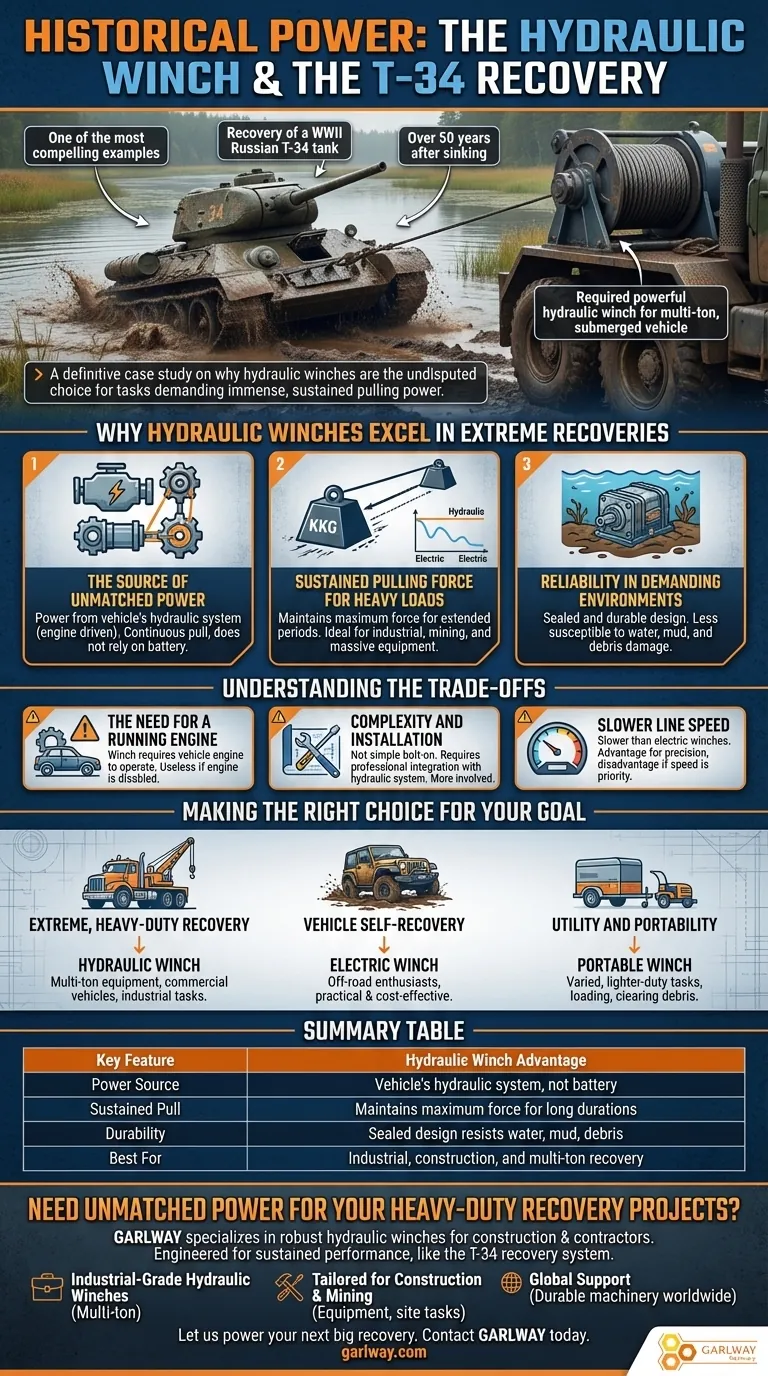
One of the most compelling historical examples is the recovery of a World War II-era Russian T-34 tank from a German lake, over 50 years after it sank. This complex operation required a powerful hydraulic winch to pull the submerged, multi-ton vehicle from the boggy lakebed, perfectly demonstrating the winch's capability for extreme, heavy-duty recovery tasks.
This T-34 recovery is more than just a historical anecdote; it serves as a definitive case study on why hydraulic winches are the undisputed choice for tasks demanding immense, sustained pulling power and reliability under the most severe conditions.

Why Hydraulic Winches Excel in Extreme Recoveries
The T-34 tank recovery highlights the core strengths that set hydraulic winches apart from other types, such as electric or portable winches. The challenge wasn't just weight, but also the immense suction and resistance from decades of mud and bog.
The Source of Unmatched Power
A hydraulic winch derives its power from a hydraulic system, typically driven by the vehicle's power steering pump or a dedicated pump. This design allows for a continuous and powerful pull that does not rely on the vehicle's battery.
This is a critical advantage in prolonged recovery operations where an electric winch could overheat or drain a battery completely, leaving the recovery effort stranded.
Sustained Pulling Force for Heavy Loads
The primary advantage demonstrated in the tank recovery is sustained power. Unlike electric models that lose efficiency and risk overheating during long, heavy pulls, a hydraulic system can maintain its maximum pulling force for extended periods.
This makes them ideal for industrial applications like construction, mining, and, as the example shows, recovering massive equipment. Tow trucks and fire apparatus often rely on hydraulic systems for this exact reason.
Reliability in Demanding Environments
The T-34 was submerged in a boggy lake, a harsh environment that demands robust equipment. Hydraulic systems are generally well-sealed and durable, making them less susceptible to damage from water, mud, and debris compared to the more exposed electrical components of other winch types.
Understanding the Trade-offs
While powerful, hydraulic winches are not the universal solution for every recovery need. Their specific design comes with clear trade-offs.
The Need for a Running Engine
A hydraulic winch requires the vehicle's engine to be running to power the hydraulic pump. If the vehicle is disabled in a way that prevents the engine from operating, the winch is useless.
Complexity and Installation
These systems are not simple bolt-on accessories. They require professional installation to integrate with the vehicle's hydraulic system, which is a more involved and costly process than setting up a typical electric winch.
Slower Line Speed
Generally, hydraulic winches have a slower line speed compared to their electric counterparts. While this can be an advantage for precise and controlled pulls, it can be a drawback when speed is a priority in less demanding situations.
Making the Right Choice for Your Goal
The T-34 recovery illustrates the peak capability of a hydraulic winch. Understanding this helps clarify which type of recovery tool is right for your specific application.
- If your primary focus is extreme, heavy-duty recovery: A hydraulic winch is the only reliable choice for recovering multi-ton equipment, commercial vehicles, or handling industrial-scale tasks.
- If your primary focus is vehicle self-recovery: An electric winch is typically the more practical and cost-effective solution for off-road enthusiasts recovering their own stuck vehicle from mud, snow, or sand.
- If your primary focus is utility and portability: A smaller, portable winch is best for varied, lighter-duty tasks like loading equipment onto a trailer or clearing debris.
Ultimately, choosing the right winch means matching the tool's core strengths to the specific demands of your recovery challenge.
Summary Table:
| Key Feature | Hydraulic Winch Advantage |
|---|---|
| Power Source | Vehicle's hydraulic system, not battery |
| Sustained Pull | Maintains maximum force for long durations |
| Durability | Sealed design resists water, mud, and debris |
| Best For | Industrial, construction, and multi-ton recovery |
Need Unmatched Power for Your Heavy-Duty Recovery Projects?
GARLWAY specializes in providing robust hydraulic winches for construction companies and contractors who demand reliability in the toughest conditions. Our winches are engineered for sustained, powerful performance—just like the system used in the historic T-34 tank recovery.
Why Choose GARLWAY?
- Industrial-Grade Hydraulic Winches: Built for multi-ton recovery and heavy lifting.
- Tailored for Construction & Mining: Ideal for recovering equipment, vehicles, and handling demanding site tasks.
- Global Support: We serve contractors and companies worldwide with durable, high-performance machinery.
Let us power your next big recovery. Contact GARLWAY today to discuss your project needs and discover the right hydraulic winch solution for you.
Visual Guide
Related Products
- Hydraulic Winding Engine Harbor Freight Winch
- Electric and Hydraulic Winch for Heavy Duty Applications
- Small Electric Winch 120V and 240V for Compact Applications
- Electric 120V Boat Winch by Badlands
- 12000 lb Electric Boat Trailer Winch with Windlass Anchor Warn
People Also Ask
- What role does hydraulic fluid play in hydraulic winches? It's the Lifeblood of Your Heavy-Duty Pulling Power
- What vehicles commonly use hydraulic winches? For Industrial Trucks Needing Unmatched Power
- What are the features of hydraulic winches? Unmatched Power and Continuous Duty for Heavy Loads
- What preventive measures can be taken to avoid oil leakage in hydraulic winches? Ensure Long-Term Reliability
- What does 'power out' mean in a hydraulic winch? Achieve Absolute Control When Lowering Heavy Loads