
At its core, a hopper lifting device is a mechanical pulley system constructed from a few key components working in unison. It includes a stationary bracket, a flexible wire rope, upper and lower pulleys for guidance, the lifting hopper that holds material, and a clutch to engage and disengage the lifting action.
This device functions by using a wire rope, guided by pulleys, to translate force into vertical lift for the hopper. The entire assembly is anchored by a fixed bracket, and its operation is controlled by a clutch mechanism.
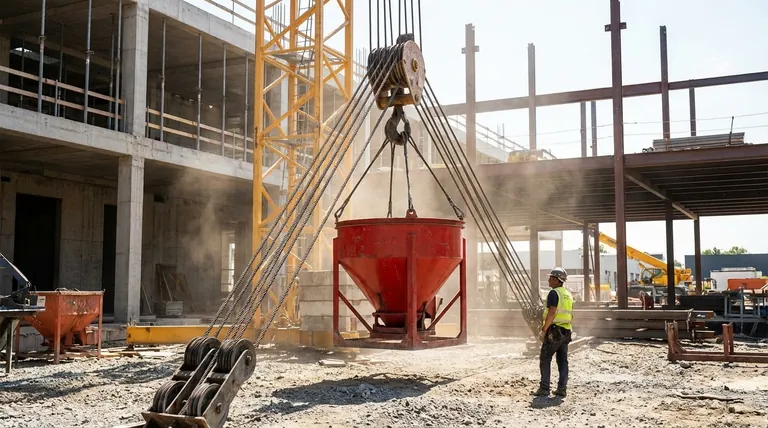
The Core Components and Their Functions
To understand the construction, it's best to examine the role each individual part plays within the larger system. The design is simple, robust, and relies on fundamental mechanical principles.
The Structural Foundation: The Bracket
The bracket serves as the stationary anchor for the entire lifting assembly. It connects directly to a larger support frame, ensuring that it remains fixed and can bear the full weight of the hopper and its contents during the lift.
The Lifting Medium: Wire Rope and Hopper
The lifting hopper is the container designed to be lifted. It is directly connected to the steel wire rope, which is the flexible component that transmits the lifting force from the power source to the load.
The Force Multiplier: Upper and Lower Pulleys
The upper and lower pulleys are the heart of the mechanism. The wire rope runs through these pulleys, which serve to redirect the pulling force and can provide a mechanical advantage, making it easier to lift a heavy load.
The Control Element: The Lifting Hopper Clutch
The lifting hopper clutch is the critical control component. It acts as a switch, engaging or disengaging the power source (like a motor or winch) from the pulley system. This allows an operator to start and stop the lift with precision.
Understanding the System's Dynamics
Simply knowing the parts isn't enough; understanding their interplay is key to appreciating the design. The reliability of this system comes from how these simple components interact to perform a demanding task.
The Path of Force
The lifting force originates from a power source, is engaged by the clutch, and is then transmitted along the wire rope. The pulleys redirect this force, converting a pull from the side or below into a direct vertical lift on the hopper. The fixed bracket absorbs all opposing forces, ensuring the lift is stable.
The Principle of Mechanical Advantage
Using both upper and lower pulleys can create a system that multiplies force. This means the force required to lift the hopper is less than the actual weight of the hopper and its contents, making the entire operation more efficient and manageable.
The Critical Role of the Clutch
Without the clutch, the system would either be always on or always off. The clutch allows for controlled engagement, which is essential for positioning the hopper correctly and, most importantly, for operational safety.
How to Apply This to Your Goal
Understanding this construction is the first step. Your next action depends on your specific objective.
- If your primary focus is maintenance or inspection: Begin by examining the wire rope for any signs of wear or fraying and ensure the pulleys rotate freely and are securely mounted.
- If your primary focus is operational safety: Confirm that the clutch engages and disengages cleanly, allowing the hopper to be held securely in position without slipping.
- If your primary focus is design or analysis: Verify that the bracket's connection to the support frame is strong enough to handle the maximum potential load, as this is the system's most critical structural point.
By seeing the device as an interconnected system rather than just a list of parts, you can effectively diagnose, operate, and maintain it.
Summary Table:
| Component | Function |
|---|---|
| Bracket | Stationary anchor connecting to the support frame. |
| Wire Rope & Hopper | Transmits force and holds the material being lifted. |
| Upper & Lower Pulleys | Redirects force and provides mechanical advantage. |
| Lifting Hopper Clutch | Engages/disengages power for precise control and safety. |
Need a Reliable Lifting Solution for Your Construction Project?
Understanding the construction of a hopper lifting device is the first step. Implementing a robust and safe system is the next. GARLWAY specializes in high-performance construction machinery, including winches and concrete handling equipment, designed for the demanding needs of construction companies and contractors globally.
Let us help you build a safer, more efficient operation. Contact GARLWAY today to discuss your specific needs and discover the right equipment for your project.
Visual Guide

Related Products
- Electric and Hydraulic Winch for Heavy Duty Applications
- Quick Windlass Portable Winch for Truck and Boat Best Boat Winch
- Portable Cement Mixer with Lift Concrete Machine
People Also Ask
- What are the differences between electric and hydraulic winches? Choose the Right Winch for Your Job
- What are some common uses for a heavy-duty winch? Power Your Construction & Industrial Projects
- What are electro-hydraulic winches and their applications? The Integrated Power Solution for Heavy-Duty Operations
- How do winches assist in bridge launching? Accelerate Bridge Placement with Controlled Pulling Power
- What are the benefits of using heavy-duty winches for large projects? Boost Efficiency & Safety


