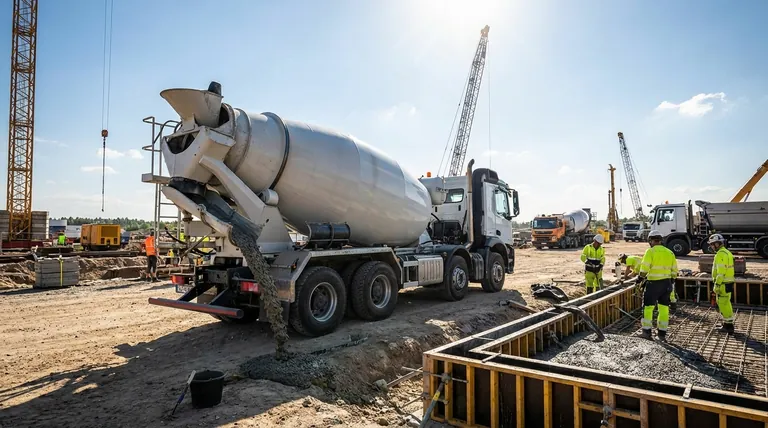
The simple reason concrete doesn't harden in a truck is continuous rotation. This constant, slow turning of the mixer drum, known as agitation, physically prevents the components from settling and initiating the full hardening process while the truck is en route to a job site.
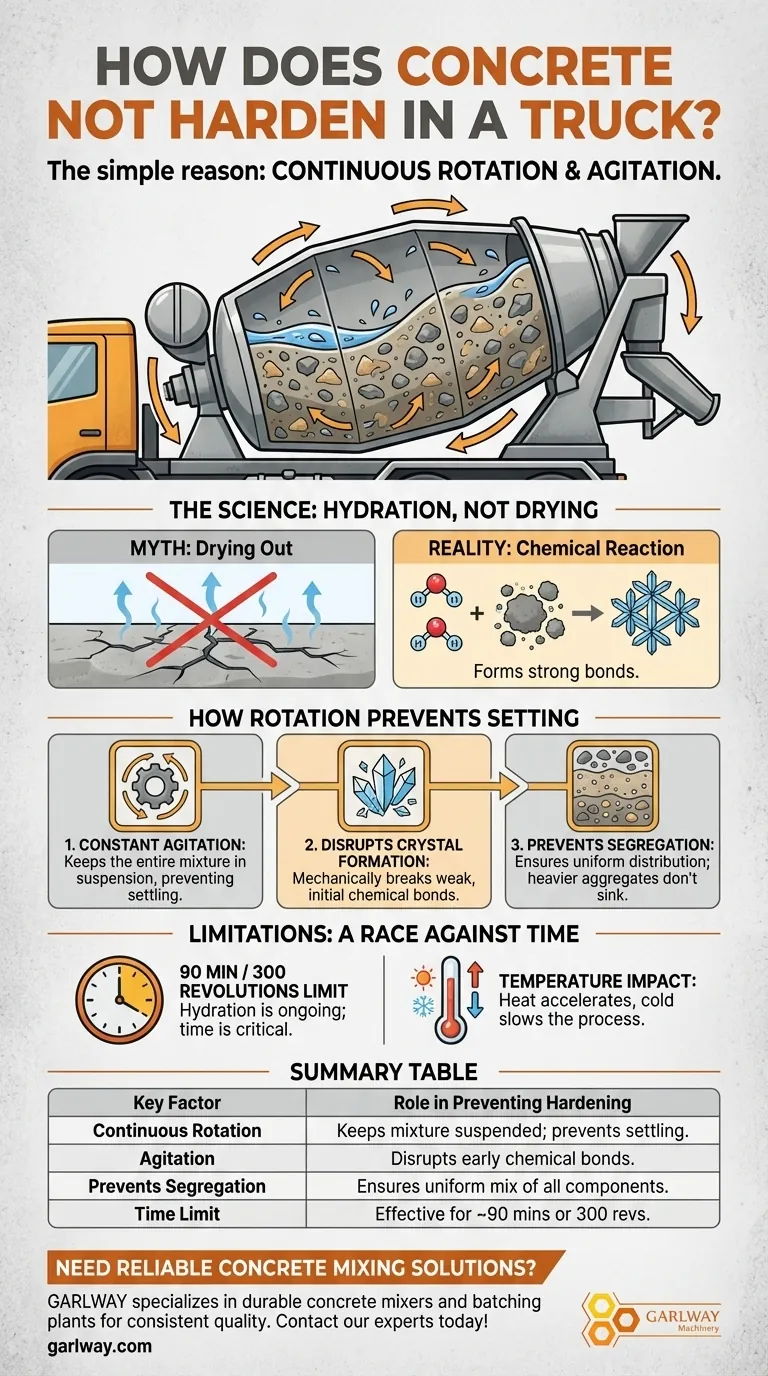
Concrete hardening is an irreversible chemical process. The goal of a mixer truck is not to stop this process but to delay its final stage—setting—by using constant mechanical agitation to keep the mixture fluid and uniform until the moment of the pour.
The Science of Concrete Hardening
A Chemical Reaction, Not Drying
A common misconception is that concrete hardens by drying out. In reality, it hardens through a chemical reaction called hydration.
When water is added to cement, it triggers a reaction that forms new, interlocking crystalline structures. These crystals bind the sand and gravel (aggregates) together into a solid, durable mass.
The Critical Initial Stage
The very beginning of the hydration process is when the mix begins to stiffen and lose its workability. This is the stage the mixer truck is designed to manage.
How Rotation Prevents Premature Setting
The Power of Agitation
The slow, constant turning of the drum keeps the entire mixture—cement, sand, aggregates, and water—in a state of suspension. This motion is often referred to as "charging" or "agitating" the mix.
Disrupting Early Crystal Formation
The mechanical force of the rotation continuously breaks apart the weak, initial crystalline bonds that try to form as hydration begins. This constant disruption keeps the mix in a liquid, workable state.
Preventing Segregation
Without rotation, the heavier aggregates would quickly sink to the bottom, and the lighter cement paste and water would rise to the top. This separation, known as segregation, would ruin the concrete's structural integrity. The turning action ensures the mix delivered to the site is completely uniform.
Understanding the Limitations
It's a Race Against Time
Agitation only delays the hardening process; it does not stop it. The hydration reaction continues from the moment water hits the cement at the batching plant.
Typically, concrete must be discharged from the truck within 90 minutes or before the drum has completed 300 revolutions, whichever comes first.
The Impact of Temperature
External factors significantly affect the timing. Hot weather accelerates the hydration reaction, shortening the window for delivery. Cold weather can slow it down too much, requiring different management.
The Risk of Over-Mixing
While mixing is essential, excessive or overly vigorous rotation can be detrimental. It can generate heat, speeding up the setting time, and can also begin to break down the aggregates, weakening the final product.
Key Principles of Concrete in Transit
- If your primary focus is workability: The key is gentle, continuous agitation to physically disrupt the initial setting process and keep the mix fluid.
- If your primary focus is strength: The key is preventing segregation. The uniform suspension of aggregates ensures the final hardened product is homogenous and strong.
- If your primary focus is timing: The key is understanding that the truck is managing a live chemical reaction that has a strict time limit from the plant to the pour.
Ultimately, the rotating drum of a concrete truck is not a passive container but an active tool managing a time-sensitive chemical process to ensure a quality product.
Summary Table:
| Key Factor | Role in Preventing Hardening |
|---|---|
| Continuous Rotation | Keeps the mixture in suspension, preventing settling and initial crystal formation. |
| Agitation | Disrupts weak early bonds from the hydration chemical reaction. |
| Prevents Segregation | Ensures a uniform mix of cement, sand, aggregates, and water. |
| Time Limit | Effective for ~90 minutes or 300 drum revolutions, as hydration continues. |
Need reliable concrete mixing solutions for your projects? GARLWAY specializes in construction machinery, offering durable concrete mixers and batching plants designed for construction companies and contractors globally. Our equipment ensures consistent mix quality and efficient delivery. Contact our experts today to discuss how we can support your construction needs!
Visual Guide
Related Products
- Ready Mixer Machine for Construction Ready Mix Machinery
- JW1000 Mobile Cement Mixer Concrete Mixer Truck and Batching Plant
- Mini Cement Mortar Mixer Truck for Construction
- Harbor Freight JS1500 On Site Concrete Mixing Volumetric Cement Mixer
- HZS90 Large Multiquip Concrete Mixers for Construction
People Also Ask
- What are the purposes of low-speed agitation in truck mixers? Preserve Concrete Quality During Transit
- How is ready-mixed concrete transported from a commercial concrete batching plant? Ensuring Quality & Timely Delivery
- What are the main ingredients mixed in a concrete mixer truck? Master the Formula for Strong Concrete
- In what ways does a mobile concrete mixer improve quality control and consistency? Achieve Superior On-Site Concrete Quality
- What types of construction projects typically use concrete mixer trucks? From Highways to Home Foundations