The lifespan of ready-mix concrete is dictated by a chemical race against time, primarily governed by the concrete's temperature, the mix design, and the use of chemical admixtures. While a general guideline in the US is to place concrete within 30 to 45 minutes of batching to maintain workability, factors like in-transit mixing and a cooler climate can extend this to two hours in places like the UK.
The core challenge is not simply about time, but about managing the rate of hydration—the chemical reaction that causes concrete to harden. Every factor influencing its pre-cured lifespan is directly related to controlling this reaction to maintain workability until placement is complete.
The Core Factor: The Hydration Process
Before examining external factors, you must understand the internal chemistry at play. Concrete doesn't "dry"; it cures through a chemical reaction.
What is Hydration?
Hydration is the exothermic chemical reaction that occurs when cement particles are mixed with water. This process forms the crystalline structures that bind the aggregates (sand and gravel) together, giving concrete its strength.
Why Time is the Primary Constraint
This hydration process begins the moment water is introduced at the batching plant. From that second forward, the concrete is progressively losing its plasticity as the chemical bonds form.
Key Environmental and Mix Variables
Several variables can dramatically accelerate or slow down the hydration process, directly impacting the concrete's workable window.
Ambient Temperature and Humidity
High ambient temperatures and low humidity are the biggest enemies of workability. Heat acts as a catalyst, significantly speeding up the hydration reaction and causing the concrete to set faster. This is a primary reason for the shorter working times advised in warmer climates.
The Water-to-Cement Ratio
The amount of water relative to the amount of cement is a critical design parameter. While more water can temporarily increase fluidity (slump), it ultimately results in weaker, more porous concrete. A lower water-to-cement ratio produces stronger concrete but reduces the initial workability and shortens the placement window.
Travel and Mixing Time
The time it takes to transport the concrete from the plant to the job site is a major part of its lifespan. Continuous agitation in the transit mixer truck prevents the aggregates from settling and slows the initial set, but the hydration clock never stops ticking.
Extending Workability with Admixtures
Modern concrete technology provides tools to manipulate the hydration process, extending the workable life without compromising quality.
The Role of Retarders
Retarders are chemical admixtures specifically designed to slow down the rate of hydration. They are essential for pours in hot weather, for large-volume pours that require more time, or when there is a long transit time from the plant.
The Function of Superplasticizers
Also known as high-range water reducers, superplasticizers increase the fluidity and workability of concrete without adding more water. This allows for a low water-to-cement ratio (for strength) while still ensuring the concrete can be placed easily.
Understanding the Trade-offs
Manipulating the workability of concrete is a delicate balance. Missteps can severely compromise the structural integrity of the final product.
The Risk of "Re-tempering"
Adding unapproved water to the mix on-site to increase its workability is known as re-tempering. This is a dangerous practice that disrupts the carefully designed water-to-cement ratio and is a leading cause of reduced concrete strength and durability.
Over-Retarding the Mix
While retarders are useful, using too much can delay the set time excessively. This can postpone finishing operations and, in extreme cases, interfere with the concrete's ultimate strength development.
The 90-Minute Rule
Many specifications adhere to a general "90-minute rule," stating that concrete must be discharged from the truck within 90 minutes of batching. This serves as a conservative industry standard to ensure the mix properties remain within specification.
Managing Your Concrete Pour Effectively
Your goal is to ensure the concrete arrives at the site with the right consistency and is placed and finished before it becomes unworkable.
- If your primary focus is working in hot weather: Plan for the shortest possible transit time and inform your supplier, as they will likely need to use retarders and chilled water in the mix.
- If your primary focus is achieving high strength: Design the mix with the lowest possible water-to-cement ratio and use a superplasticizer to achieve the necessary workability, rather than adding more water.
- If your primary focus is managing a complex or time-consuming pour: Coordinate closely with the ready-mix supplier to schedule staggered deliveries and use a retarding admixture to keep the placement edges fresh.
Ultimately, successful concrete placement hinges on anticipating these factors and communicating your project's specific needs clearly to your supplier.
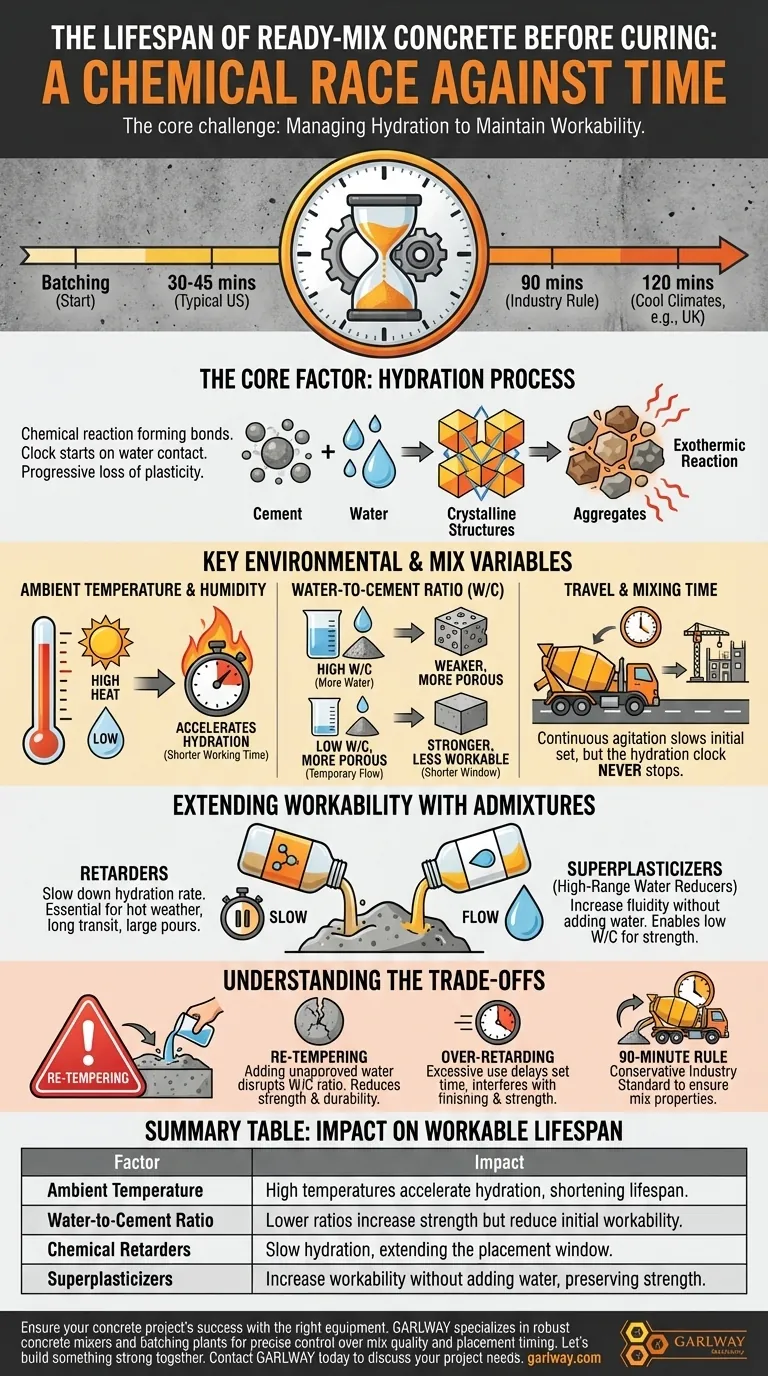
Summary Table:
| Factor | Impact on Workable Lifespan |
|---|---|
| Ambient Temperature | High temperatures accelerate hydration, shortening lifespan. |
| Water-to-Cement Ratio | Lower ratios increase strength but reduce initial workability. |
| Chemical Retarders | Slow hydration, extending the placement window. |
| Superplasticizers | Increase workability without adding water, preserving strength. |
Ensure your concrete project's success with the right equipment.
Managing the lifespan of ready-mix concrete is critical for a strong, durable pour. GARLWAY specializes in construction machinery, offering robust concrete mixers and batching plants designed for consistent performance and reliable delivery. Our equipment helps construction companies and contractors globally maintain precise control over mix quality and placement timing.
Let's build something strong together. Contact GARLWAY today to discuss your project needs and find the perfect machinery solution.
Visual Guide
Related Products
- Portable Ready Mix Concrete Mixer Equipment
- HZS180 Ready Mix Concrete Plant for Foundations with Sand and Cement
- Ready Mixer Machine for Construction Ready Mix Machinery
- HZS120 Ready Mix Concrete Batching Plant Commercial Mud Cement Mixer
- HZS25 Best Cement Mixer for Quick Mix Concrete at Bunnings
People Also Ask
- What was the first recorded version of the portable concrete mixer and who invented it? Discover the 1904 Horse-Drawn Innovation
- How does a portable concrete mixer benefit construction projects? Boost Efficiency & Cut Costs On-Site
- How does the portable concrete mixer optimize time in small construction projects? Gain On-Demand Control & Efficiency
- What are the four main components of a portable concrete mixer? Build Better Concrete with the Right Mixer
- What is the use of a portable concrete mixer? Maximize On-Site Control & Efficiency