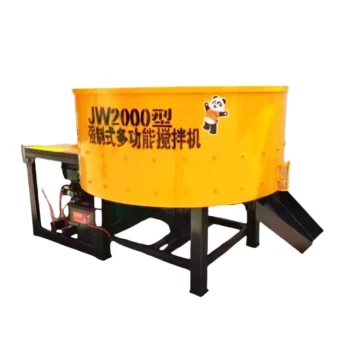
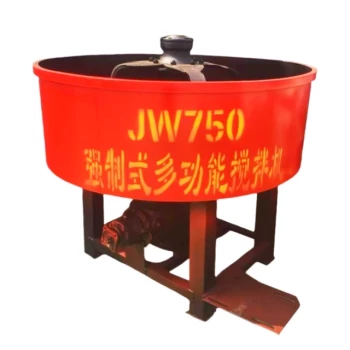
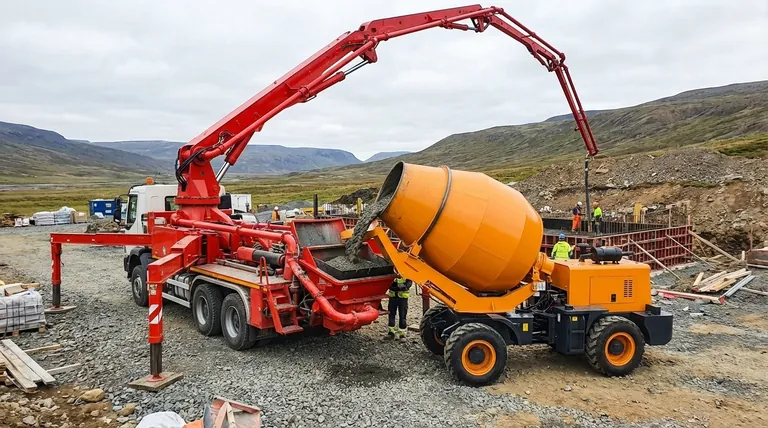
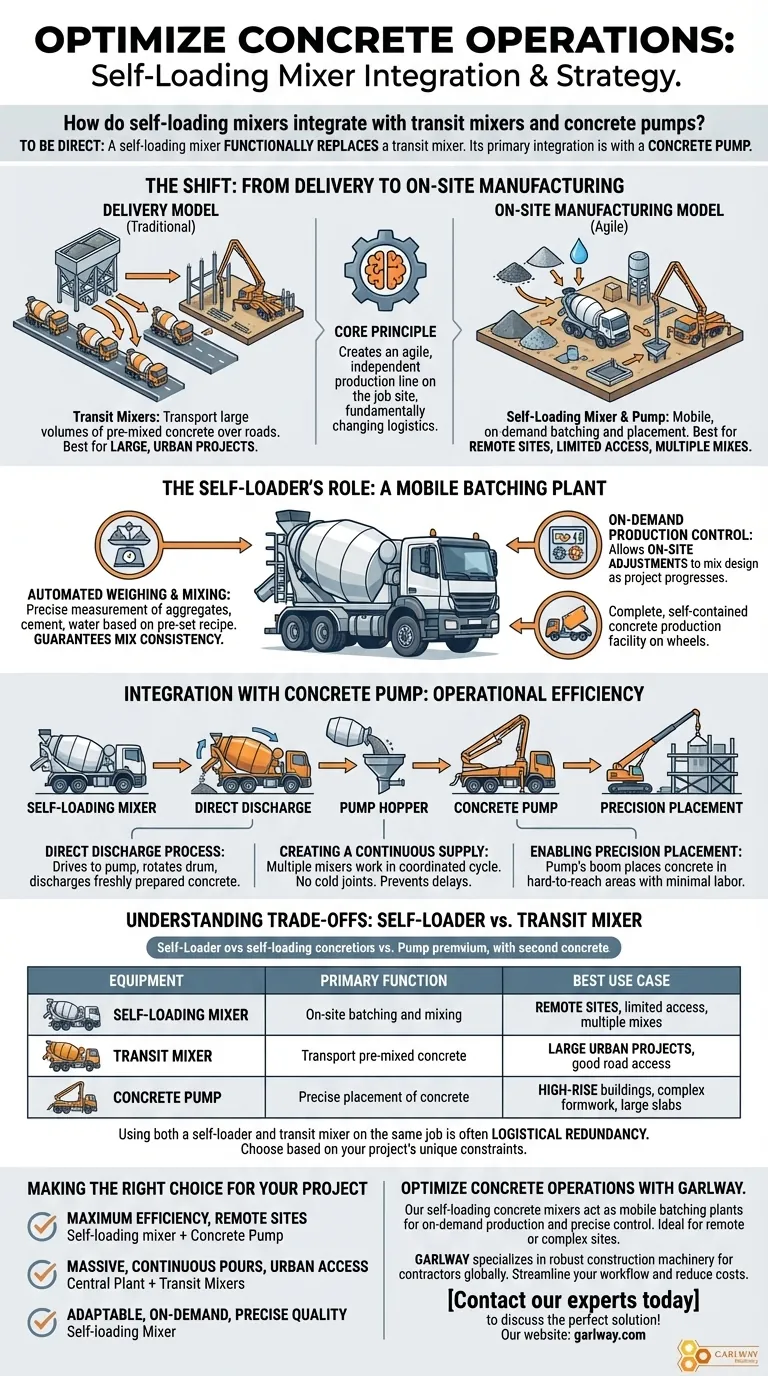
To be direct, a self-loading mixer doesn't typically integrate with a transit mixer; it functionally replaces it. Its primary integration is with a concrete pump, where it acts as a mobile, on-demand batching plant that feeds the pump directly on-site. This combination creates a self-sufficient system for producing and precisely placing concrete, streamlining the entire process from raw material to final placement.
The core principle to understand is the shift from a "delivery" model to an "on-site manufacturing" model. The self-loader and pump combination creates an agile, independent production line on the job site, fundamentally changing the logistics of concrete work.
The Self-Loader's Role: A Mobile Batching Plant
Before analyzing the integration, it's critical to understand that a self-loading mixer is more than just a truck. It is a complete, self-contained concrete production facility on wheels.
Automated Weighing and Mixing
These machines are equipped with sophisticated and automated weighing systems. The operator loads aggregates, cement, and water, and the machine's system ensures each component is measured precisely according to the pre-set recipe.
This automation guarantees mix consistency across every batch, significantly reducing the risk of human error and minimizing material waste.
On-Demand Production Control
Unlike receiving a pre-mixed batch from a central plant, self-loaders provide total control. This allows for on-site adjustments to the mix design, ensuring each batch perfectly meets the specific structural requirements of the project as work progresses.
How the Self-Loader and Concrete Pump Integrate
The synergy between a self-loading mixer and a concrete pump is a model of operational efficiency. The process is straightforward and eliminates multiple logistical steps.
The Direct Discharge Process
The self-loading mixer drives directly to the concrete pump's location on the job site. The operator then rotates the mixing drum and discharges the freshly prepared concrete directly into the pump's hopper.
Creating a Continuous Supply
For larger or continuous pours, multiple self-loading mixers can work in a coordinated cycle. While one mixer is discharging into the pump, another can be loading raw materials and mixing the next batch, ensuring the pump is never waiting for concrete.
This continuous flow prevents cold joints and keeps the project moving forward without the delays often associated with waiting for transit mixers to arrive from an off-site plant.
Enabling Precision Placement
Once the concrete is in the hopper, the concrete pump takes over. Its boom allows for the precise placement of concrete in hard-to-reach areas, such as high-rise building floors, complex formwork, or large-scale slabs, with minimal labor.
Understanding the Trade-offs: Self-Loader vs. Transit Mixer
The decision to use a self-loading mixer is a strategic one that hinges on project logistics. Using both a self-loader and a transit mixer on the same job is almost always a sign of logistical redundancy.
The Transit Mixer's Function
A transit mixer is fundamentally a transportation vehicle. It is designed to carry large volumes of pre-mixed concrete from a high-capacity central batching plant over public roads to a construction site. It excels in serving large, urban projects with easy access.
The Self-Loader's Niche
A self-loading mixer thrives where a transit mixer struggles. It is the ideal solution for remote sites, projects with limited access, or jobs requiring multiple, different concrete mixes throughout the day. Its value is in eliminating the dependency on an off-site plant and the travel time associated with it.
The Inefficiency of Overlap
Asking a self-loading mixer to "integrate" with a transit mixer misses the point. The self-loader's core advantage is its ability to produce concrete from raw materials on-site, making the delivery service of a transit mixer unnecessary and cost-prohibitive for that same task.
Making the Right Choice for Your Project
Choosing your concrete strategy depends entirely on the unique constraints and goals of your construction project.
- If your primary focus is maximum efficiency on remote or logistically complex sites: The self-loading mixer and concrete pump combination is the definitive solution.
- If your primary focus is supplying massive, continuous pours for a large-scale project with good road access: A traditional central plant and a fleet of transit mixers remains the most effective model.
- If your primary focus is adaptable, on-demand concrete production with precise quality control: The self-loading mixer provides unparalleled control and flexibility right on the job site.
Ultimately, selecting the correct equipment is about aligning your tools with your project's core logistical challenges to ensure a successful outcome.
Summary Table:
| Equipment | Primary Function | Best Use Case |
|---|---|---|
| Self-Loading Mixer | On-site batching and mixing | Remote sites, limited access, multiple mixes |
| Transit Mixer | Transport pre-mixed concrete | Large urban projects with good road access |
| Concrete Pump | Precise placement of concrete | High-rise buildings, complex formwork, large slabs |
Optimize your concrete operations with GARLWAY.
Our self-loading concrete mixers are engineered to function as mobile batching plants, providing the on-demand production and precise control your project needs. Paired with a concrete pump, they create a seamless, efficient system ideal for remote locations or complex sites.
GARLWAY specializes in construction machinery, offering robust and reliable solutions for construction companies and contractors globally. Let us help you streamline your workflow and reduce logistical costs.
Contact our experts today to discuss the perfect equipment solution for your next project!
Visual Guide
Related Products
- Skid Steer Self Loading Concrete Mixers for Construction
- Belle Mixer Drum Self Loading Mortar Mixers JS3000
- Portable Cement Mixer with Lift Concrete Machine
- Portable Concrete Mixer Machine Equipment for Mixing Concrete
- Portable Ready Mix Concrete Mixer Equipment
People Also Ask
- How does the control system improve production efficiency in a self loading concrete mixer? Automate Mixing for Speed & Quality
- What is the purpose of keeping the drum rotating during transportation in a self loading concrete mixer? Ensure Quality & Consistency
- How does the weighing process work in a self loading concrete mixer? Achieve Precise, On-Site Concrete Batching
- What components are involved in the loading process of a self loading concrete mixer? A Guide to the Key Systems
- How should materials be loaded into a self-loading concrete mixer? Master the Step-by-Step Process