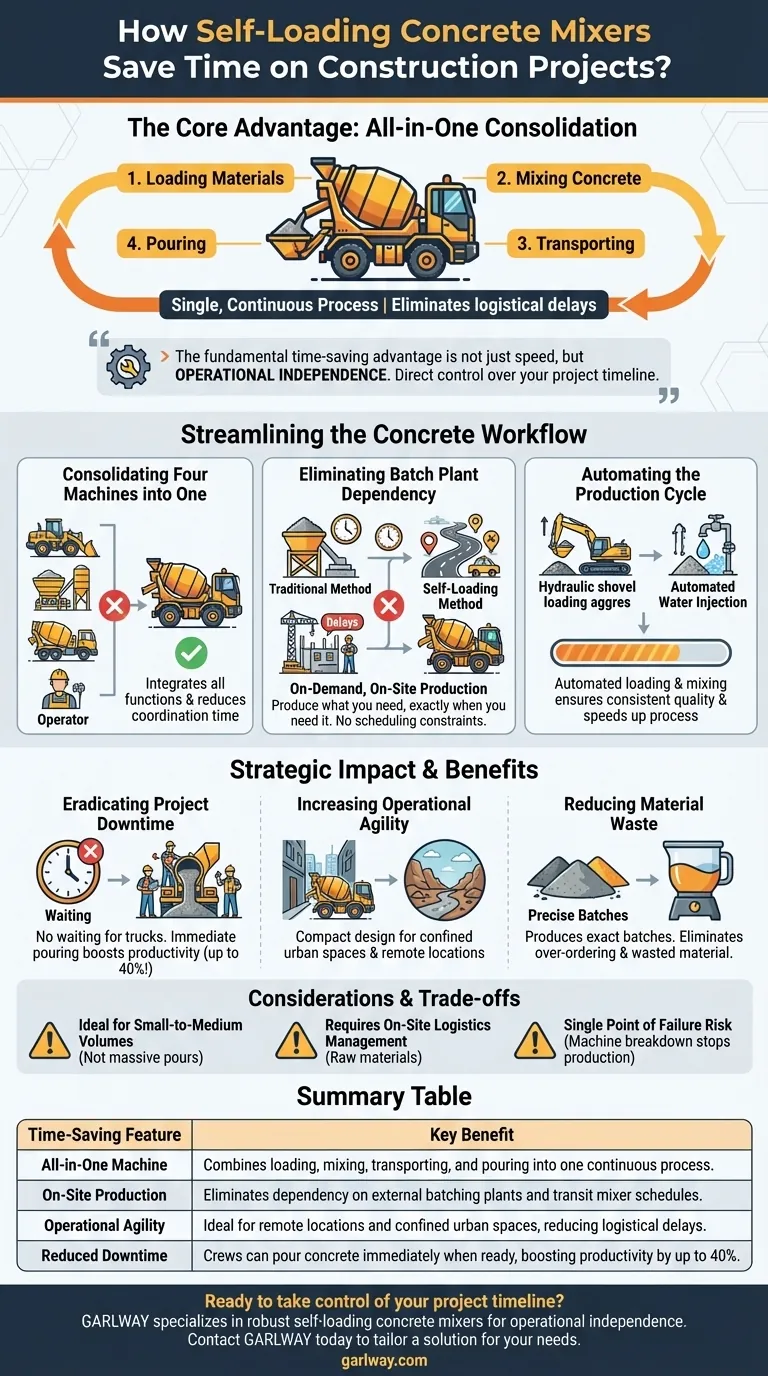
At their core, self-loading concrete mixers save time by consolidating four distinct jobs—loading materials, mixing concrete, transporting it, and pouring it—into a single, continuous process handled by one machine. This integration eliminates the logistical delays and dependencies inherent in traditional concrete production, where materials are handled at a central batching plant and then transported to the job site. By making concrete production a localized, on-demand activity, these mixers remove critical bottlenecks from the construction workflow.
The fundamental time-saving advantage is not just speed, but operational independence. By removing the reliance on external batching plants and delivery schedules, you gain direct control over the most critical path in your project timeline.
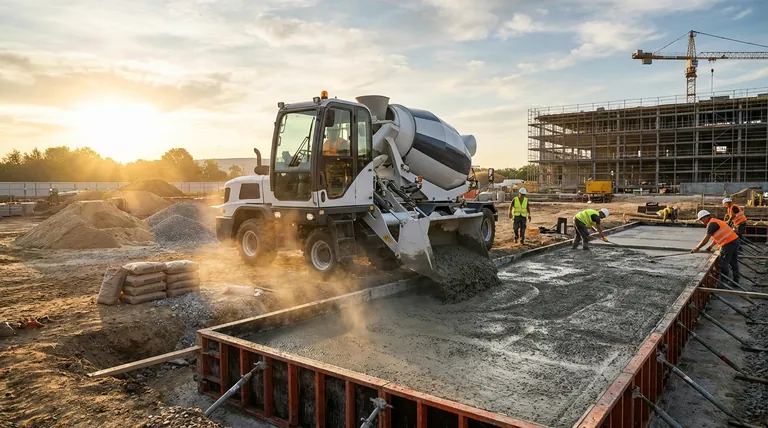
How Self-Loaders Streamline the Concrete Workflow
The time savings from a self-loading mixer stem from a fundamental redesign of the concrete production process. Instead of a multi-stage, multi-location workflow, it becomes a single-point operation.
Consolidating Four Machines into One
A traditional concrete pour requires a wheel loader for raw materials, a batching plant for mixing, and a transit mixer for transport. A self-loading mixer integrates all of these functions. This immediately removes the time spent coordinating different pieces of equipment and the operators needed for each one.
Eliminating Batch Plant Dependency
The most significant source of delays in conventional concreting is the reliance on an off-site batching plant. Projects are subject to the plant's schedule, traffic delays during transit, and potential communication errors. With a self-loader, you produce what you need, exactly when you need it, directly at the point of use.
Automating the Production Cycle
These machines automate the loading of aggregates and cement via their hydraulic shovel and the precise introduction of water. This automation reduces the potential for human error and speeds up the entire mixing process, ensuring a consistent quality mix every time without the delays of manual measurement.
The Strategic Impact of On-Site Production
Moving concrete production to the job site has profound effects on overall project velocity and efficiency, which can boost productivity by up to 40% compared to traditional methods.
Eradicating Project Downtime
Crews no longer have to wait for a concrete truck to arrive. As soon as a section is ready for pouring, the mixer can prepare a fresh batch. This eliminates the costly idle time that plagues projects dependent on external suppliers.
Increasing Operational Agility
Self-loaders are often more compact and maneuverable than large transit mixers. Their design allows them to operate effectively in confined urban spaces or remote locations far from the nearest batching plant, opening up new efficiencies on challenging sites.
Reducing Material Waste
By producing concrete in precise batches as needed, you significantly reduce the risk of over-ordering or having a partially used truckload go to waste because of a delay on-site. This optimizes material use and contributes to a more efficient, cost-effective operation.
Understanding the Trade-offs and Considerations
While highly efficient, self-loading mixers are not a universal solution. Their value is context-dependent, and it's important to understand their limitations.
Batch Capacity vs. Scale
Self-loading mixers are ideal for small-to-medium volume pours. For massive, continuous pours like a high-rise foundation, the output of a dedicated, high-capacity batching plant and a fleet of transit mixers remains superior.
On-Site Logistics are Still Required
While you eliminate the transit mixer, you must now manage the logistics of getting raw materials—cement, sand, aggregate, and water—to the job site. This requires careful planning to ensure the machine is never idle due to a lack of components.
Reliance on a Single Point of Failure
The machine's all-in-one nature is its greatest strength but also a potential weakness. If the self-loader breaks down, your entire concrete production capacity stops. This contrasts with having multiple transit mixers, where one can be taken out of service with less impact.
Making the Right Choice for Your Project
Choosing a self-loading mixer depends entirely on the specific demands and constraints of your construction environment.
- If your primary focus is remote or infrastructure projects: The ability to create high-quality concrete far from any established plant is the single greatest advantage.
- If your primary focus is urban or confined-space construction: The machine's agility and compact footprint can solve major logistical challenges where larger vehicles cannot operate efficiently.
- If your primary focus is maximizing labor efficiency and minimizing delays: The streamlined, on-demand workflow directly reduces crew downtime and eliminates dependencies on third-party suppliers.
By transforming concrete production from a logistical challenge into a controlled, on-site process, these machines empower you to master your project's schedule.
Summary Table:
| Time-Saving Feature | Key Benefit |
|---|---|
| All-in-One Machine | Combines loading, mixing, transporting, and pouring into one continuous process. |
| On-Site Production | Eliminates dependency on external batching plants and transit mixer schedules. |
| Operational Agility | Ideal for remote locations and confined urban spaces, reducing logistical delays. |
| Reduced Downtime | Crews can pour concrete immediately when ready, boosting productivity by up to 40%. |
Ready to take control of your project timeline and eliminate concrete delivery delays?
GARLWAY specializes in providing robust and efficient self-loading concrete mixers for construction companies and contractors globally. Our machines are engineered to deliver the operational independence and time savings detailed in this article.
Contact GARLWAY today to discuss how our self-loading mixers, along with our full range of construction machinery including winches and concrete batching plants, can be tailored to your specific project needs and help you save time and money.
Visual Guide
Related Products
- Skid Steer Self Loading Concrete Mixers for Construction
- Belle Mixer Drum Self Loading Mortar Mixers JS3000
- Portable Cement Mixer with Lift Concrete Machine
- Portable Concrete Mixer Machine Equipment for Mixing Concrete
- Portable Ready Mix Concrete Mixer Equipment
People Also Ask
- How does the control system improve production efficiency in a self loading concrete mixer? Automate Mixing for Speed & Quality
- What is the purpose of keeping the drum rotating during transportation in a self loading concrete mixer? Ensure Quality & Consistency
- How does the weighing process work in a self loading concrete mixer? Achieve Precise, On-Site Concrete Batching
- What components are involved in the loading process of a self loading concrete mixer? A Guide to the Key Systems
- How should materials be loaded into a self-loading concrete mixer? Master the Step-by-Step Process