At their core, self-loading concrete mixers enhance mobility and versatility by integrating the entire concrete production process—loading, mixing, and transporting—into a single, all-terrain machine. This consolidation fundamentally changes the logistics of concrete supply, moving it from a dependency on external batching plants to an on-demand, on-site capability. Their rugged design and advanced steering systems allow them to operate where traditional concrete trucks cannot.
The true advantage of a self-loading mixer is not just its ability to move, but its capacity to transform any location into a self-sufficient concrete production site. This eliminates logistical dependencies and gives project managers direct control over their concrete supply chain.
The Core Principle: From Logistical Chain to Single Unit
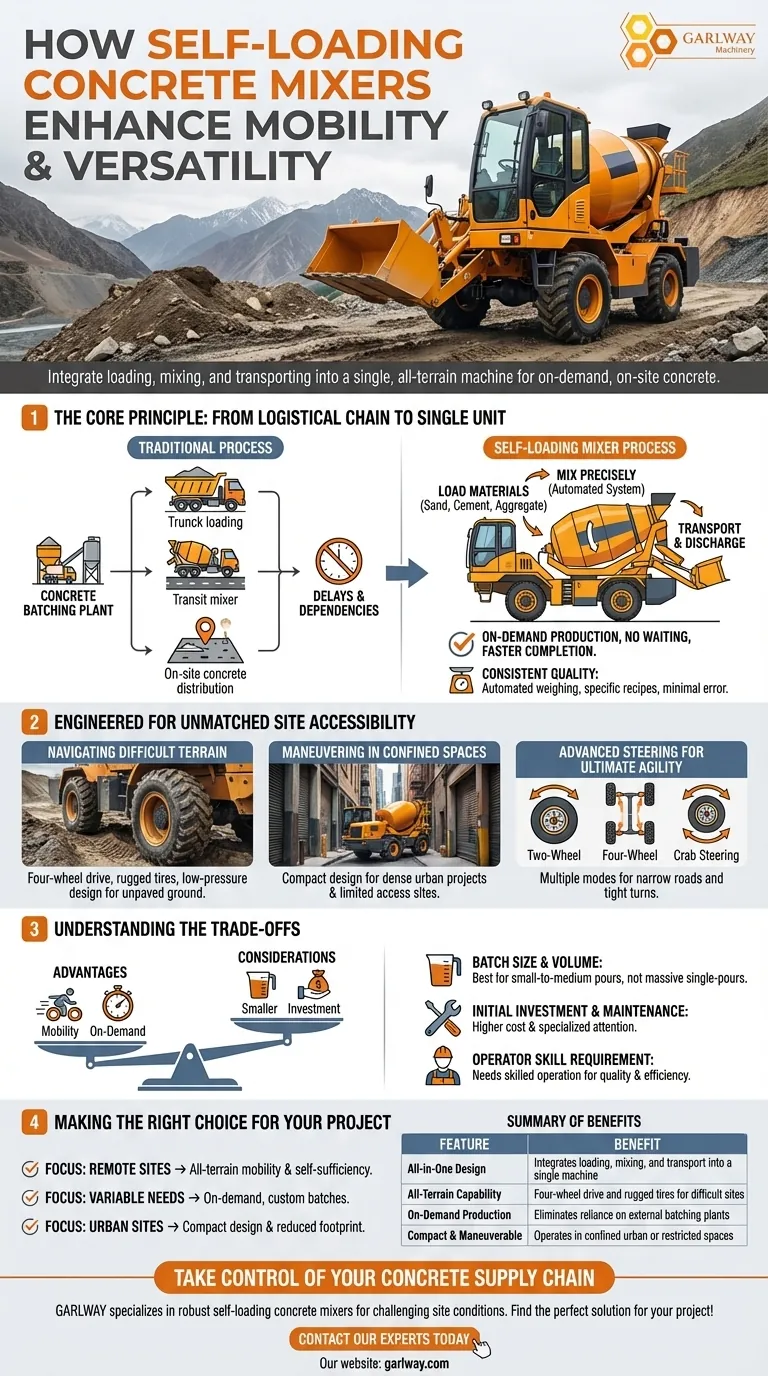
Traditional concrete work involves a complex chain: a batching plant, a transit mixer truck, and on-site distribution. Self-loading mixers collapse this entire sequence into one machine.
Integrating Functions into One Machine
A self-loading mixer combines a wheel loader, a traditional mixer, and a transporter. It can load its own raw materials (like sand, cement, and aggregate), mix them precisely, and discharge the finished concrete exactly where it's needed.
Enabling On-Demand Production
This integrated design eliminates the reliance on ready-mix plant schedules and delivery times. There are no more delays waiting for a truck, allowing for continuous work and faster project completion, which is critical for projects with tight schedules.
Ensuring Consistent Quality
Modern units feature automated and precise weighing systems. Operators can set a specific recipe, and the machine automatically measures materials, ensuring consistent concrete quality from the first batch to the last while minimizing material wastage and human error.
Engineered for Unmatched Site Accessibility
The primary advantage that users immediately notice is the machine's ability to navigate challenging environments that would stop a conventional concrete truck.
Navigating Difficult Terrain
Equipped with four-wheel drive, rugged tires, and often low-pressure, wide-base designs, these mixers have excellent off-road performance. They are built to operate effectively on the uneven, unpaved ground typical of rural and new construction sites.
Maneuvering in Confined Spaces
Their compact design is a significant advantage in dense urban projects or sites with limited access. They can operate in spaces too tight for larger, separate pieces of equipment.
Advanced Steering for Ultimate Agility
Many models feature multiple steering modes, such as two-wheel, four-wheel, and "crab" steering. This allows for exceptional maneuverability, enabling the machine to navigate narrow roads and execute tight turns with ease.
Understanding the Trade-offs
While highly effective, self-loading mixers are a specialized tool. Understanding their limitations is key to using them correctly.
Batch Size and Volume
A self-loading mixer cannot match the sheer volume of a large, dedicated transit mixer truck arriving from a high-capacity batching plant. They are best suited for small-to-medium pours or continuous, steady production rather than massive, single-pour foundations.
Initial Investment and Maintenance
The complexity of an all-in-one machine means a higher initial purchase price compared to simpler equipment. Maintenance is also more involved, as the hydraulic, loading, and mixing systems all require specialized attention.
Operator Skill Requirement
Effectively operating a self-loading mixer requires more skill than driving a standard truck. The operator is responsible for loading correctly, managing the mix recipe, and navigating the site, making them a key factor in production quality and efficiency.
Making the Right Choice for Your Project
The decision to use a self-loading mixer should be based on your project's specific logistical challenges and goals.
- If your primary focus is remote or difficult-to-access sites: The mixer's all-terrain mobility and self-sufficiency are its greatest strengths.
- If your primary focus is projects with variable concrete needs: Its ability to produce fresh, custom batches on demand provides unparalleled flexibility.
- If your primary focus is maximizing efficiency on constrained urban sites: The compact, all-in-one design reduces the equipment footprint and simplifies on-site logistics.
By bringing the batching plant directly to the job site, these machines give you complete control over your concrete production.
Summary Table:
| Feature | Benefit |
|---|---|
| All-in-One Design | Integrates loading, mixing, and transport into a single machine |
| All-Terrain Capability | Four-wheel drive and rugged tires for difficult sites |
| On-Demand Production | Eliminates reliance on external batching plants |
| Compact & Maneuverable | Operates in confined urban or restricted spaces |
Ready to take control of your concrete supply chain? GARLWAY specializes in robust construction machinery, including self-loading concrete mixers designed for contractors and construction companies facing challenging site conditions. Our machines deliver the mobility and versatility you need for on-demand production. Contact our experts today to find the perfect solution for your project!
Visual Guide
Related Products
- Skid Steer Self Loading Concrete Mixers for Construction
- Belle Mixer Drum Self Loading Mortar Mixers JS3000
- Portable Cement Mixer with Lift Concrete Machine
- Portable Concrete Mixer Machine Equipment for Mixing Concrete
- Portable Ready Mix Concrete Mixer Equipment
People Also Ask
- How does the control system improve production efficiency in a self loading concrete mixer? Automate Mixing for Speed & Quality
- What is the purpose of keeping the drum rotating during transportation in a self loading concrete mixer? Ensure Quality & Consistency
- How does the weighing process work in a self loading concrete mixer? Achieve Precise, On-Site Concrete Batching
- What components are involved in the loading process of a self loading concrete mixer? A Guide to the Key Systems
- How should materials be loaded into a self-loading concrete mixer? Master the Step-by-Step Process