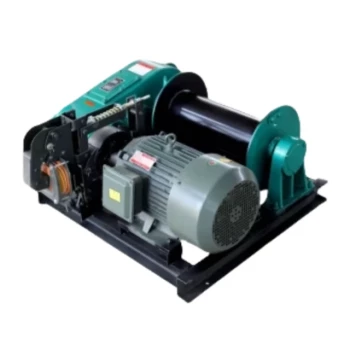
At their core, remote control capabilities transform an electric winch from a simple pulling device into a precise and significantly safer tool. They enhance operation by allowing the user to manage the winching process from a safe distance, offering a superior vantage point and enabling finer control over the load's speed and position.
The true value of a remote control isn't convenience; it's the fundamental shift it creates in operator safety. By moving the user away from the winch line and load, it mitigates the single greatest risk in any winching operation.
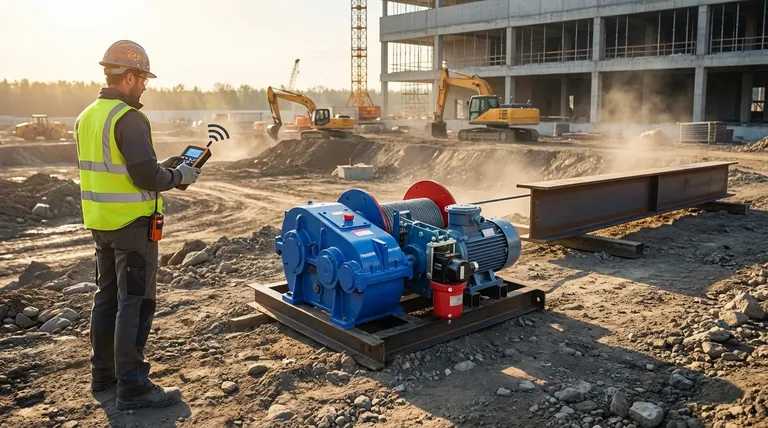
The Primary Advantage: Operator Safety and Visibility
The most critical enhancement offered by remote controls is the ability to separate the operator from the machine. This has profound implications for safety and operational awareness.
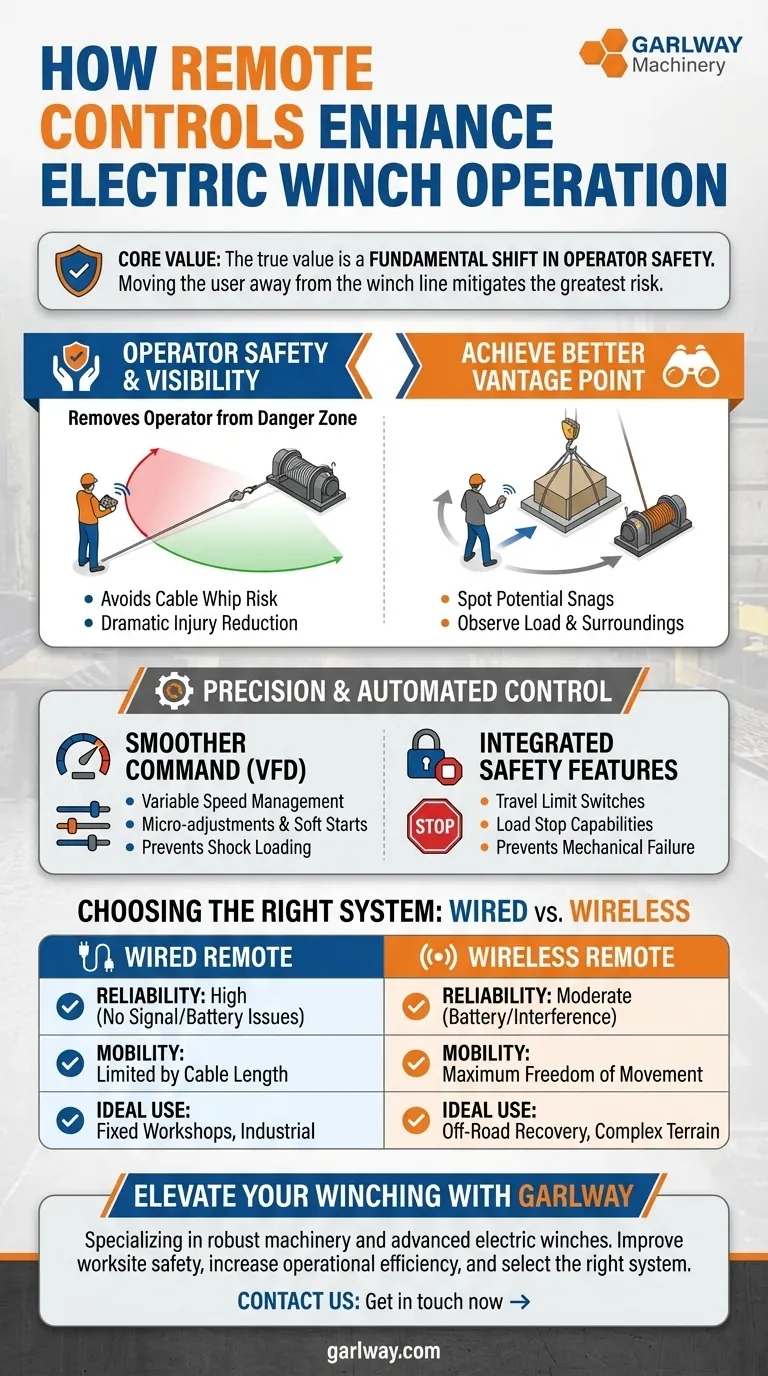
Removing the Operator from the Danger Zone
A winch line under tension stores an immense amount of kinetic energy. Should the cable snap or a connection point fail, it can whip back with lethal force.
A remote control allows the operator to stand clear of this direct line of fire, dramatically reducing the risk of serious injury.
Achieving a Better Vantage Point
Being tethered to the winch limits your field of view. A remote, especially a wireless one, lets you move around the vehicle or load.
This freedom provides the ideal vantage point to spot potential snags, ensure the line is spooling correctly onto the drum, and observe the load's movement in relation to its surroundings.
A New Level of Precision and Control
Beyond safety, remote systems provide a more nuanced level of command over the winch's mechanical functions, leading to smoother and more efficient work.
Managing Speed and Direction
Many modern remote-controlled winches integrate with variable frequency drives (VFDs). This technology allows for precise management of the motor's speed.
Instead of a simple on/off engagement, the operator can initiate a pull slowly, make micro-adjustments, and stop smoothly, preventing shock loading on the winch and its components.
Integrating Automated Safety Features
Advanced remote systems can incorporate crucial safety functions. These often include travel limit switches to prevent the hook from being pulled into the fairlead or over-traveling.
They can also feature load stop capabilities, which automatically halt the operation if the winch's rated capacity is exceeded, preventing motor burnout and mechanical failure.
Understanding the Trade-offs: Wired vs. Wireless
While both remote types improve upon direct manual control, they have distinct operational characteristics.
The Reliability of Wired Remotes
A wired remote connects directly to the winch via a physical cable. Its primary advantage is reliability; it is not susceptible to battery failure or radio signal interference.
The main drawback is the physical limitation of the cord's length, which can sometimes restrict operator positioning.
The Freedom of Wireless Remotes
Wireless remotes offer maximum mobility, which is invaluable in complex recovery situations or when a clear line of sight is difficult to achieve.
However, they rely on batteries that can die at inopportune moments and are potentially vulnerable to signal interference in environments with heavy radio traffic.
A Critical Limitation to Remember
A remote control can only command the functions the winch motor and gearing are built to perform. Most electric winches can "power in" but only "freewheel out."
A remote cannot add a "power out" function if the winch doesn't have it. It is a control interface, not a mechanical upgrade.
Making the Right Choice for Your Application
Selecting the right remote system depends entirely on your specific operational needs and environment.
- If your primary focus is off-road vehicle recovery: A wireless remote is superior, as it provides the freedom to navigate difficult terrain for the best possible view.
- If your primary focus is a fixed workshop or industrial setting: A wired remote offers unmatched reliability, eliminating concerns about battery life or signal interference from other equipment.
- If your primary focus is maximum safety and precision: Prioritize a winch system with integrated variable speed control and limit switches, regardless of whether its remote is wired or wireless.
Ultimately, choosing the right control system elevates an electric winch from a brute-force tool to a precise and safe instrument for heavy work.
Summary Table:
| Feature | Wired Remote | Wireless Remote |
|---|---|---|
| Reliability | High (no signal/battery issues) | Moderate (subject to battery life/interference) |
| Mobility | Limited by cable length | Maximum freedom of movement |
| Ideal Use Case | Fixed workshops, industrial settings | Off-road recovery, complex terrain |
| Key Advantage | Consistent performance | Superior vantage point and flexibility |
Ready to enhance your winching operations with superior safety and control?
At GARLWAY, we specialize in providing robust construction machinery, including advanced electric winches with reliable remote control systems. Our solutions are designed for construction companies and contractors worldwide who demand precision and safety in heavy-duty applications.
We can help you:
- Improve worksite safety by allowing operators to control winches from a safe distance.
- Increase operational efficiency with smooth, variable speed control and integrated safety features.
- Select the right remote system (wired or wireless) tailored to your specific environment and needs.
Contact us today to discuss how a GARLWAY remote-controlled winch can transform your projects. Get in touch now →
Visual Guide
Related Products
- Electric 120V Boat Winch by Badlands
- Electric and Hydraulic Winch for Heavy Duty Applications
- Small Electric Winch 120V and 240V for Compact Applications
- 12000 lb Electric Boat Trailer Winch with Windlass Anchor Warn
- Electric Hoist Winch Boat Anchor Windlass for Marine Applications
People Also Ask
- How do electric boat winches work? Unlock Effortless Launching & Retrieval
- How much current does an electric boat winch draw? Plan Your Electrical System for Peak Performance
- Can I run a winch straight from a battery? Essential Power Setup for Safe Operation
- What are the types of electric winches available? Choose the Right Winch for Your Job
- What are the uses of electric winches in mining and tunneling? Enhance Safety and Efficiency Underground