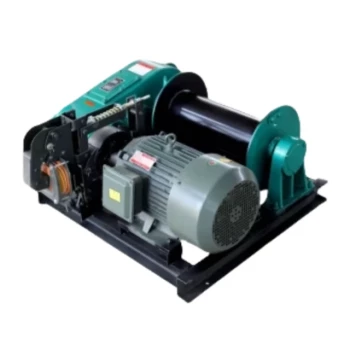
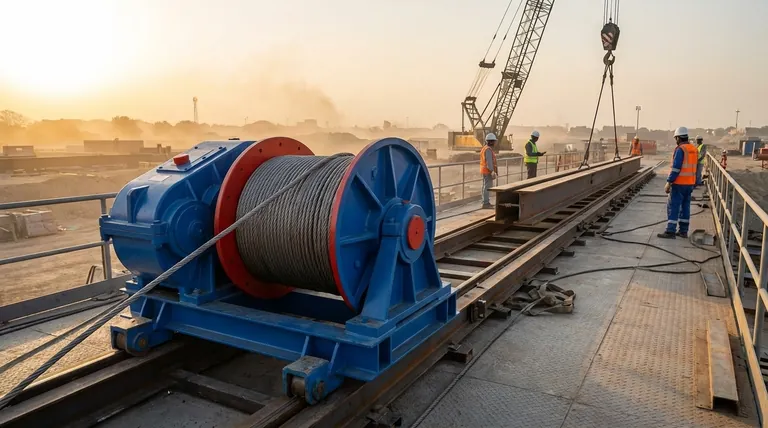
At their core, industrial winches enhance operational efficiency by automating demanding lifting and pulling tasks. By replacing slow, high-risk manual labor with controlled mechanical force, they dramatically reduce the time and personnel required for material handling, directly cutting down on operational downtime and increasing overall productivity.
The true value of an industrial winch isn't just its power, but its ability to transform a workflow. It replaces high-effort, high-risk manual processes with a controlled, repeatable, and faster mechanical operation, creating a safer and more productive environment.
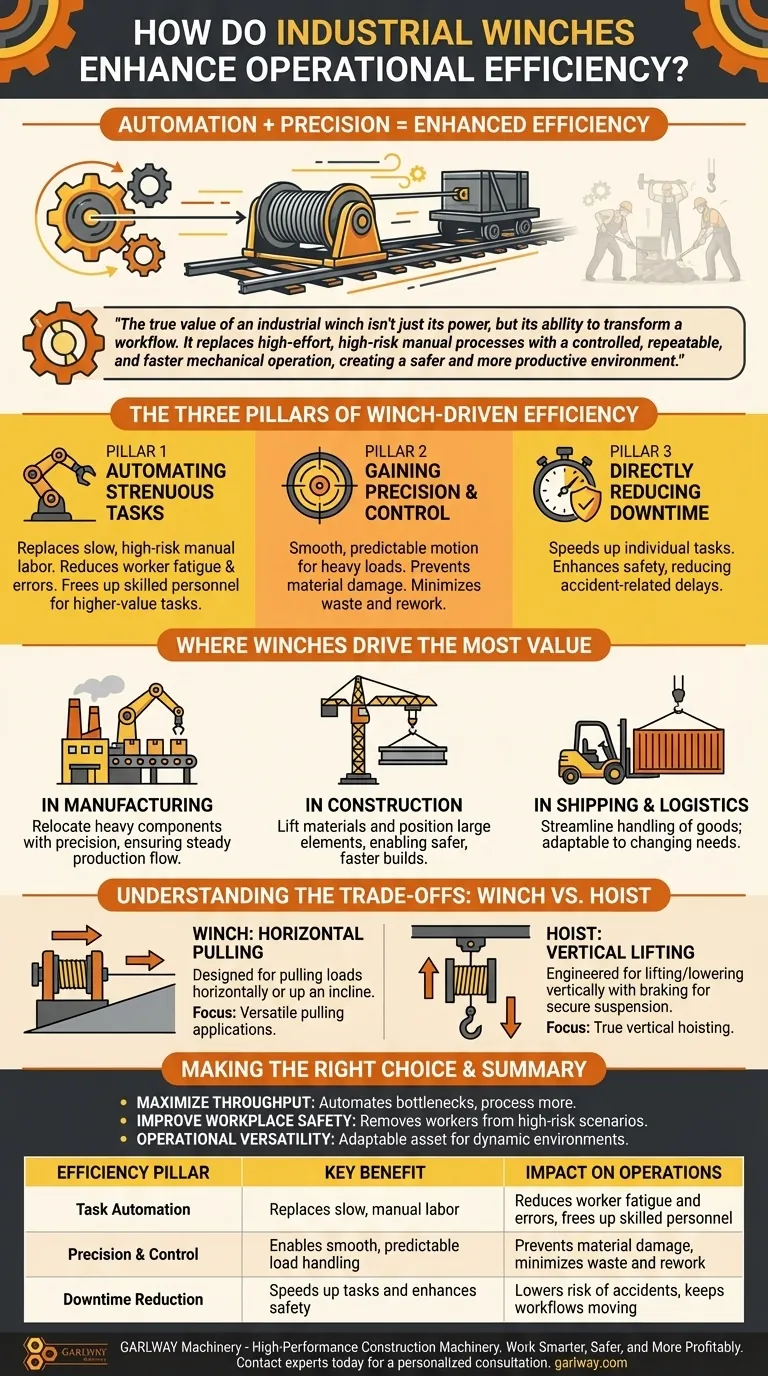
The Three Pillars of Winch-Driven Efficiency
Understanding how a winch improves efficiency requires looking beyond the simple act of pulling. The gains come from three fundamental changes to your operational process.
Pillar 1: Automating Strenuous and Repetitive Tasks
An industrial winch excels at taking over tasks that are physically demanding and repetitive. This has a direct impact on your workforce and workflow.
By automating this labor, you reduce worker fatigue, which in turn lowers the risk of costly errors and injuries. It also frees up skilled personnel to focus on higher-value activities that require human intellect rather than brute force.
Pillar 2: Gaining Precision and Control Over Heavy Loads
Manually handling massive objects is often imprecise and dangerous. Industrial winches provide a level of control that is impossible to achieve by hand.
Whether lifting steel beams on a construction site or maneuvering heavy components on an assembly line, the winch allows for smooth, predictable motion. This precision prevents damage to materials and equipment, minimizing waste and rework.
Pillar 3: Directly Reducing Operational Downtime
Downtime is a primary drain on efficiency and profitability. Winches attack this problem from two angles.
First, they speed up individual tasks, reducing the time that other processes or personnel have to wait for materials to be moved. Second, by creating a safer work environment, they reduce the likelihood of accidents and injuries that can halt operations for hours or even days.
Where Winches Drive the Most Value
The versatility of industrial winches allows them to be deployed across numerous sectors, each time solving a core efficiency problem.
In Manufacturing
On an assembly line, winches are used to relocate heavy components with precision. This ensures the production line keeps moving at a steady, predictable pace.
In Construction
Winches are indispensable for lifting heavy building materials to upper levels or positioning large structural elements like steel beams, tasks that would be prohibitively slow and dangerous otherwise.
In Shipping and Logistics
In shipping yards or warehouses, winches streamline the handling of heavy goods and cargo. They can be mounted to structural beams or mobile platforms to adapt to changing needs.
Understanding the Trade-offs: Winch vs. Hoist
A common point of confusion is the distinction between a winch and a hoist. Choosing the right tool is critical for both safety and efficiency.
When to Choose a Winch
A winch is primarily designed for pulling loads horizontally or up an incline. While some are rated for vertical lifting, their core strength is in versatile pulling applications.
When to Choose a Hoist
A hoist is a device specifically engineered for lifting and lowering loads vertically. Its braking systems are designed to suspend a load securely, making it the correct choice for true vertical hoisting. Using a winch for a task better suited to a hoist can be a significant safety risk.
Making the Right Choice for Your Goal
To determine if a winch is the right investment, align it with your specific operational objective.
- If your primary focus is maximizing throughput: A winch automates bottlenecks in material handling, allowing you to process more in less time.
- If your primary focus is improving workplace safety: A winch removes workers from high-risk manual lifting scenarios, drastically reducing injury potential and associated downtime.
- If your primary focus is operational versatility: The adaptability of a winch to various pulling tasks makes it a flexible asset for dynamic work environments.
Ultimately, integrating an industrial winch is not just about lifting heavier; it's about working smarter, safer, and more profitably.
Summary Table:
| Efficiency Pillar | Key Benefit | Impact on Operations |
|---|---|---|
| Task Automation | Replaces slow, manual labor | Reduces worker fatigue and errors, frees up skilled personnel |
| Precision & Control | Enables smooth, predictable load handling | Prevents material damage, minimizes waste and rework |
| Downtime Reduction | Speeds up tasks and enhances safety | Lowers risk of accidents, keeps workflows moving |
Ready to boost your operational efficiency with a reliable industrial winch?
At GARLWAY, we specialize in high-performance construction machinery, including robust industrial winches, concrete mixers, and batching plants. Our solutions are engineered to help construction companies and contractors worldwide work smarter, safer, and more profitably by automating demanding tasks and reducing downtime.
Contact our experts today for a personalized consultation and discover the right winch solution for your specific needs!
Visual Guide
Related Products
- Hydraulic Winding Engine Harbor Freight Winch
- Electric and Hydraulic Winch for Heavy Duty Applications
- Small Electric Winch 120V and 240V for Compact Applications
- Portable Small Trailer Winch
- Warn Winch Windlass Boat Trailer Winch
People Also Ask
- What role does hydraulic fluid play in hydraulic winches? It's the Lifeblood of Your Heavy-Duty Pulling Power
- What vehicles commonly use hydraulic winches? For Industrial Trucks Needing Unmatched Power
- What are the features of hydraulic winches? Unmatched Power and Continuous Duty for Heavy Loads
- What preventive measures can be taken to avoid oil leakage in hydraulic winches? Ensure Long-Term Reliability
- What does 'power out' mean in a hydraulic winch? Achieve Absolute Control When Lowering Heavy Loads