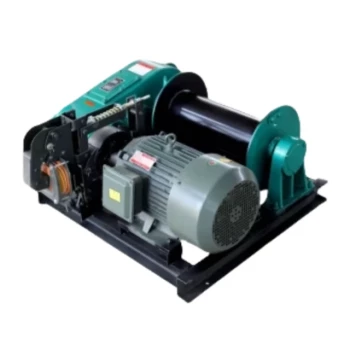
At its core, a winch is used in tree and stump removal to apply a tremendous and controlled pulling force that would be impossible to generate manually. This mechanical advantage allows you to precisely direct the fall of a tree, pull down smaller trees, and, most notably, extract stubborn stumps by tearing their root systems from the ground.
A winch transforms a difficult, and often unpredictable, task into a controlled process. It's not just about brute force; it's about applying that force with precision to ensure safety and efficiency.
The Core Principle: Mechanical Advantage
A tree or stump is held in place by an incredibly strong and complex root system. A winch works by multiplying the force you apply, creating enough power to overcome this natural anchoring.
Overcoming Natural Resistance
The primary challenge in tree removal is the immense holding power of the earth and the tree's own structure.
A winch provides a slow, steady, and powerful pull that can gradually break roots and overcome the forces holding a stump in place, a task that is nearly impossible with simple leverage.
Gaining Control
For standing trees, especially those near homes or power lines, control is paramount.
A winch line, properly attached, allows you to create tension in a specific direction. This ensures that when the tree is cut, it falls exactly where you intend it to, preventing catastrophic damage.
Key Applications in Tree and Stump Removal
While the principle is simple—pull hard—the applications are specific and require different approaches to be effective and safe.
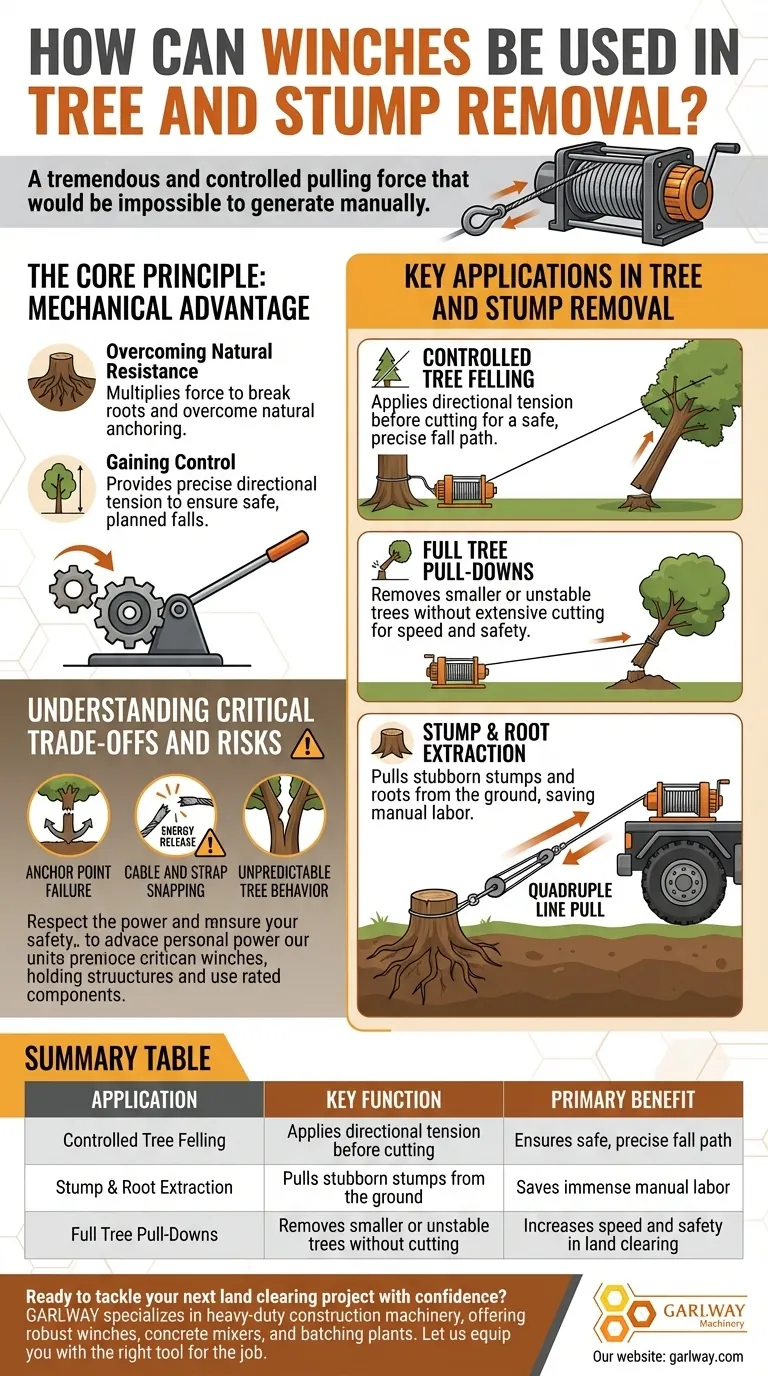
Controlled Tree Felling
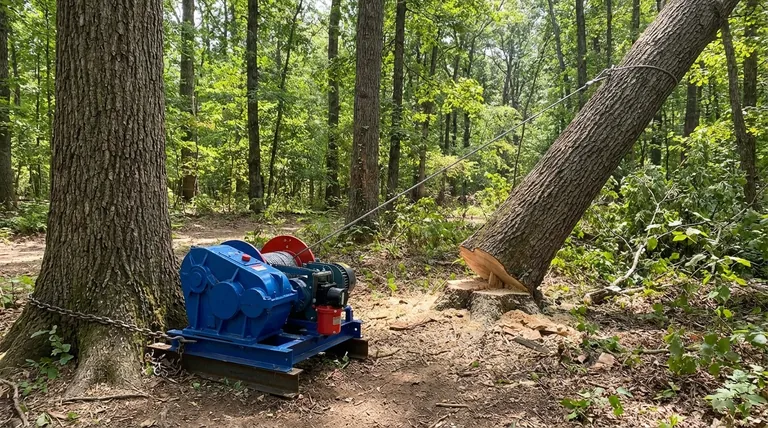
This is the most common professional use. A line is attached high up the trunk of the tree, with the other end running to the winch, which is anchored to a solid object like another tree or a heavy vehicle.
By applying tension before the final back-cut is made, you eliminate any guesswork. The tree is guided safely to the ground in the predetermined direction.
Full Tree Pull-Downs
For smaller, unstable, or partially fallen trees, a winch can be used to pull the entire tree down without extensive cutting.
This is often used in land clearing operations where speed is a factor and the risk of the tree falling in an uncontrolled manner is high.
Stump and Root Extraction
This is where a winch's raw power is most evident. After digging around a stump to expose major roots and cutting them, a winch can be used to pull the entire stump out of the ground.
For exceptionally stubborn stumps, advanced techniques like a quadruple line pull, using snatch blocks, can be employed to multiply the winch's pulling force even further.
Understanding the Critical Trade-offs and Risks
Using a winch introduces immense force into a situation, and that power must be respected. Misuse can lead to severe equipment damage, injury, or death.
Anchor Point Failure
The object your winch is attached to (the anchor) must be able to withstand the pulling force.
If you anchor to a tree that is too small or rotten, or a vehicle that is too light, you risk pulling the anchor over instead of your target. The anchor must be significantly more stable than the object you are pulling.
Cable and Strap Snapping
Every component in a winching system has a load limit. If the force required to move the tree or stump exceeds the rating of the cable, strap, or shackle, it can snap violently.
This is one of the most significant dangers. A snapping cable stores and releases a tremendous amount of energy, acting like a whip that can cause devastating injury.
Unpredictable Tree Behavior
Applying force to a tree can have unexpected consequences. The trunk can split, twist, or break in a way that bypasses your controls.
This is especially true with rotted or compromised trees. A proper assessment of the tree's health is critical before you ever attach a line.
Making the Right Choice for Your Goal
Using a winch is a powerful technique, but it must be matched to the specific task and executed with a deep understanding of the safety principles involved.
- If your primary focus is safely felling a tree near a structure: Use the winch to apply directional tension, ensuring the tree falls exactly where planned after you make the proper felling cuts.
- If your primary focus is removing a large, stubborn stump: Ensure your winch and anchor points are rated well above the expected force and clear a large area for safety.
- If your primary focus is clearing many small trees or large rocks: A winch can be a massive time and labor saver, allowing one person to move objects that would otherwise require heavy machinery.
Ultimately, a winch gives you the power to manage overwhelming natural forces with control and precision.
Summary Table:
| Application | Key Function | Primary Benefit |
|---|---|---|
| Controlled Tree Felling | Applies directional tension before cutting | Ensures safe, precise fall path |
| Stump & Root Extraction | Pulls stubborn stumps from the ground | Saves immense manual labor |
| Full Tree Pull-Downs | Removes smaller or unstable trees without cutting | Increases speed and safety in land clearing |
Ready to tackle your next land clearing project with confidence?
A powerful, reliable winch is the key to safe and efficient tree and stump removal. GARLWAY specializes in heavy-duty construction machinery, offering robust winches, concrete mixers, and batching plants designed for the demands of professional contractors and construction companies.
Let us equip you with the right tool for the job. Contact our experts today to find the perfect winch for your needs and enhance your project's safety and productivity.
Visual Guide
Related Products
- Warn Winch Windlass Boat Trailer Winch
- Electric and Hydraulic Winch for Heavy Duty Applications
- Small Electric Winch 120V and 240V for Compact Applications
- Quick Windlass Portable Winch for Truck and Boat Best Boat Winch
- Hydraulic Winding Engine Harbor Freight Winch
People Also Ask
- What are the main components of a boat trailer winch? A Guide to Safe & Efficient Boat Loading
- What factors should be considered when choosing a boat trailer winch? Ensure Safe and Effortless Boat Loading
- What is the purpose of boat trailer winches? Safely and Efficiently Load Your Boat
- What are the two main types of boat trailer winches? Manual vs. Electric Explained
- How often should a boat trailer winch be replaced? Your Guide to Safety and Longevity