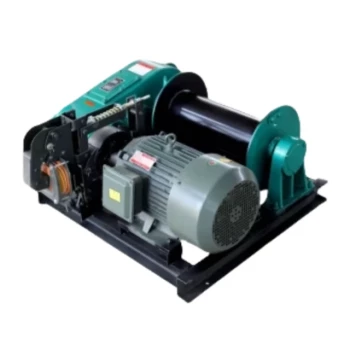
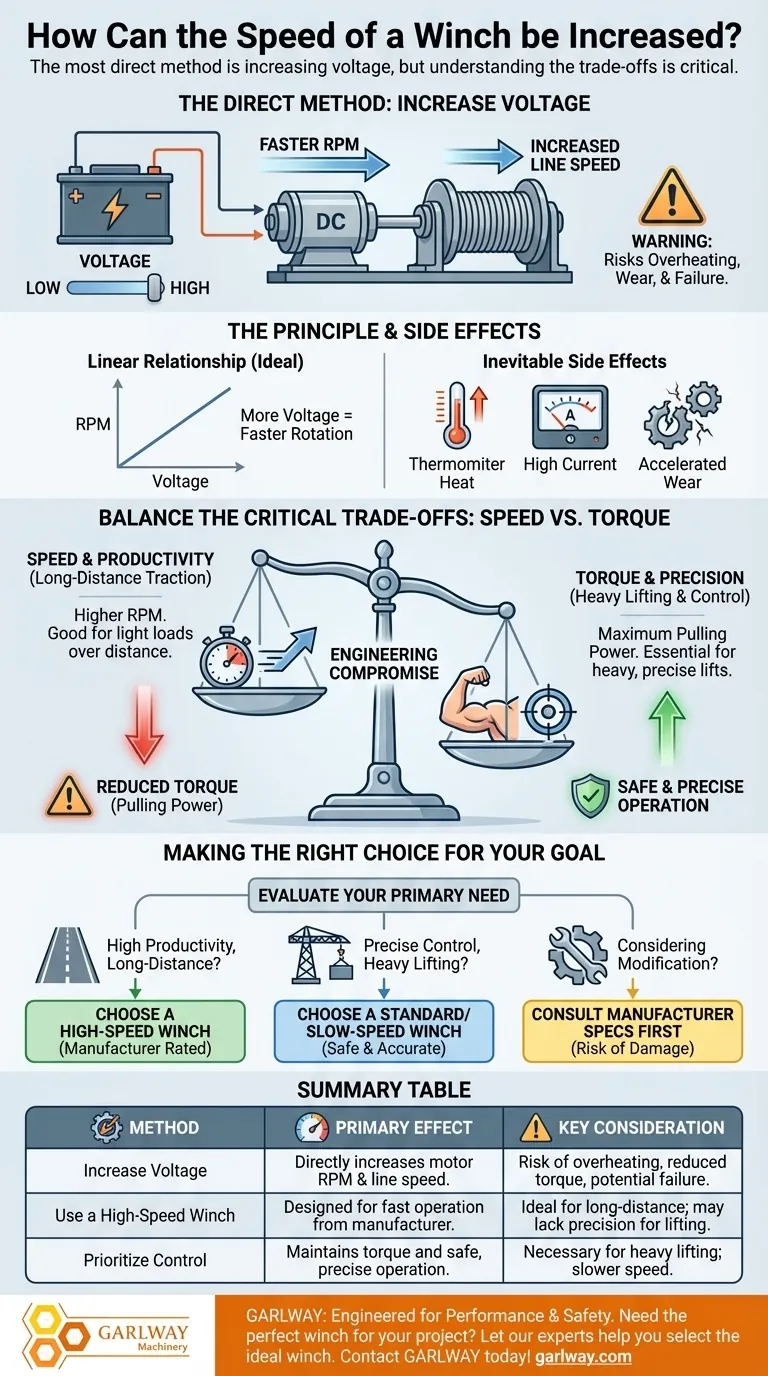
To be clear, the most direct method to increase the speed of a winch is by increasing the voltage supplied to its electric motor. A higher voltage causes the motor to spin faster, which in turn increases the line speed of the winch drum.
While increasing voltage is the direct answer, the critical insight is understanding the fundamental trade-off between speed, torque (pulling power), and control. Simply making a winch faster may compromise its ability to handle heavy loads or perform precise operations.
The Principle: How Voltage Governs Speed
The relationship between voltage and the speed of a DC motor, which is common in winches, is fundamentally linear. More electrical pressure (voltage) results in a faster rotation.
The Direct Electrical Impact
An electric motor's rotational speed is directly proportional to the voltage applied across its terminals. Doubling the voltage, in an ideal scenario without load, will nearly double the motor's revolutions per minute (RPM).
The Inevitable Side Effects
However, this modification does not happen in a vacuum. Increasing voltage will also affect the current draw and heat generation. Pushing a motor beyond its designed voltage specifications can lead to overheating, accelerated wear, and potential failure.
Understanding the Critical Trade-offs
Modifying a winch for speed is not just an electrical change; it's an engineering compromise. You must weigh the benefits of increased speed against potential downsides in power and safety.
Speed vs. Torque
Torque is the rotational force a winch can generate—its raw pulling power. Winch motors are designed to provide a specific amount of torque at a specific voltage. While increasing voltage boosts speed under light loads, it can reduce the motor's ability to generate the necessary torque to start pulling a very heavy load.
Productivity vs. Precision
The intended application is the most important factor. For long-distance pulling or traction, a fast-speed winch improves productivity and reduces energy consumption over time.
For construction or installation projects with short lifting distances and high accuracy requirements, a slow-speed winch is superior. Slower operation provides the control needed to position loads precisely and safely.
Modification vs. Component Failure
Using a winch motor outside of its manufacturer-specified voltage range is a significant risk. The internal windings, brushes, and bearings are all designed for a specific operational window. Exceeding this can quickly lead to component burnout and complete winch failure.
Making the Right Choice for Your Goal
Before attempting any modification, evaluate your primary need to ensure your solution aligns with your objective.
- If your primary focus is high productivity on long-distance pulls: Seek out a winch specifically designed and rated for high-speed operation from the manufacturer.
- If your primary focus is precise control and heavy lifting: A standard or slow-speed winch is the correct and safer tool for the job.
- If you are considering modifying an existing winch: Always consult the manufacturer's technical specifications first to understand its voltage limits and avoid causing irreversible damage.
Ultimately, selecting the right tool for the application is a more reliable strategy than modifying one beyond its intended purpose.
Summary Table:
| Method | Primary Effect | Key Consideration |
|---|---|---|
| Increase Voltage | Directly increases motor RPM and line speed. | Risk of overheating, reduced torque, and potential motor failure. |
| Use a High-Speed Winch | Designed for fast operation from the manufacturer. | Ideal for long-distance pulls; may lack precision for lifting. |
| Prioritize Control | Maintains torque and safe, precise operation. | Necessary for heavy lifting and installation; slower speed. |
Need the perfect winch for your project's speed and power requirements?
At GARLWAY, we specialize in engineering robust construction machinery, including winches, concrete mixers, and batching plants for contractors and construction companies worldwide. Don't compromise on performance or safety by modifying equipment beyond its limits.
Let our experts help you select the ideal winch tailored to your specific needs for optimal productivity and control.
Contact GARLWAY today for a consultation!
Visual Guide
Related Products
- Warn Winch Windlass Boat Trailer Winch
- Electric and Hydraulic Winch for Heavy Duty Applications
- Small Electric Winch 120V and 240V for Compact Applications
- 12000 lb Electric Boat Trailer Winch with Windlass Anchor Warn
- Quick Windlass Portable Winch for Truck and Boat Best Boat Winch
People Also Ask
- What are the main components of a boat trailer winch? A Guide to Safe & Efficient Boat Loading
- What factors should be considered when choosing a boat trailer winch? Ensure Safe and Effortless Boat Loading
- What is the purpose of boat trailer winches? Safely and Efficiently Load Your Boat
- What are the two main types of boat trailer winches? Manual vs. Electric Explained
- How often should a boat trailer winch be replaced? Your Guide to Safety and Longevity