Introduction
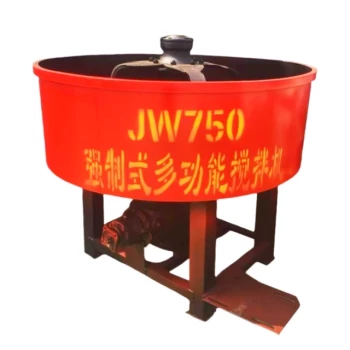
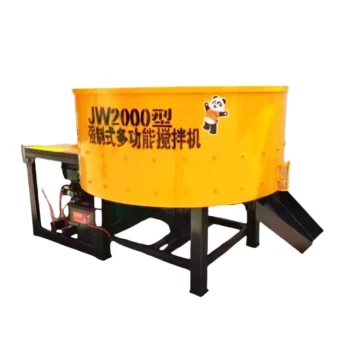
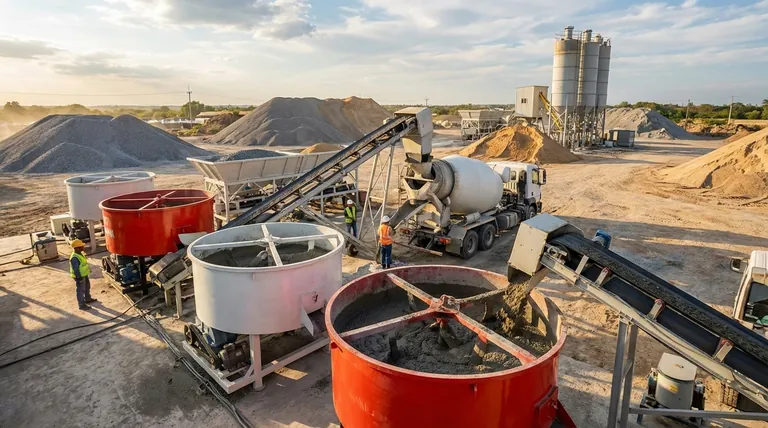
Forced mixers have become the undisputed leader in commercial concrete production, outperforming traditional self-falling mixers in efficiency, mix quality, and operational flexibility. This article examines the mechanical superiority of forced mixing technology, its economic impact on construction projects, and real-world validation from infrastructure megaprojects. Whether you're selecting equipment for high-strength applications or optimizing batching plant workflows, understanding these advantages ensures informed decision-making.
Mechanical Principles of Concrete Mixing Technologies
How Forced Mixers Achieve Superior Material Integration
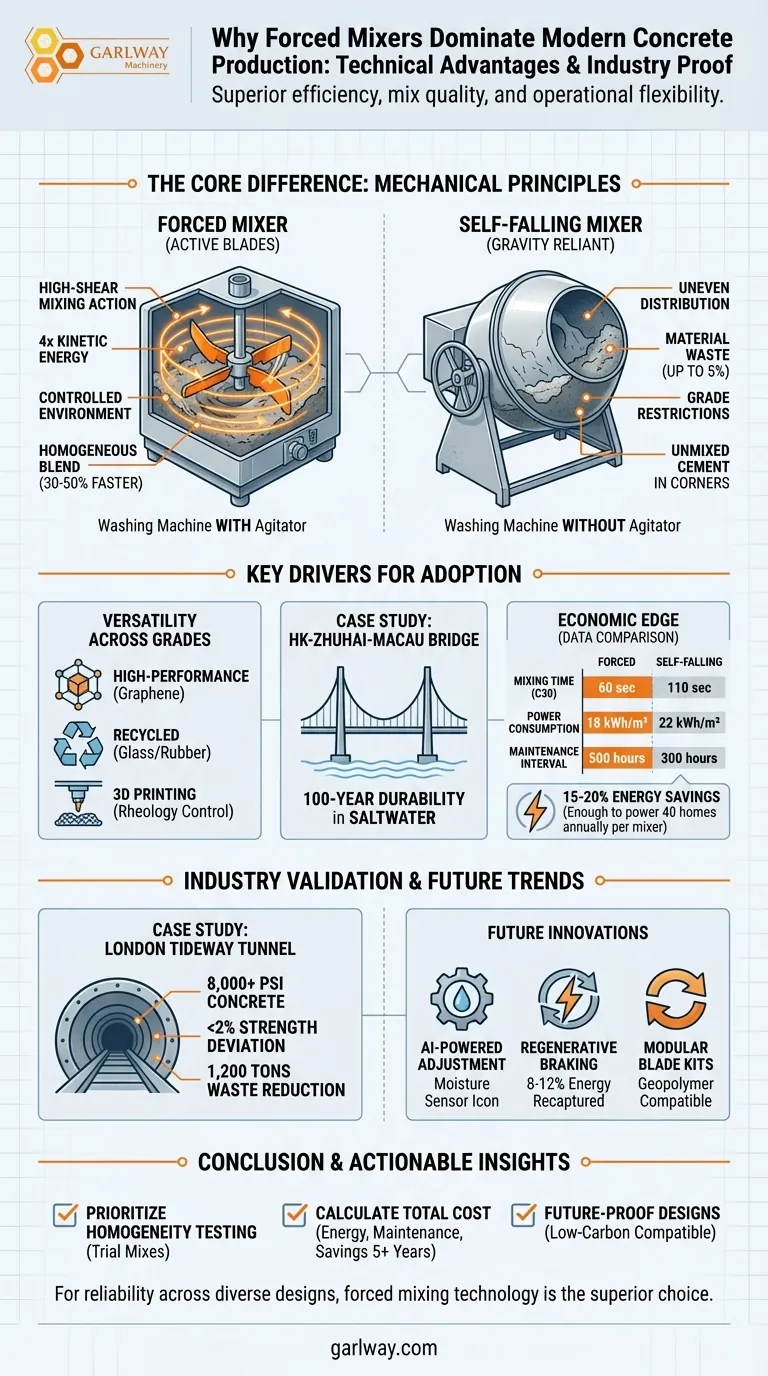
Forced mixers use rotating blades or paddles to actively push materials through a contained mixing chamber, creating a homogeneous blend in 30-50% less time than gravity-dependent systems. Key mechanisms include:
- High-Shear Mixing Action: Blades generate 4x greater kinetic energy than free-fall methods, breaking down cement clusters and ensuring even aggregate coating.
- Controlled Environment: Enclosed design prevents material segregation, critical for fiber-reinforced or self-compacting concrete.
- Adaptive Speed Settings: Variable RPM adjustments handle diverse mix designs—from stiff dry-cast to fluid SCC mixtures.
Ever wondered why precast manufacturers exclusively use forced mixers? The answer lies in their ability to maintain batch-to-batch consistency, where even minor variations can compromise structural integrity.
Limitations of Self-Falling Mixers in Modern Applications
While drum mixers suffice for basic residential concrete, they struggle with:
- Low Output Precision: Reliance on gravity causes uneven distribution of admixtures.
- Material Waste: Up to 5% cement remains unmixed in drum corners.
- Grade Restrictions: Ineffective for mixes exceeding C50 strength or containing silica fume.
A visual analogy: Self-falling mixers are like washing machines without agitators—some items get cleaned, others don’t.
Critical Factors Driving Forced Mixer Adoption
Versatility Across Concrete Grades and Construction Scenarios
From airport runways to earthquake-resistant bridges, forced mixers handle:
- High-Performance Concrete: Uniform dispersion of nano-additives like graphene.
- Recycled Materials: Efficient blending of crushed glass or rubber aggregates.
- 3D Printing Applications: Precise rheology control for layer adhesion.
Case in point: The Hong Kong-Zhuhai-Macau Bridge used forced mixers to achieve 100-year durability in saltwater environments.
Energy Efficiency and Operational Cost Comparisons
| Metric | Forced Mixer | Self-Falling Mixer |
|---|---|---|
| Mixing Time (C30) | 60 sec | 110 sec |
| Power Consumption | 18 kWh/m³ | 22 kWh/m³ |
| Maintenance Interval | 500 hours | 300 hours |
The 15-20% energy savings compound significantly in large-scale operations—enough to power 40 homes annually per mixer.
Industry Validation and Future Trends
Case Study: Forced Mixers in High-Strength Infrastructure Projects
London’s Tideway Tunnel project mandated mixers capable of:
- Producing 8,000+ psi concrete with <2% strength deviation
- Operating at 95% uptime in confined urban sites
- Integrating real-time moisture sensors
Forced mixers met all criteria while reducing waste by 1,200 tons compared to drum alternatives.
Innovations in Mixer Design for Sustainable Construction
Emerging advancements include:
- AI-Powered Batch Adjustment: Automatically compensates for aggregate moisture variations.
- Regenerative Braking Systems: Recaptures 8-12% of rotational energy.
- Modular Blade Kits: Swap configurations for geopolymer vs. traditional concrete.
Brands like Garlway now integrate these features into their construction machinery lines, aligning with global decarbonization goals.
Conclusion & Actionable Insights
Forced mixers aren’t just equipment—they’re precision instruments that determine concrete’s lifespan and structural performance. When evaluating options:
- Prioritize Homogeneity Testing: Request trial mixes measuring compressive strength variance.
- Calculate Total Cost: Factor in energy use, maintenance, and material savings over 5+ years.
- Future-Proof Designs: Opt for mixers compatible with low-carbon binders.
For operations requiring reliability across diverse mix designs, the industry’s shift toward forced mixing technology offers undeniable proof of its superiority.
Visual Guide
Related Products
- Portable Cement Mixer with Lift Concrete Machine
- Skid Steer Self Loading Concrete Mixers for Construction
- Harbor Freight JS1500 On Site Concrete Mixing Volumetric Cement Mixer
- Shaft Mixer Machine for Cement and Regular Concrete Mixing
- Ready Mixer Machine for Construction Ready Mix Machinery
Related Articles
- How to Transform Your Cement Mixer into a High-Performance Art Tool
- How Component Engineering Elevates Cement Mixer Performance for Small Projects
- How to Repurpose Your Cement Mixer for Ammunition, Farming, and DIY Projects
- How to Repurpose Cement Mixers for High-Efficiency Farm Material Processing
- How Cement Mixers Solve Industrial Derusting Challenges Safely and Efficiently