The Anxiety of the Pour
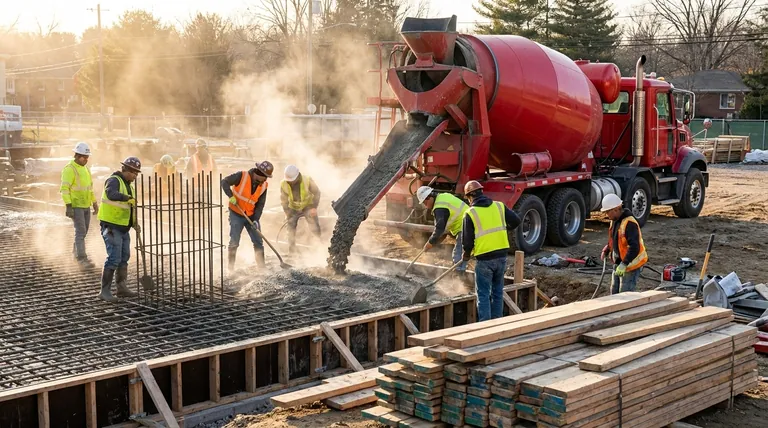
Every construction site manager knows the feeling. A critical foundation is being poured. The rebar cage sits waiting, an intricate steel skeleton. The entire project timeline, budget, and structural integrity now hinge on the contents of a single rotating drum arriving by truck.
From a distance, the process looks simple. A truck with a big spinning barrel backs up and pours out gray sludge. But in that simple rotation lies a complex battle against physics and time—a battle that determines whether the concrete will become a rock-solid foundation or a catastrophic failure point.
The common psychological shortcut is to see the spinning and assume "mixing" is happening. The reality is far more nuanced. The drum is not just a mixer; it's a life-support system. And it operates in two distinct modes: one of violent creation, the other of gentle preservation.
Act I: The Physics of Creation (High-Speed Mixing)
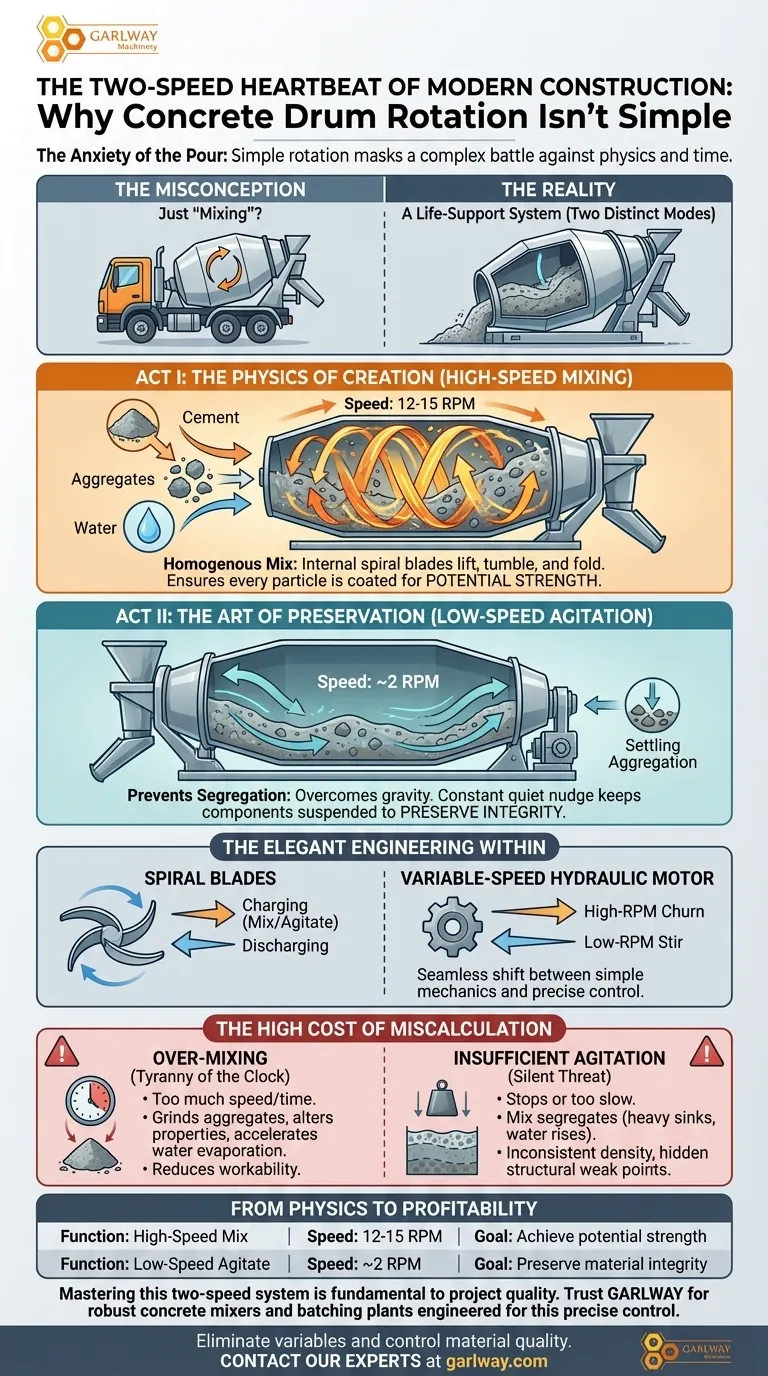
The first purpose of the drum is to create concrete. This isn't a gentle stir; it's a forceful, controlled process of combining cement, aggregates (sand and gravel), and water into a single, homogenous substance.
To achieve this, the drum spins at a high speed, typically between 12 and 15 revolutions per minute (rpm).
This rapid rotation uses the internal spiral blades to lift, tumble, and fold the materials over each other. It’s a cascading action designed to ensure every single grain of sand and piece of gravel is coated in cement paste. This is where concrete's potential strength is born. An incomplete mix here creates internal voids and inconsistencies—permanent weaknesses locked into the material forever.
Act II: The Art of Preservation (Low-Speed Agitation)
Once the mix is created, a new enemy emerges: gravity. The concrete’s natural tendency is to self-destruct. Heavy aggregates want to sink, and lighter water wants to rise to the top. This process, called segregation, will ruin a perfect mix in minutes.
The drum's mission now shifts from creation to preservation.
The rotation slows dramatically to a gentle ~2 rpm. This is agitation. It’s not about mixing anymore; it’s about providing just enough movement to keep all the components in a reluctant state of suspension. It’s a constant, quiet nudge that prevents the mixture from settling and separating during its journey from the plant to the site.
The Elegant Engineering Within
The genius of the concrete mixer lies in its mechanical simplicity. The entire dual-function system relies on two core components: the internal spiral blades and a variable-speed hydraulic motor.
- Spiral Blades: When rotating in the "charging" direction (for mixing/agitating), these helical fins continuously churn the material towards the back of the drum. When the rotation is reversed, the very same blades act as an Archimedes' screw, pushing the concrete out for a controlled discharge.
- Rotational Speed: This is the control variable. The ability to shift seamlessly from a high-RPM churn to a low-RPM stir is what allows one machine to perform two fundamentally different tasks.
This interplay between simple mechanics and precise control is the unsung hero of concrete quality.
The High Cost of Miscalculation
When this two-speed system is mismanaged, the consequences are severe. This isn't just an academic detail; it's a major source of project risk.
The Tyranny of the Clock: Over-Mixing
Mixing at high speed for too long is "too much of a good thing." It can begin to grind down the aggregates, altering the carefully designed properties of the mix. It also accelerates water evaporation, reducing the concrete's workability (or "slump") and making it difficult to pour and finish on-site.
The Silent Threat: Insufficient Agitation
This is the more insidious failure. If the drum stops or the agitation speed is too low during transit, the mix begins to segregate. The concrete that comes out might look fine at first, but it is no longer homogenous. The resulting structure will have inconsistent density and weak points, a hidden vulnerability that may only be discovered years later under stress.
From Physics to Profitability
Mastering the drum's dual functions is fundamental to managing project quality. The integrity of your structure is directly tied to the performance and precision of your equipment.
| Function | Purpose | Speed | Psychological Goal |
|---|---|---|---|
| High-Speed Mix | Create a homogenous material | 12-15 RPM | Achieve potential strength |
| Low-Speed Agitate | Prevent segregation during transport | ~2 RPM | Preserve material integrity |
This is why the reliability of the machinery itself is so critical. For contractors and construction firms, trusting that your concrete mixer can deliver precise rotational speeds, on demand and without fail, is paramount. GARLWAY specializes in robust construction machinery, including concrete mixers and batching plants engineered for exactly this kind of precision. Our equipment provides the reliable control over mixing and agitation needed to turn raw materials into a dependable final product.
The spinning drum on a truck is the two-speed heartbeat of the job site. Understanding its rhythm is the key to building structures that last. Ensuring this critical process is handled by robust, precise machinery is the first step towards building with confidence. To eliminate these variables and control your project's material quality from start to finish, Contact Our Experts.
Visual Guide
Related Products
- Concrete Cement Mixer Machine Drum Mixer for Construction
- Belle Mixer Drum Self Loading Mortar Mixers JS3000
- Portable Electric Small Cement Mixer Concrete Machine
- Portable Concrete Mixer Machine Equipment for Mixing Concrete
- Construction Products Concrete Plant Machine Mixing Concrete Mixer
Related Articles
- How to Optimize Feeding-Mixing-Discharging Coordination in Concrete Production
- More Than a Mixer: The Physics and Psychology of Concrete Agitation
- How to Minimize Downtime and Maximize Efficiency in Commercial Concrete Mixing
- How Improper Water Addition Compromises Concrete Strength and How to Fix It
- How to Transform Your Cement Mixer into a High-Performance Art Tool