The Anxiety of the Pour
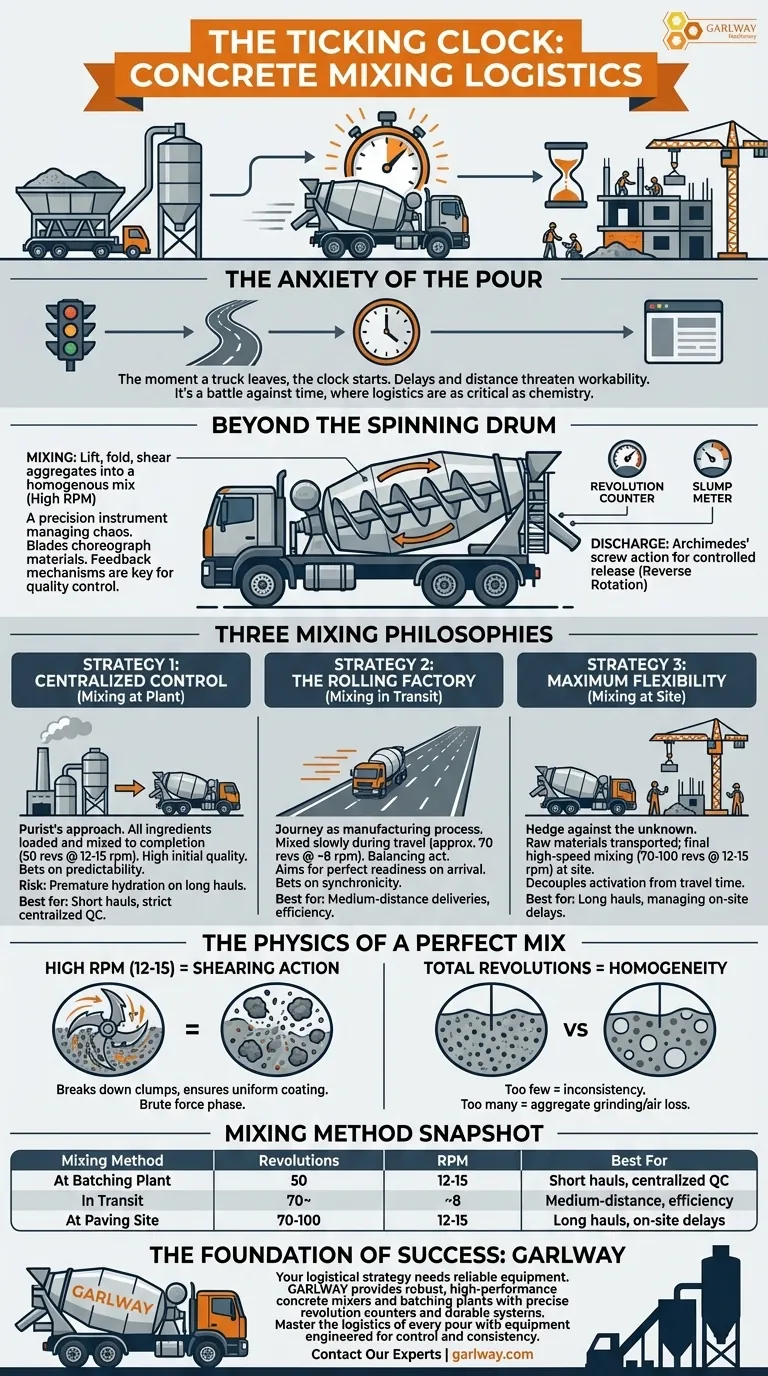
The moment a concrete truck leaves the batching plant, an invisible clock starts ticking.
Every traffic light, every unexpected delay, every minute the truck waits on-site tightens the window for a successful pour. Concrete is a perishable product. Its workability—its very lifeblood—is finite.
This is the central tension of every concrete project. It’s a battle against time, where the logistics of delivery are just as critical as the chemical formula of the mix itself. The decision of when to mix the concrete is not a minor detail; it is the core of your risk management strategy.
Beyond the Spinning Drum
We often see a truck mixer as just a large, spinning barrel. This misses the point. It is a precision instrument designed to manage chaos.
Inside the drum, helical blades are not just stirring; they are performing a complex choreography. Rotating one way, they lift, fold, and shear the aggregates, cement, and water into a homogenous, predictable material. Rotated the other way, they become an Archimedes' screw, discharging the finished product with control.
Modern mixers are equipped with revolution counters and slump meters for a reason. They are feedback mechanisms, providing data in a process where assumptions can lead to failure. The machine isn't just transporting material; it's a mobile quality control lab.
A System of Trade-offs: Three Mixing Philosophies
Choosing where to mix your concrete is less about following a rulebook and more about adopting a philosophy for managing your project's unique logistical challenges.
Strategy 1: Centralized Control (Mixing at the Plant)
This is the purist's approach. All materials are loaded and mixed to completion—typically 50 revolutions at a high speed (12-15 rpm)—in the controlled environment of the plant.
This strategy bets on predictability. It assumes a short, clear path from the plant to the pour. When it works, it provides the highest degree of initial quality control. But it also starts the hydration clock immediately, exposing the entire batch to the risk of any delay.
Strategy 2: The Rolling Factory (Mixing in Transit)
Here, the journey itself becomes part of the manufacturing process. The ingredients are loaded, and the drum rotates at a slower, methodical pace (~8 rpm) for about 70 revolutions during transit.
This is an act of calculated efficiency. It aims to have the concrete perfectly mixed the moment the truck arrives, balancing the risks of premature hydration against the need for readiness. It’s a bet on synchronicity between travel time and mixing time.
Strategy 3: Maximum Flexibility (Mixing at the Site)
This strategy is a hedge against the unknown. The raw materials are transported to the site with minimal agitation. Only upon arrival does the final, high-speed mixing (70-100 revolutions) begin.
This approach grants the on-site team maximum control over the concrete's workability. It decouples the concrete's "activation" from the uncertainties of travel. It is the preferred strategy when the haul is long or the site is prone to the small, cascading delays that can compromise a pour.
The Physics of a Perfect Mix
The numbers—50 revolutions, 12 rpm, 100 revolutions—are not arbitrary figures. They are distillations of physics and materials science.
- High RPM (12-15): This speed creates the powerful shearing action needed to break down clumps of cement and ensure every particle of sand and aggregate is coated in cement paste. This is the "brute force" phase of mixing.
- Total Revolutions: This ensures homogeneity. Too few, and you get inconsistent pockets of strength and weakness. Too many, and you risk grinding down the aggregates or losing essential entrained air, affecting durability.
The choice of method is about applying this physics at the most opportune moment.
| Mixing Method | Key Characteristic | Typical Revolutions | Typical RPM | Best For |
|---|---|---|---|---|
| At the Batching Plant | Mixed completely before departure | 50 | 12-15 | Short hauls, centralized quality control |
| In Transit | Mixed during travel to the site | 70 | ~8 | Medium-distance deliveries, efficiency |
| At the Paving Site | Mixed entirely upon arrival | 70-100 | 12-15 | Long hauls, managing on-site delays |
The Foundation of Success: The Right Machine for the Job
Your logistical strategy is only as strong as the equipment you rely on to execute it. Whether you demand centralized control at the plant or ultimate flexibility at the site, your success depends on a mixer that performs predictably, every single time.
A precise revolution counter is not a luxury; it is the guarantee that your mixing protocol was followed. A durable drum and blade system ensures that the physics of the mix are achieved consistently, batch after batch.
This is where GARLWAY provides the foundation for operational excellence. We build robust, high-performance concrete mixers and batching plants for contractors who understand that managing the ticking clock is everything. Our equipment is engineered not just to transport concrete, but to give you the control necessary to master the complex logistics of every pour.
When your entire project relies on the quality of that final material, you need machinery that is as serious about precision as you are.
Ready to ensure every pour meets your standards for quality and efficiency? Contact Our Experts
Visual Guide
Related Products
- Portable Concrete Mixer Machine Equipment for Mixing Concrete
- Construction Products Concrete Plant Machine Mixing Concrete Mixer
- Portable Electric Concrete Mixer Machine for Cement Mixing
- JZC400 Mobile Small Concrete Mixer Cement Mixer Machine
- Hydraulic Concrete Mixer Machine Cement Mixing Equipment for Mixture Concrete
Related Articles
- How to Diagnose and Prevent Sensor Resistance Failures in Concrete Mixing Equipment
- How to Build an OSHA-Compliant Safety System for Concrete Mixer Workspaces
- The Downtime Equation: How a Manufacturer's Support System Defines Your Concrete Mixer's True Cost
- How to Choose Concrete Mixers for Long-Term Reliability and Cost Savings
- How Concrete Composition Works: The Science Behind Stronger Structures