The Manager, The Generator, and The Silent Standstill
Imagine a construction site manager on a remote project. The foundation pour is scheduled for 9 a.m. The air is crisp, the crew is ready, but the site's only generator has just sputtered to a halt. His powerful, corded electric mixer sits idle—a perfect machine rendered useless by a single point of failure.
This scenario isn't about a broken generator. It’s a story about a hidden dependency.
The choice between an electric, gasoline, or diesel concrete mixer is rarely about which one spins a drum best. It's a strategic decision about the environment you work in and the kind of risks you're willing to accept. It's a choice between the tether and the titan.
The Electric Mixer: A Pact of Predictability
An electric concrete mixer operates on a simple, powerful promise: if you have a reliable power source, it will work. Flawlessly, quietly, and with zero emissions.
The Comfort of the Cord
Its greatest strength is its simplicity. There are no oil changes, no fuel runs, no spark plugs to foul. This makes it the undisputed champion of controlled environments—indoor renovations, basement work, or well-established residential sites where power is a given.
Its quiet, emission-free operation isn't a feature; it's a non-negotiable requirement for working in enclosed or poorly ventilated spaces.
The Hidden Vulnerability
But that cord is more than a power line; it's a tether. It dictates where you can work and anchors your productivity to the stability of the power grid. As our site manager discovered, this dependency is its fundamental limitation. The electric mixer thrives on certainty and falters in chaos.
The Combustion Engine: Embracing Autonomy
Combustion engines—gasoline and diesel—represent a deliberate break from the grid. They are machines built for the unpredictable reality of the open construction site. This freedom, however, comes with its own set of responsibilities.
The Agile Workhorse: Gasoline Engines
A gasoline-powered mixer is the versatile generalist. It balances robust power with manageable weight, making it the go-to for small-to-medium outdoor projects where mobility is key.
Think of it as the adaptable freelancer of mixers. It can be moved easily from a garden patio project to a fence line repair, asking only for a can of fuel in return for its complete locational freedom.
The Enduring Titan: Diesel Engines
Diesel engines are not just more powerful; they operate on a different principle. They are built for torque and endurance. Found on larger-capacity mixers (350L-500L), they are designed for the relentless, high-volume demands of large-scale construction.
Their fuel efficiency isn't a minor perk; it's a critical economic factor on remote sites where every hour of operation counts. A diesel engine is a commitment to industrial-scale work, where sustained power and long-term operating cost outweigh all other concerns.
The Real Decision Matrix: Environment, Rhythm, and Responsibility
Choosing the right power source means looking past the spec sheet and analyzing the physics and psychology of your worksite.
The Environment is the Real Boss
- Constraint: The physical space dictates the tool. The exhaust fumes from a gasoline or diesel engine make them unusable indoors. This isn't a preference; it's a hard line drawn by safety.
- Choice: An electric mixer is the only option for interior work. A combustion engine is designed for the open air.
The Rhythm of the Work
- Constraint: The project's tempo demands a matching power source. Small, intermittent batches have different needs than a continuous, day-long pour.
- Choice: Electric mixers are perfect for stop-and-go tasks. Diesel mixers are built to match the relentless rhythm of a major foundation pour, running for hours without complaint. Gasoline models sit comfortably in between.
The Burden of Self-Sufficiency
- Constraint: Autonomy requires maintenance. An electric motor is largely a "plug-and-play" device. A combustion engine is a relationship that requires fuel, oil, and regular service.
- Choice: This is the trade-off for freedom. You accept the responsibility of maintenance in exchange for the ability to work anywhere, anytime.
A Strategic Overview
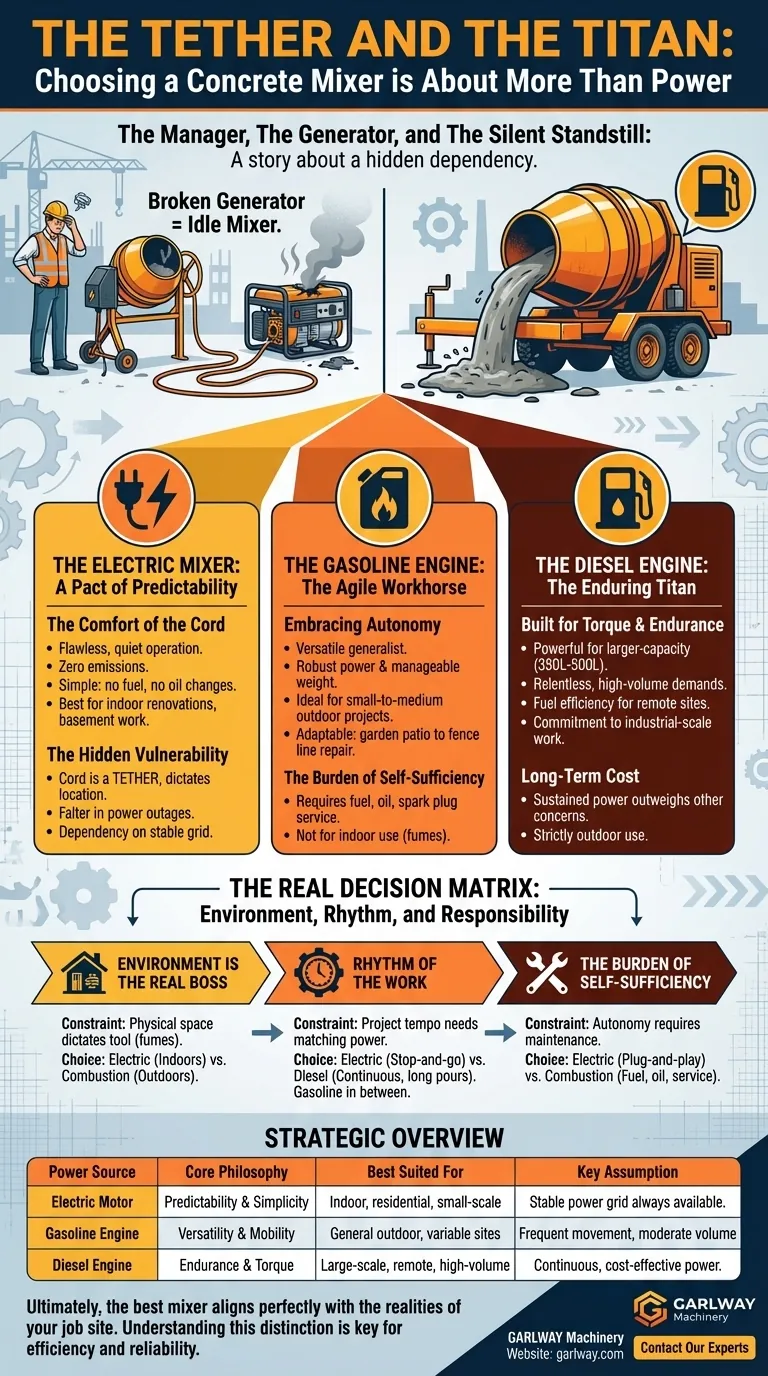
| Power Source | Core Philosophy | Best Suited For... | Key Assumption |
|---|---|---|---|
| Electric Motor | Predictability & Simplicity | Indoor, residential, or small-scale work | A stable power grid is always available. |
| Gasoline Engine | Versatility & Mobility | General outdoor construction, variable sites | Frequent movement and moderate volume are the norm. |
| Diesel Engine | Endurance & Torque | Large-scale, remote, high-volume jobs | The project demands continuous, cost-effective power. |
Ultimately, the best concrete mixer isn't the most powerful one. It's the one whose core design philosophy aligns perfectly with the realities of your job site. Understanding this distinction is the key to ensuring every project runs not just efficiently, but reliably.
At GARLWAY, we provide a comprehensive range of construction machinery designed for the specific demands of contractors worldwide. We understand that choosing between the tether and the titan is a critical business decision. Let us help you select the precise concrete mixer that fits your project's unique operational needs. Contact Our Experts
Visual Guide
Related Products
- Portable Concrete Mixer Machine Equipment for Mixing Concrete
- Construction Products Concrete Plant Machine Mixing Concrete Mixer
- Portable Electric Concrete Mixer Machine for Cement Mixing
- JZC400 Mobile Small Concrete Mixer Cement Mixer Machine
- Hydraulic Concrete Mixer Machine Cement Mixing Equipment for Mixture Concrete
Related Articles
- How to Diagnose and Prevent Sensor Resistance Failures in Concrete Mixing Equipment
- How to Build an OSHA-Compliant Safety System for Concrete Mixer Workspaces
- The Downtime Equation: How a Manufacturer's Support System Defines Your Concrete Mixer's True Cost
- How to Choose Concrete Mixers for Long-Term Reliability and Cost Savings
- How Concrete Composition Works: The Science Behind Stronger Structures