The Anatomy of a Bottleneck
A plant manager invests in a powerful new twin-shaft mixer, the centerpiece of his upgraded production line. But within weeks, he notices a problem. The line halts intermittently. Cycle times are inconsistent. The shiny new machine, designed for high output, has become the bottleneck.
The mistake wasn't in choosing the wrong mixer size or power. The mistake was in seeing the mixer as a single object, not a system.
A mixer’s performance isn't defined by its motor or its capacity. It's defined by three interconnected configuration choices: how materials get in, how they get out, and how the machine is kept alive. These decisions are a reflection of a company's operational philosophy—a choice between managing daily tasks and designing a self-sustaining system.
The Rhythm of Production: Feeding Systems
The feeding system dictates the pulse of your entire operation. It's the first decision that separates a manual-batch process from a continuous-flow factory.
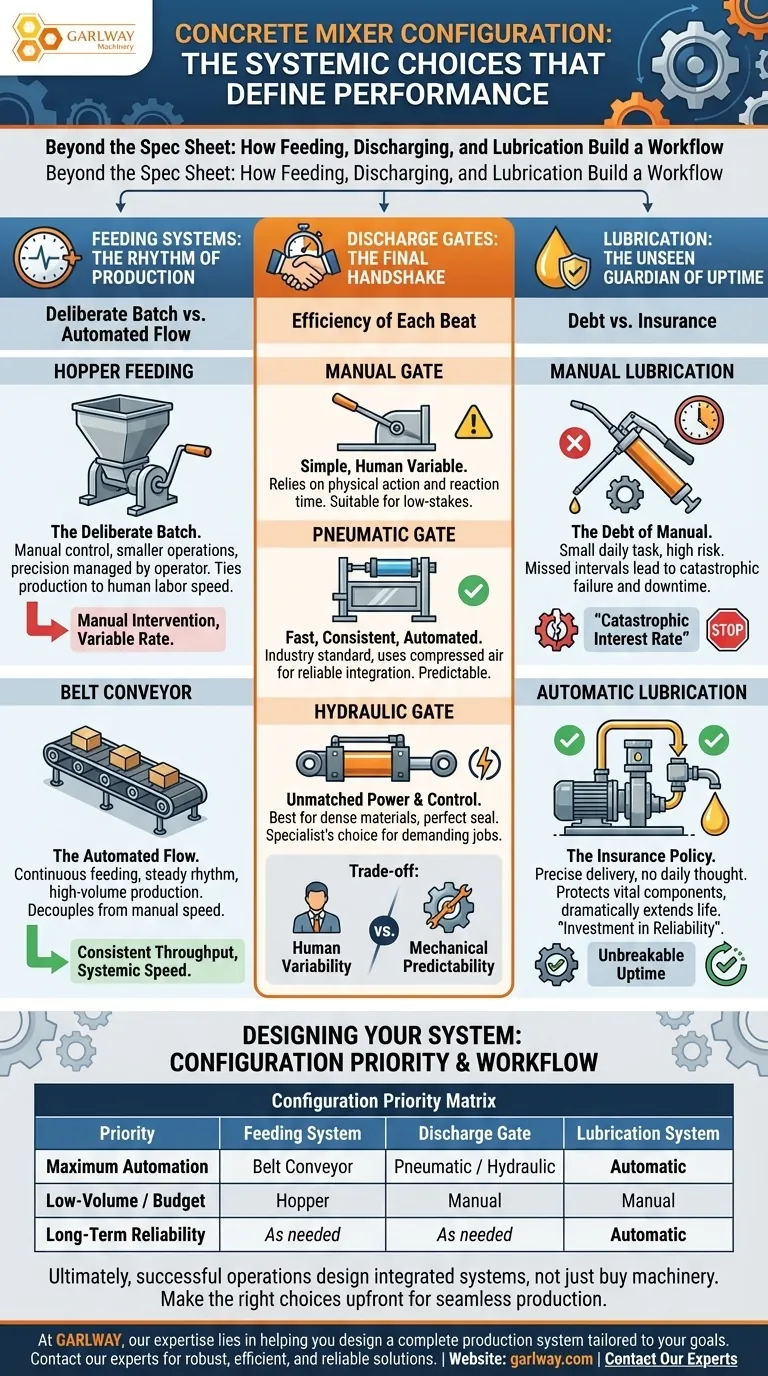
Hopper Feeding: The Deliberate Batch
A hopper is simple. An operator or loader deposits a pre-measured batch of materials. It is an act of deliberate, manual control.
This method is perfect for smaller, non-continuous operations where precision is managed by the operator, not the clock. The psychological appeal is its simplicity and low upfront cost. But it fundamentally ties your production rate to the speed and availability of human labor.
Belt Conveyor: The Automated Flow
A belt conveyor transforms the mixer into a component within a larger, automated organism. It feeds materials continuously, creating a steady, predictable rhythm.
This isn't just about speed; it's about consistency. It decouples production from manual intervention, allowing the system to achieve a throughput that no team of operators could ever match. Choosing a conveyor is a commitment to high-volume, systematic production.
The Final Handshake: Discharge Gates
If feeding sets the rhythm, the discharge gate determines the efficiency of each beat. It's the point where the mixer completes its task and hands off the product to the next stage.
Manual vs. Automated Gates
-
Manual Gate: Operated by a lever, it relies on an operator's physical action. It's the simplest mechanism, but introduces a variable: human reaction time. For low-stakes applications, this is acceptable.
-
Pneumatic Gate: Using compressed air, this system offers a fast, consistent, and automated "handshake." It's the industry standard for a reason—it's reliable and integrates seamlessly into a central control system.
-
Hydraulic Gate: When the material is exceptionally dense or the seal must be perfect, hydraulics provide unmatched power and control. It's the specialist's choice for the most demanding jobs.
The choice is a trade-off between human variability and mechanical predictability. In a high-volume plant, shaving a few seconds off every cycle through automation translates into significant output gains over a year.
The Unseen Guardian of Uptime: Lubrication
This is the most critical decision, and the one most often guided by a dangerous cognitive bias: we systematically overvalue immediate savings and undervalue future risk.
The Debt of Manual Lubrication
Choosing manual lubrication is like taking on a small, daily debt. A technician must apply grease to bearings and seals at precise intervals. It seems minor.
But this debt has a catastrophic interest rate. A missed interval, an incorrect amount of grease, a new technician who wasn't trained properly—these small moments of human error are inevitable. When a critical bearing seizes from lack of lubrication, the entire production line stops. The cost of downtime and emergency repairs will always dwarf the initial savings of forgoing an automated system.
The Insurance of Automatic Lubrication
An automatic lubrication system is an insurance policy against human error and unplanned downtime. It uses a pump to deliver the exact amount of lubricant to every critical point, precisely when needed.
It requires no daily thought. It protects the most vital—and expensive—components of your machine, dramatically extending their life. This isn't a feature; it is a strategic decision to invest in reliability. It is the defining characteristic of a professional-grade operation that prioritizes long-term resilience over short-term cost.
Designing Your System, Not Just Buying a Mixer
The configuration of your mixer is a blueprint for your operational reality. Each choice—feeding, discharging, lubrication—builds upon the others to create a workflow that either enhances or restricts your plant's potential.
| Configuration Priority | Feeding System | Discharge Gate | Lubrication System |
|---|---|---|---|
| Maximum Automation | Belt Conveyor | Pneumatic/Hydraulic | Automatic |
| Low-Volume / Budget | Hopper | Manual | Manual |
| Long-Term Reliability | As needed | As needed | Automatic |
Ultimately, the most successful operations are run by teams who understand they aren't just buying machinery; they are designing integrated systems. Making the right choices upfront is the difference between fighting fires and achieving seamless production.
At GARLWAY, our expertise lies in helping you design a complete production system tailored to your goals. We understand that the true value of a mixer lies in how its configuration supports your entire workflow. To build a system that is robust, efficient, and reliable for years to come, Contact Our Experts.
Visual Guide
Related Products
- Portable Concrete Mixer Machine Equipment for Mixing Concrete
- Construction Products Concrete Plant Machine Mixing Concrete Mixer
- Portable Electric Concrete Mixer Machine for Cement Mixing
- JZC400 Mobile Small Concrete Mixer Cement Mixer Machine
- Hydraulic Concrete Mixer Machine Cement Mixing Equipment for Mixture Concrete
Related Articles
- How to Diagnose and Prevent Sensor Resistance Failures in Concrete Mixing Equipment
- How to Build an OSHA-Compliant Safety System for Concrete Mixer Workspaces
- The Downtime Equation: How a Manufacturer's Support System Defines Your Concrete Mixer's True Cost
- How to Choose Concrete Mixers for Long-Term Reliability and Cost Savings
- How Concrete Composition Works: The Science Behind Stronger Structures