The human brain loves a single, dominant metric. We see it in car horsepower, camera megapixels, and processor speeds. In construction, that number is often the concrete mixer's output: cubic meters per hour (m³/h). It’s a powerful, simple figure that promises speed and efficiency.
But this focus is a cognitive trap. It mistakes the capacity of a single component for the capability of the entire system. A mixer's true value isn't its peak theoretical output, but how seamlessly it integrates into the messy, unpredictable reality of a construction site.
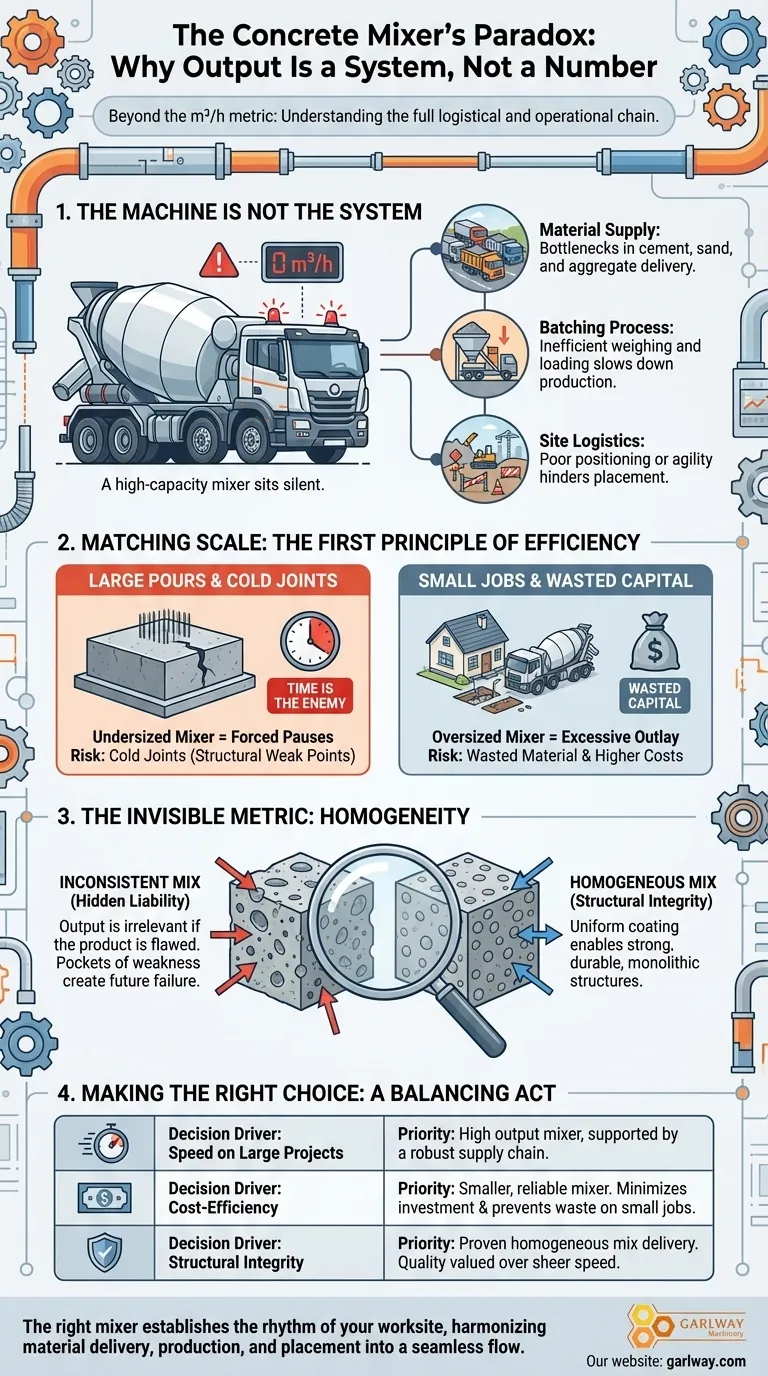
The Machine Is Not the System
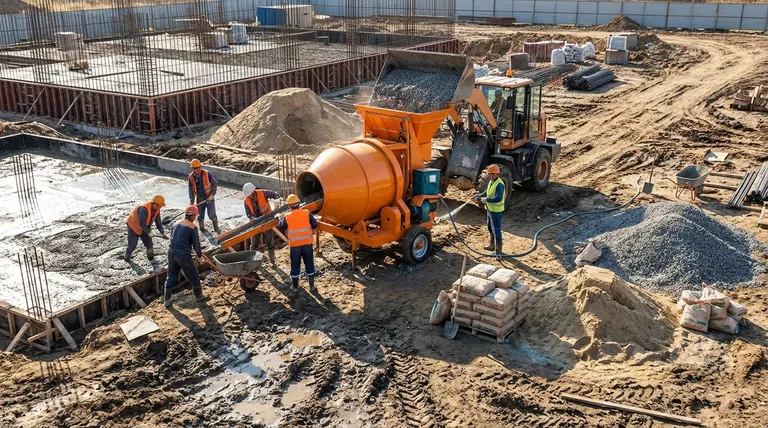
Imagine a site foreman, watching his crew lean on their shovels. The brand new, high-capacity mixer—the one that promised to accelerate the project timeline—sits silent. Why? The aggregate delivery is stuck in traffic, and the on-site storage can't buffer the demand.
This scene plays out every day. A mixer's output number is a promise, but the logistical chain is what allows that promise to be kept.
- Material Supply: Can your supply chain for cement, sand, and aggregate consistently feed the machine at its stated capacity? Any bottleneck here renders the mixer's power irrelevant.
- Batching Process: Is the process of weighing and loading materials efficient enough to keep pace? A slow batching plant turns a high-speed mixer into an expensive waiting game.
- Site Logistics: Can the mixer be positioned effectively? On complex sites, the agility of a mobile mixer can contribute more to project velocity than raw output alone.
Thinking about output without considering the system is like owning a race car but having no fuel. The potential is there, but the performance is zero.
Matching Scale: The First Principle of Efficiency
The most fundamental decision is aligning the mixer's capacity with the project's true demand. This isn't just about avoiding waste; it's about respecting the physics and economics of concrete.
Large Pours and the Threat of the Cold Joint
For massive foundations or continuous vertical builds, a high-output mixer is non-negotiable. Here, the primary enemy is time.
Concrete waits for no one. When a fresh pour meets concrete that has already begun to harden, it creates a "cold joint"—a structural weak point that can compromise the integrity of the entire build. An undersized mixer creates forced pauses, making cold joints an almost certainty. It's a critical failure that stems from a single procurement error.
Small Jobs and the Ghost of Wasted Capital
Conversely, using a high-capacity mixer for a small residential repair or landscaping job is a quiet financial disaster.
The initial capital outlay is excessive. The operational costs are higher. And worst of all, you risk wasting material, as a large batch may expire before your small crew can possibly place it. It’s the equivalent of using a sledgehammer to crack a nut—it works, but the cost and inefficiency are immense.
The Invisible Metric: Homogeneity
Even if the volume is right and the logistics are smooth, there is a deeper measure of performance: the quality of the mix itself.
The goal of any mixer is to produce a homogeneous batch, where every grain of sand and piece of aggregate is uniformly coated in cement paste. This uniformity is what allows the chemical reactions of hydration to create a strong, durable, monolithic structure.
An inconsistent mix is a hidden liability. It contains pockets of weakness that won't be visible until long after the project is complete, when cracks appear or the surface begins to fail under stress. Output is irrelevant if the product itself is flawed.
Making the Right Choice: A Balancing Act
Choosing a mixer isn't about finding the biggest number. It's about honestly assessing your project's unique constraints and priorities.
| Decision Driver | Your Priority Should Be... |
|---|---|
| Speed on Large Projects | A mixer with a high output, supported by a robust and verified material supply chain. |
| Cost-Efficiency | A smaller, reliable mixer that minimizes upfront investment and prevents material waste on intermittent or small-scale jobs. |
| Structural Integrity | A mixer proven to deliver a verifiably homogeneous mix, where quality is valued even more than sheer speed. |
The right concrete mixer doesn't just produce concrete; it establishes the rhythm of your entire worksite, harmonizing material delivery, production, and placement into a seamless flow. It’s this operational harmony, not a spec sheet number, that defines a successful project.
At GARLWAY, we understand that construction machinery is part of a larger system. Our range of concrete mixers and batching plants is designed to meet the real-world demands of contractors, ensuring your equipment is a solution, not a bottleneck. Let us help you find the perfect rhythm for your next project. Contact Our Experts
Visual Guide
Related Products
- Portable Concrete Mixer Machine Equipment for Mixing Concrete
- Construction Products Concrete Plant Machine Mixing Concrete Mixer
- Portable Electric Concrete Mixer Machine for Cement Mixing
- JZC400 Mobile Small Concrete Mixer Cement Mixer Machine
- Hydraulic Concrete Mixer Machine Cement Mixing Equipment for Mixture Concrete
Related Articles
- How to Diagnose and Prevent Sensor Resistance Failures in Concrete Mixing Equipment
- How to Build an OSHA-Compliant Safety System for Concrete Mixer Workspaces
- The Downtime Equation: How a Manufacturer's Support System Defines Your Concrete Mixer's True Cost
- How to Choose Concrete Mixers for Long-Term Reliability and Cost Savings
- How Concrete Composition Works: The Science Behind Stronger Structures