The Allure of Overkill
There's a psychological pull toward the biggest, most powerful tool. We equate size with capability and complexity with sophistication. On a construction site, this often translates to a belief that a larger, more industrial mixer is inherently better, regardless of the task at hand.
This is a cognitive trap. The most significant, yet often unseen, cost on any project is the cost of a mismatch. Using a tool that is too large for the job creates inefficiency, wastes capital, and complicates logistics. True expertise isn't about having the most powerful equipment; it's about deploying the right equipment.
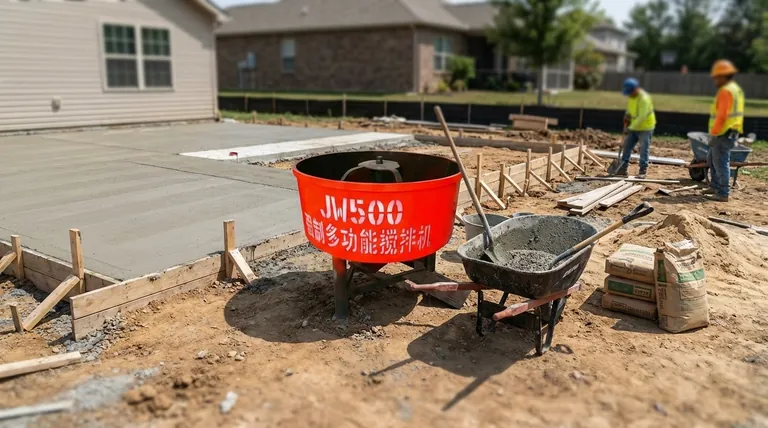
For small to medium-scale projects—the patios, foundations, and walkways that are the lifeblood of many contractors—the ideal tool is rarely the largest one.
The Elegant Simplicity of the Drum Mixer
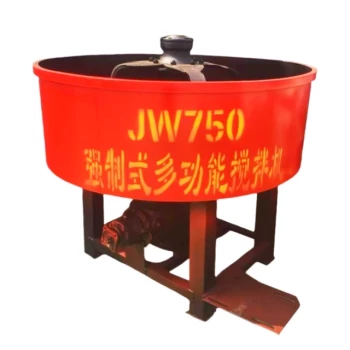
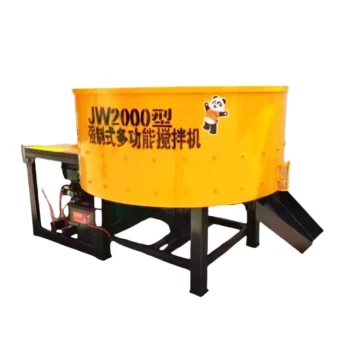
The drum concrete mixer is a testament to focused engineering. Its design is brutally simple and effective: a rotating drum with internal paddles continuously lifts and drops the aggregate, sand, and cement, folding them into a homogenous mixture. This simplicity is not a compromise; it's a strategic advantage.
A Design Forged by Focus
A machine with fewer moving parts has fewer points of failure. The straightforward mechanics of a drum mixer mean it is exceptionally durable and reliable. There is an elegance to this. It’s a tool designed to do one job perfectly, without the operational burden of more complex systems. It’s built for the field, not the workshop.
The Economics of Simplicity
The simple design leads directly to a lower initial investment and significantly reduced maintenance costs. For a business, this isn't just about saving money; it's about a smarter allocation of capital. Less downtime for repairs and minimal upkeep mean the machine is a productive asset, not a recurring liability.
Mobility as a Strategic Advantage
Small job sites are often constrained. A massive piece of equipment is an obstacle. Most drum mixers, however, are designed for portability. Their ability to be easily moved around a site is a critical feature, allowing for pours exactly where they are needed and adapting to the project's flow.
Sizing the Solution: It's a Numbers Game
Choosing the right mixer requires a clear-eyed assessment of the project's actual demands.
Finding the Sweet Spot: Capacity and Control
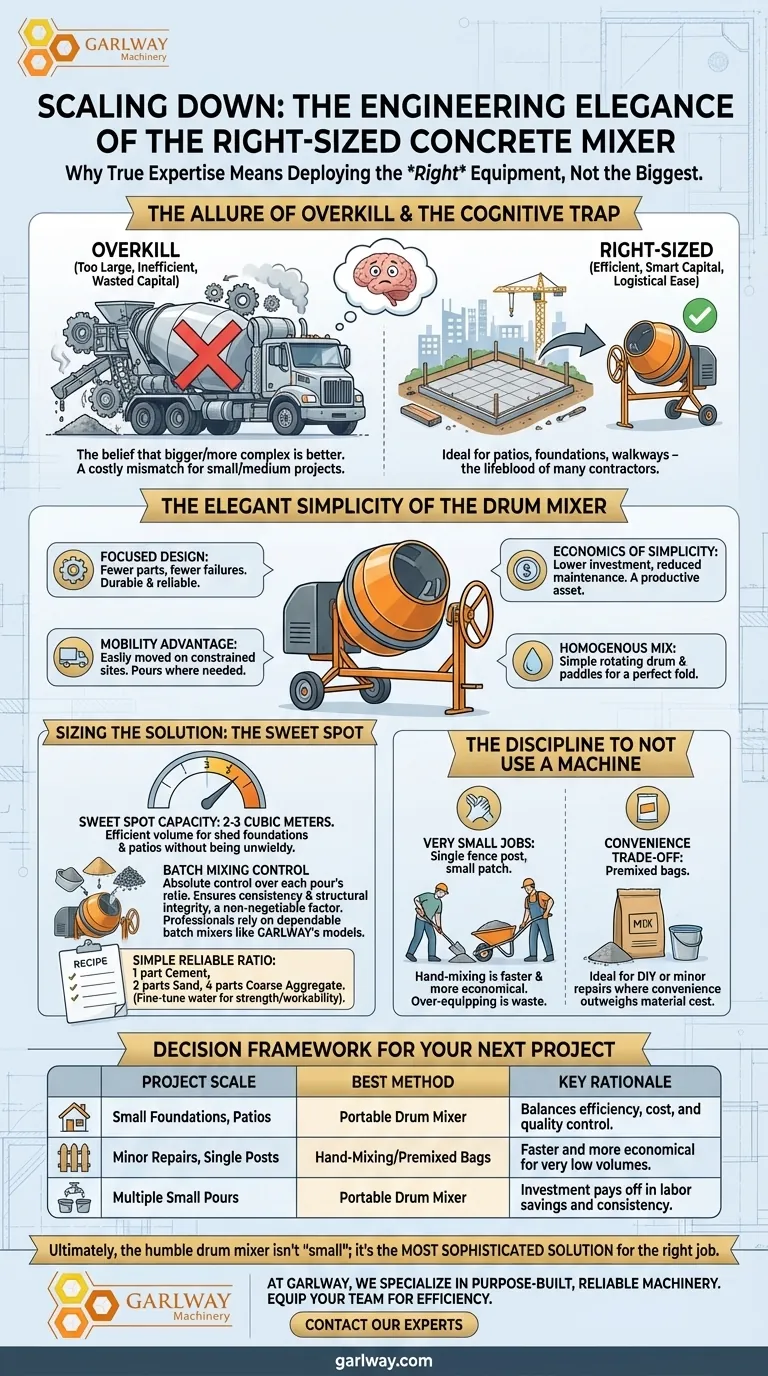
For most small-scale pours, a mixer capacity of 2 to 3 cubic meters is the sweet spot. This provides enough volume to complete tasks like shed foundations or patios efficiently without being unwieldy.
Critically, drum mixers are batch mixers. This provides absolute control over the mix for each pour. You load the precise ratio of materials for one batch at a time, ensuring consistency and strength—a non-negotiable factor when structural integrity is on the line. This level of control is why professionals rely on dependable batch mixers, like the durable and efficient models offered by GARLWAY, for projects where every detail matters.
A Simple, Reliable Ratio
For most general applications, a standard mix provides excellent results:
- 1 part cement
- 2 parts sand
- 4 parts coarse aggregate
The water-to-cement ratio is key. Less water yields stronger concrete, but it becomes more difficult to work with. Batch mixing allows you to fine-tune this for each specific application.
The Discipline to Not Use a Machine
The most experienced professionals understand a crucial principle: sometimes the best tool is no tool at all. Knowing when to forgo a machine is as important as knowing which one to choose.
When a Wheelbarrow is the Superior Tool
Is the task setting a single fence post? Patching a small crack? In these scenarios, the time spent setting up, powering, and cleaning a mechanical mixer is pure inefficiency. Hand-mixing in a wheelbarrow is faster, more economical, and perfectly adequate for the job. Over-equipping is a form of waste.
The Trade-off of Convenience
Premixed concrete bags, which only require water, are another alternative. They are ideal for DIY users or for very small repairs where convenience outweighs the higher material cost. They eliminate the need to store raw materials and get the ratios right, but they are not economical for anything larger than a minor patch.
A Decision Framework for Your Next Project
Making the right choice comes down to matching the method to the volume.
| Project Scale | Best Method | Key Rationale |
|---|---|---|
| Small Foundations, Patios | Portable Drum Mixer | Balances efficiency, cost, and quality control. |
| Minor Repairs, Single Posts | Hand-Mixing/Premixed Bags | Faster and more economical for very low volumes. |
| Multiple Small Pours | Portable Drum Mixer | Investment pays off in labor savings and consistency. |
Ultimately, the goal is not just to mix concrete; it is to complete a project efficiently and effectively. The humble drum mixer isn't just a "small" tool; for the right job, it is the most sophisticated solution because it perfectly aligns with the project's real-world needs.
At GARLWAY, we specialize in providing this kind of purpose-built, reliable machinery for contractors who understand the value of a perfect fit. If you're ready to equip your team with a tool that enhances efficiency rather than hindering it, Contact Our Experts.
Visual Guide
Related Products
- Portable Concrete Mixer Machine Equipment for Mixing Concrete
- Construction Products Concrete Plant Machine Mixing Concrete Mixer
- Portable Electric Concrete Mixer Machine for Cement Mixing
- JZC400 Mobile Small Concrete Mixer Cement Mixer Machine
- Hydraulic Concrete Mixer Machine Cement Mixing Equipment for Mixture Concrete
Related Articles
- How to Diagnose and Prevent Sensor Resistance Failures in Concrete Mixing Equipment
- How to Build an OSHA-Compliant Safety System for Concrete Mixer Workspaces
- The Downtime Equation: How a Manufacturer's Support System Defines Your Concrete Mixer's True Cost
- How to Choose Concrete Mixers for Long-Term Reliability and Cost Savings
- How Concrete Composition Works: The Science Behind Stronger Structures