Construction professionals know hoist failures carry devastating consequences—from costly downtime to life-threatening accidents. Yet most safety programs remain reactive, relying on generic checklists rather than engineered risk mitigation. This guide transforms hoist inspections from compliance formalities into predictive safeguards by merging mechanical science with operational testing protocols.
Hoist Safety as Systemic Risk Management
True hoist safety starts by treating every component as part of an interdependent system. Isolated part inspections miss critical failure pathways.
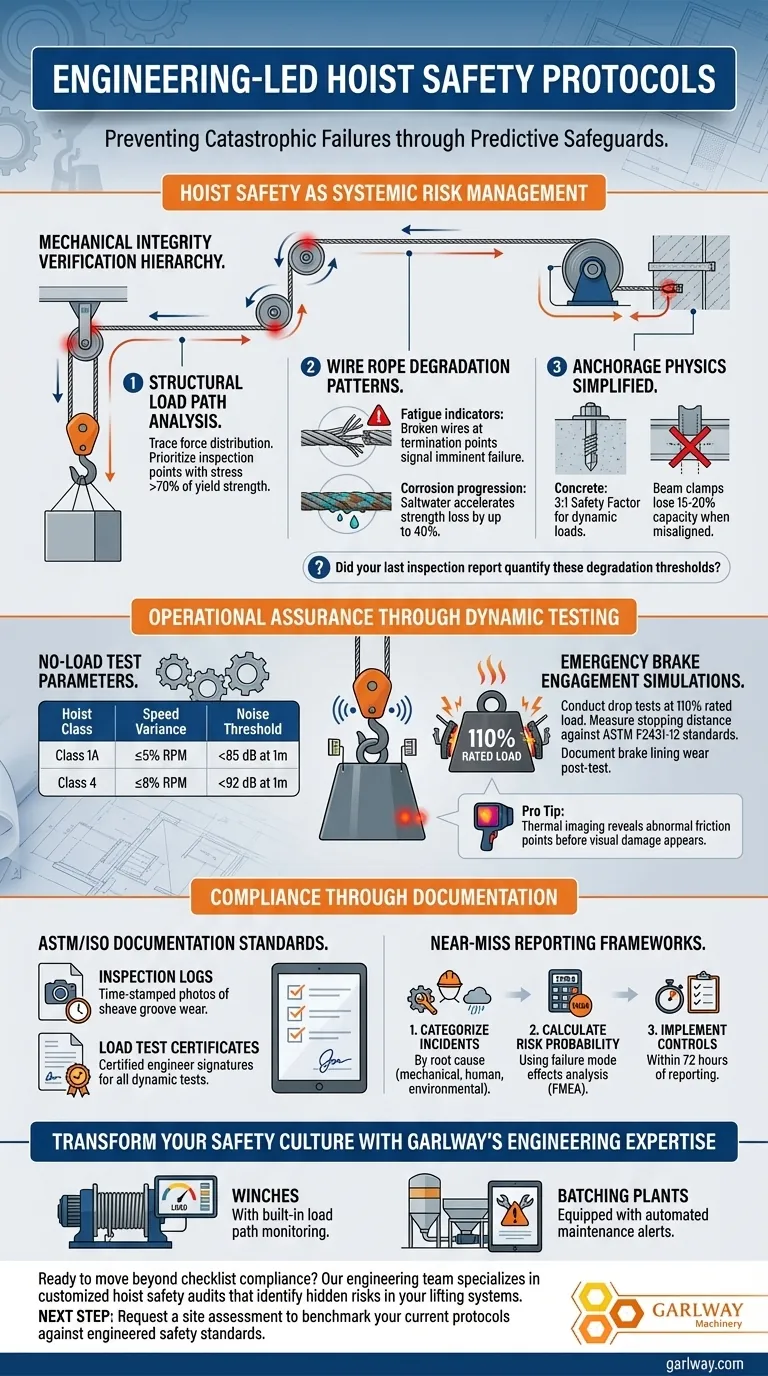
Mechanical Integrity Verification Hierarchy
-
Structural Load Path Analysis
- Trace force distribution from hook to anchorage
- Prioritize inspection points where stress concentrations exceed 70% of yield strength
-
Wire Rope Degradation Patterns
- Fatigue indicators: Broken wires at termination points signal imminent failure
- Corrosion progression: Saltwater environments accelerate strength loss by up to 40%
-
Anchorage Physics Simplified
- Concrete anchorage requires 3:1 safety factor for dynamic loads
- Beam clamps lose 15-20% capacity when misaligned
Did your last inspection report quantify these degradation thresholds?
Operational Assurance Through Dynamic Testing
Paperwork compliance means nothing without real-world validation.
No-Load Test Parameters
| Hoist Class | Speed Variance Allowance | Noise Threshold |
|---|---|---|
| Class 1A | ≤5% RPM fluctuation | <85 dB at 1m |
| Class 4 | ≤8% RPM fluctuation | <92 dB at 1m |
Emergency Brake Engagement Simulations
- Conduct drop tests at 110% rated load
- Measure stopping distance against ASTM F2431-12 standards
- Document brake lining wear patterns post-test
Pro Tip: Thermal imaging during testing reveals abnormal friction points before visual damage appears.
Compliance Through Documentation
Regulatory paperwork becomes actionable intelligence when structured correctly.
ASTM/ISO Documentation Standards
- Inspection logs: Time-stamped photos of sheave groove wear
- Load test certificates: Certified engineer signatures for all dynamic tests
Near-Miss Reporting Frameworks
- Categorize incidents by root cause (mechanical, human, environmental)
- Calculate risk probability using failure mode effects analysis (FMEA)
- Implement controls within 72 hours of reporting
Transform Your Safety Culture With GARLWAY’s Engineering Expertise
While protocols provide structure, consistent execution requires the right tools. GARLWAY’s construction machinery integrates inspection-ready features like:
- Winches with built-in load path monitoring
- Batching plants equipped with automated maintenance alerts
Ready to move beyond checklist compliance? Our engineering team specializes in customized hoist safety audits that identify hidden risks in your lifting systems.
Next Step: Request a site assessment to benchmark your current protocols against engineered safety standards.
Visual Guide
Related Products
- Electric Hoist Winch Boat Anchor Windlass for Marine Applications
- Electric and Hydraulic Winch for Heavy Duty Applications
- Hydraulic Winding Engine Harbor Freight Winch
- Portable Cement Mixer with Lift Concrete Machine
- 12000 lb Electric Boat Trailer Winch with Windlass Anchor Warn
Related Articles
- How Boat Anchor Winches Prevent Injuries and Enhance Marine Safety
- Why Boat Anchor Winches Earn "Best Accessory" Status: A Deep Dive into User Satisfaction Drivers
- How to Install a Hoist Winch Safely: Avoiding Critical Mistakes
- How to Debug Hoist Winches Safely: Electrical Checks & Mechanical Adjustments
- How to Optimize Hoist Winch Safety: A Systematic Protocol for Accident Prevention