Introduction
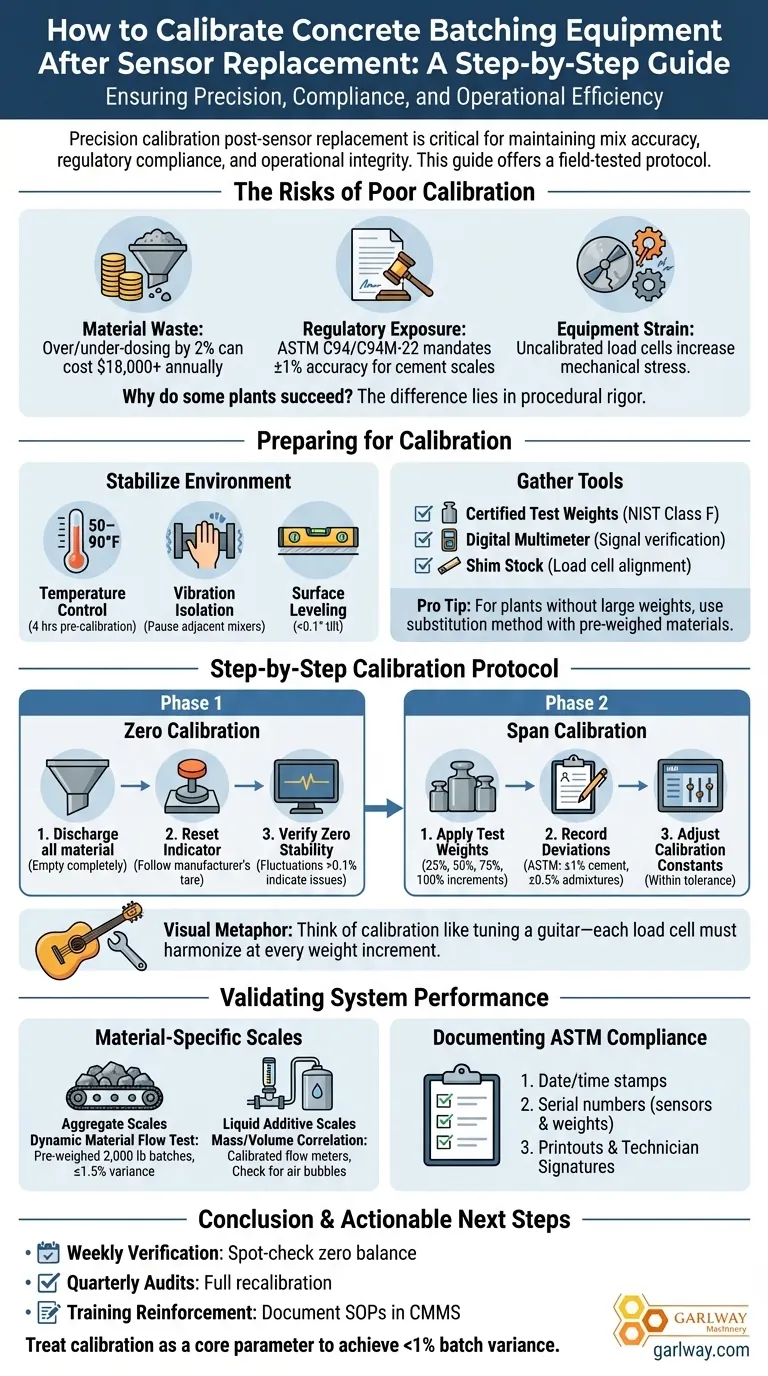
When replacing sensors in concrete batching equipment, precision calibration isn’t just a best practice—it’s a necessity for maintaining mix accuracy, compliance, and operational efficiency. This guide provides plant operators and quality control teams with a field-tested protocol to restore measurement integrity post-sensor installation, covering environmental prep, calibration execution, and ASTM-standard validation.
Ensuring Equipment Precision After Sensor Replacement
Sensor replacements disrupt the delicate equilibrium of batching systems. Even minor deviations in weight measurement can cascade into costly batch failures or structural non-compliance.
Key Risks of Poor Calibration:
- Material waste: Over/under-dosing aggregates by 2% can increase raw material costs by $18,000 annually (based on average plant throughput)
- Regulatory exposure: ASTM C94/C94M-22 mandates ±1% accuracy for cement scales
- Equipment strain: Uncalibrated load cells increase mechanical stress on mixer blades
Ever wondered why some plants repeat calibration monthly while others operate flawlessly for quarters? The difference lies in procedural rigor.
Preparing for Calibration: Environmental and Tool Requirements
1. Stabilize the Operating Environment
- Temperature control: Maintain 50–90°F (10–32°C) for 4 hours pre-calibration—thermal expansion alters metal components
- Vibration isolation: Pause adjacent equipment like garlway concrete mixers during tests
- Surface leveling: Verify <0.1° tilt using a machinist’s level
2. Gather Calibration Tools
| Tool | Purpose | Tolerance Standard |
|---|---|---|
| Certified test weights | Span calibration | NIST Class F or better |
| Digital multimeter | Signal verification | ±0.5% reading |
| Shim stock | Load cell alignment | 0.001" thickness variants |
Pro Tip: For plants without test weights exceeding 5,000 lbs, use the substitution method with pre-weighed bulk materials.
Step-by-Step Scale Calibration Protocol
Phase 1: Zero Calibration
- Discharge all material – Empty hoppers completely, including residual particles
- Reset the indicator – Follow manufacturer’s tare sequence (typically 3-5 second hold)
- Verify zero stability – Fluctuations beyond 0.1% of capacity indicate mechanical issues
Phase 2: Span Calibration
- Apply test weights in 25%, 50%, 75%, and 100% increments of scale capacity
- Record deviations at each point—ASTM allows ±1% for cement, ±0.5% for admixtures
- Adjust calibration constants via HMI until all points fall within tolerance
Visual Metaphor: Think of calibration like tuning a guitar—each string (load cell) must harmonize at every fret (weight increment).
Validating System Performance
Testing Procedures for Material-Specific Scales
Aggregate Scales:
- Test Method: Dynamic material flow test with pre-weighed 2,000 lb batches
- Acceptance Criteria: ≤1.5% variance between belt scale and static weighbridge
Liquid Additive Scales:
- Test Method: Mass/volume correlation using calibrated flow meters
- Critical Check: Verify no air bubbles in transducer lines
Documenting ASTM Compliance
Create a calibration dossier containing:
- Date/time stamps for each test phase
- Serial numbers of replaced sensors and test weights
- Printouts of calibration certificates with technician signatures
Conclusion & Actionable Next Steps
Post-sensor calibration isn’t a one-time event but the first step in a precision maintenance cycle. Implement these practices:
- Weekly Verification: Spot-check zero balance before Monday’s first batch
- Quarterly Audits: Full recalibration aligning with garlway equipment service intervals
- Training Reinforcement: Document calibration SOPs in your CMMS
By treating calibration as a core production parameter rather than a compliance checkbox, plants can achieve the <1% batch variance that separates adequate operations from industry-leading precision.
Products You Might Be Looking For:
View concrete batching plant options
Explore ready-mix concrete batching solutions
Visual Guide
Related Products
- HZS120 Ready Mix Concrete Batching Plant Commercial Mud Cement Mixer
- HZS75 Concrete Batching Plant Cement Mixer Price Concrete Mixer Bunnings Mixing Plant
- HZS35 Small Cement Concrete Mixing Batch Plant
- Commercial Electric Concrete Mixer Machine HZS 50 Small Batch Plant for Sale
- Portable Concrete Mixer Machine Equipment for Mixing Concrete
Related Articles
- How Raw Material Variability Impacts Concrete Batching Accuracy
- How to Optimize Dust Control in Concrete Batching Plants: A Compliance-Focused Guide
- Optimizing Concrete Batching Accuracy: Technology-Driven Solutions for Modern Plants
- How Sensor Technologies Revolutionize Concrete Batching Accuracy
- How Sensor Technologies Reduce Concrete Batching Errors and Boost ROI