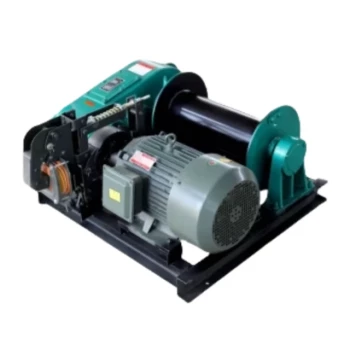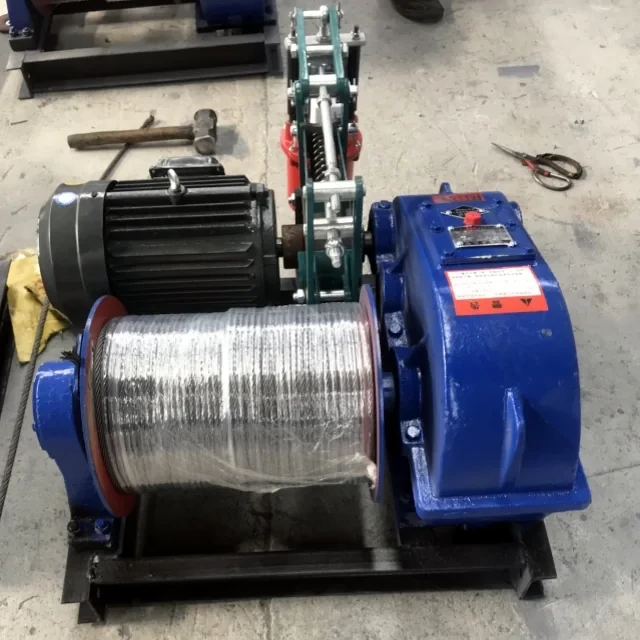
When engineering projects demand more than off-the-shelf solutions, large-tonnage non-standard winches become the backbone of success. These specialized tools combine brute strength with surgical precision, enabling industries to tackle extreme loads in high-risk environments—from suspending bridge cables to maneuvering cargo in cramped ports.
Large-Tonnage Non-Standard Winches in Modern Engineering
Custom Design and Adaptability for Extreme Loads
Standard winches falter under unique demands, but non-standard models thrive. Their secret? Tailored engineering. Unlike conventional winches with fixed drum capacities, non-standard variants adapt to:
- Irregular load distributions (e.g., asymmetrical cargo)
- Variable speed requirements (slow precision vs. rapid hauling)
- Environmental constraints (corrosion-resistant materials for marine use)
Example: Capstan winches use rope instead of cable, maintaining consistent pull force without drum accumulation—a game-changer for sustained heavy-load tasks.
Ever wondered how a winch handles 50-ton loads without snapping? The answer lies in custom torque calibration and reinforced drum designs.
Safety Mechanisms for High-Risk Environments
Safety isn’t optional when lives and million-dollar projects are at stake. Non-standard winches integrate:
- Load monitoring systems: Detect overloads in real-time.
- Fail-safes: Ratchet stops and friction brakes prevent dangerous reversals.
- Operator protection: Rope-based systems (like capstans) reduce injury risks if lines break.
Industry Mandate: Cables must have a safety factor of 3 (breaking load ≥ 3x working limit), per ISO standards.
Applications Across Key Industries
Bridge Construction: Suspending the Unthinkable
Imagine threading 100-ton cables across a river gorge. Non-standard winches make it possible with:
- Precision control for millimeter-perfect alignment.
- Multi-point synchronization to balance loads across multiple winches.
Case Study: In one project, engineers used synchronized winches to lower a 200-ton bridge segment into place within a 5cm tolerance window.
Port Logistics: Heavy Lifting in Tight Spaces
Ports face a paradox: move massive containers fast but carefully. Non-standard winches solve this with:
- Compact designs for confined areas.
- Automated pulling to reduce manual labor and downtime.
Did you know? Automated winches can cut cargo-handling time by 30% versus manual methods.
Advantages Over Standard Winches
Flexibility in Customized Load Distribution
Standard winches force projects to adapt to their limits. Non-standard models flip the script:
- Adjustable drum configurations for uneven loads.
- Modular components (e.g., swapable motors for different torque needs).
Compliance with Industry Safety Standards
While standard winches meet baseline requirements, non-standard units exceed them:
- ISO-certified load monitoring.
- Redundant braking systems (e.g., dual friction brakes + ratchet locks).
Conclusion: Why Invest in Non-Standard Winches?
Large-tonnage non-standard winches aren’t just tools—they’re risk mitigators and efficiency multipliers. They turn "impossible" lifts into routine operations while keeping crews safe.
Actionable Insight: For projects with unpredictable loads or tight deadlines, prioritize winches offering:
- Custom engineering (like Garlway’s adaptable designs).
- Proven safety protocols (load sensors, fail-safe brakes).
- Industry-specific optimizations (e.g., marine-grade materials).
In heavy lifting, the right winch doesn’t just move weight—it moves progress forward.
Related Products
- Electric and Hydraulic Winch for Heavy Duty Applications
- 12000 lb Heavy Duty Electric Boat Winch
- Best 18000 Pound Drum Anchor Trailer Winch
- Heavy Duty Electric Boat Winch Windlass Anchor
- Quick Windlass Portable Winch for Truck and Boat Best Boat Winch
Related Articles
- How to Choose the Right Winch for Heavy-Duty Applications: A Scenario-Based Guide
- How to Maximize Electrical Winch Performance in Challenging Environments
- How to Choose Between Manual and Electric Winches for Your Project
- How to Choose Between Reversible and Friction Electric Winches: A Transmission Guide
- Beyond Brute Force: The Calculated Power of the Electric Winch