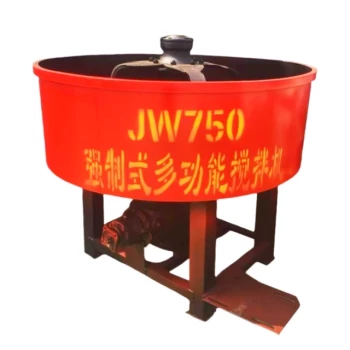
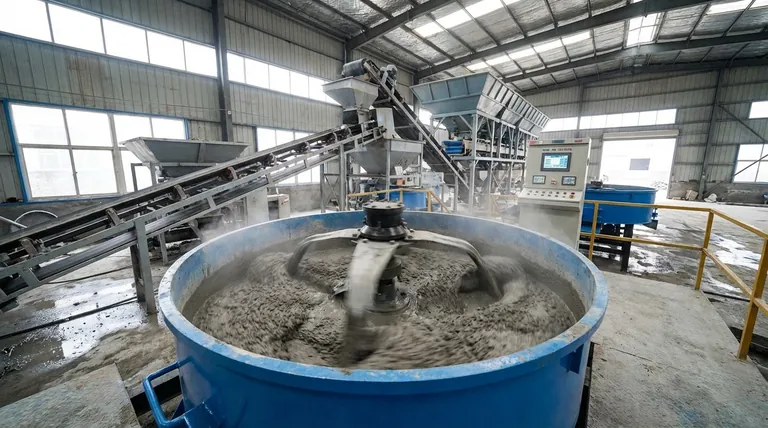
For producing high-quality or commercial concrete, the best choices are overwhelmingly twin-shaft mixers and planetary mixers. Unlike simpler drum mixers, these advanced systems use a high-intensity, forced-mixing action that guarantees a thoroughly uniform and consistent distribution of all components—from aggregates and cement to water and admixtures. This homogeneity is the critical foundation for achieving predictable strength, durability, and performance in demanding applications.
The key to high-quality concrete isn't just the ingredients, but the mixing technology itself. The choice between a gentle "free-fall" mixer and a powerful "forced-action" mixer directly dictates the final product's consistency and strength.
The Core Principle: Forced vs. Free-Fall Mixing
The fundamental difference between mixers suitable for commercial use and those for small jobs lies in how they combine the materials. This single distinction impacts everything from mix time to the concrete's ultimate performance.
Understanding Forced-Action Mixing
Forced-action mixers, like twin-shaft and planetary models, use a series of powerful paddles or blades that rotate through the material at high speed.
This mechanical shearing and folding action actively forces particles together. The result is an extremely fast, efficient, and homogenous mix, which is essential for activating all the cement and evenly dispersing additives.
Understanding Free-Fall Mixing
A standard drum mixer is a "free-fall" or gravity-based system. It uses fins inside a rotating drum to lift the material and then let it drop.
While simple and effective for basic concrete, this method is less intense. It relies on random tumbling and can struggle to break apart clumps or evenly distribute fine materials, especially in low-slump or complex mix designs.
A Closer Look at High-Performance Mixers
For commercial production, two types of forced-action mixers dominate the market due to their superior performance and reliability.
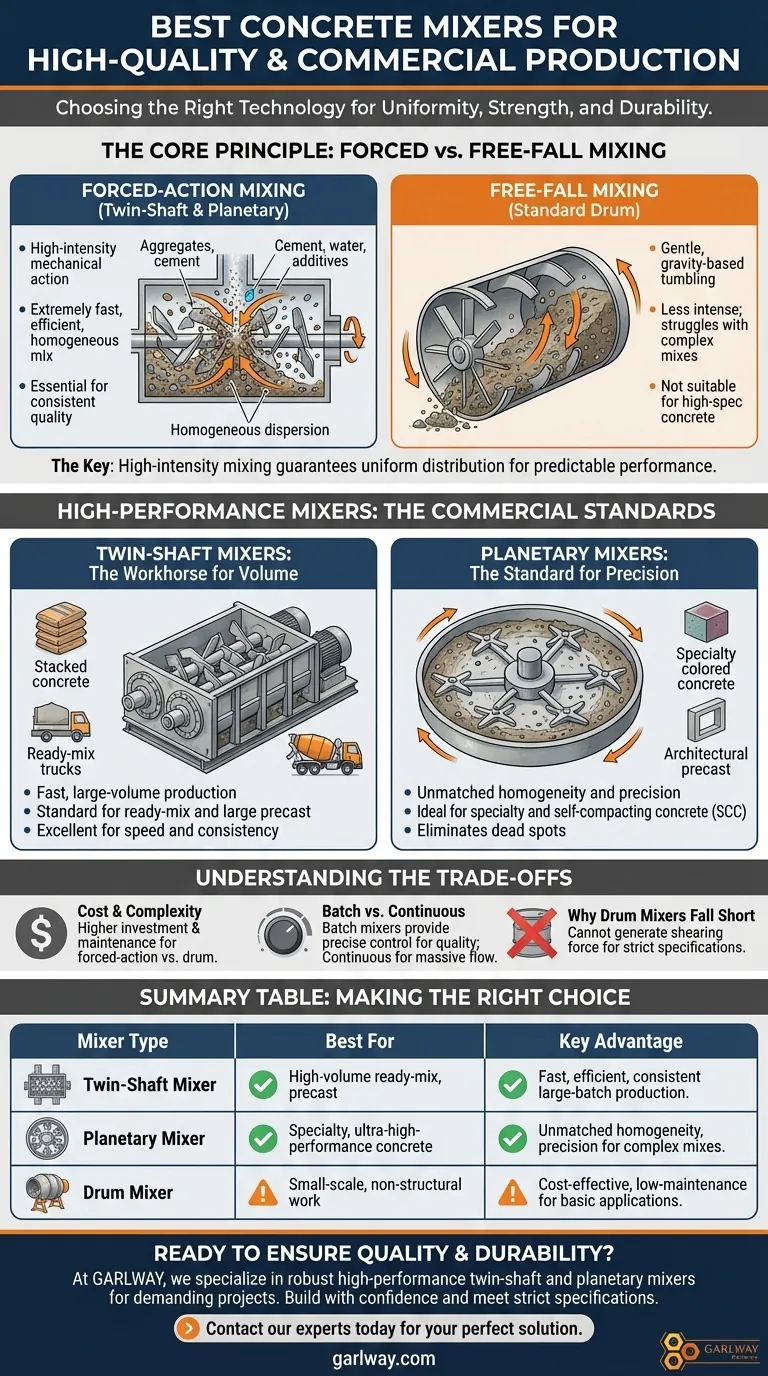
Twin-Shaft Mixers: The Workhorse for Volume
A twin-shaft mixer uses two parallel, horizontal shafts with interlocking paddles that rotate in opposite directions. This creates a highly energetic mixing zone in the center of the unit.
They are renowned for their ability to produce large volumes of high-quality concrete very quickly, making them the standard choice for most ready-mix plants and large-scale precast operations.
Planetary Mixers: The Standard for Precision
Planetary mixers (or counter-current mixers) feature one or more mixing stars that rotate on their own axes while also revolving around the center of the mixing pan.
This complex movement ensures that the paddles cover every point within the drum, eliminating dead spots and producing an exceptionally uniform mix. They are the preferred choice for specialty concrete like self-compacting concrete (SCC), colored concrete, or products requiring a perfect finish.
Understanding the Trade-offs
Selecting the right mixer involves balancing performance requirements with operational realities like cost, scale, and maintenance.
The Cost and Complexity Factor
High-performance twin-shaft and planetary mixers represent a significant capital investment. They also have more complex drive systems and wear parts, leading to higher maintenance costs compared to a simple drum mixer.
Batch vs. Continuous Production
Most high-quality concrete is produced in batch mixers (like twin-shaft and planetary) because they offer precise control over the ratios for each specific load.
Continuous mixers are designed for massive-scale projects like dam construction or soil stabilization, where a constant, high-volume flow of concrete is needed and minor variations between batches are less critical.
Why Drum Mixers Fall Short for Commercial Use
The gentle, gravity-based action of a drum mixer is its primary limitation. It simply cannot generate the shearing force required to guarantee the uniform dispersion needed for concrete that must meet strict strength and durability specifications.
Making the Right Choice for Your Production Goal
Your specific application will determine the ideal mixing technology.
- If your primary focus is high-volume ready-mix or standard precast concrete: The twin-shaft mixer offers the best combination of speed, efficiency, and consistent quality for large-scale production.
- If your primary focus is ultra-high-performance or specialty concrete: The planetary mixer is the superior choice for its unmatched homogeneity and precision, which are critical for complex mix designs.
- If your primary focus is small-scale, non-structural work: A traditional drum mixer remains a cost-effective and low-maintenance option where precise quality control is not the main driver.
Ultimately, investing in the correct mixing technology is the first step toward guaranteeing the structural integrity and long-term durability of your concrete.
Summary Table:
| Mixer Type | Best For | Key Advantage |
|---|---|---|
| Twin-Shaft Mixer | High-volume ready-mix, precast | Fast, efficient, consistent large-batch production |
| Planetary Mixer | Specialty, ultra-high-performance concrete | Unmatched homogeneity, precision for complex mixes |
| Drum Mixer | Small-scale, non-structural work | Cost-effective, low-maintenance for basic applications |
Ready to ensure the quality and durability of your commercial concrete?
At GARLWAY, we specialize in providing robust construction machinery, including high-performance twin-shaft and planetary concrete mixers designed for construction companies and contractors who demand reliability and precision. Our solutions are engineered to deliver the uniform mixing essential for high-strength concrete, helping you meet strict project specifications and build with confidence.
Contact our experts today to discuss your project needs and find the perfect concrete mixing solution for your business.
Visual Guide
Related Products
- JS500 Electric Cement Concrete Mixer for Sale
- Shaft Mixer Machine for Cement and Regular Concrete Mixing
- Portable Cement Mixer with Lift Concrete Machine
- HZS90 Large Multiquip Concrete Mixers for Construction
- HZS25 Best Cement Mixer for Quick Mix Concrete at Bunnings
People Also Ask
- What are the benefits of electric concrete mixers? Quiet, Clean, and Low-Maintenance Mixing
- What are the four factors to consider when selecting a concrete mixer? Optimize Your Construction Project
- What are the two main types of concrete mixers and their uses? Choose the Right Mixer for Your Project
- What is a concrete mixer used for? Achieve Consistent, High-Quality Concrete
- How can a concrete mixer be used to remove rust from metal parts? A Powerful, Large-Scale Cleaning Method