
When selecting concrete mixing equipment, the non-tilting drum mixer is a foundational piece of machinery primarily found on small to medium-sized construction sites. Its design is optimized for producing consistent batches of concrete where a full-scale tilting mixer would be inefficient or oversized.
The core principle dictating a non-tilting mixer's use is its discharge mechanism. By using an internal chute rather than tilting the entire drum, it provides a rapid and controlled flow suitable for smaller jobs, but this same design makes it less effective for very coarse or dry concrete mixes.
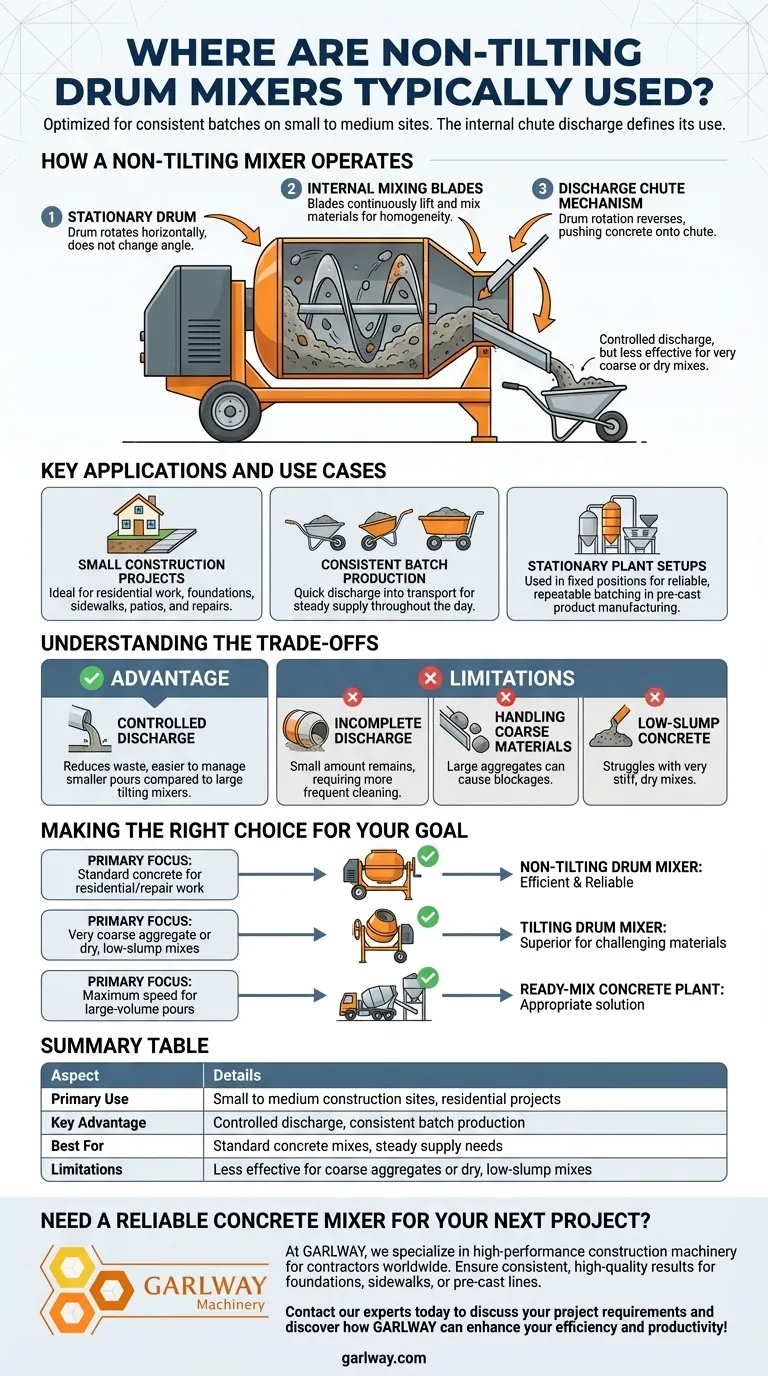
How a Non-tilting Mixer Operates
The Stationary Drum
A non-tilting mixer features a drum that rotates on a horizontal axis. Unlike its tilting counterpart, the drum itself does not change its angle to discharge the contents.
Internal Mixing Blades
Inside the drum, specifically designed blades continuously lift and tumble the aggregates, cement, and water. This action ensures a thorough and homogenous mix.
The Discharge Chute Mechanism
Discharge is achieved by inserting a chute into the drum's opening. The rotational direction of the drum is often reversed, and the blade configuration then effectively pushes the mixed concrete out and onto the chute.
Key Applications and Use Cases
Small Construction Projects
This is the most common application. Non-tilting mixers are ideal for residential work, such as laying foundations, pouring sidewalks, creating patios, or for general repair tasks.
Consistent Batch Production
The design allows for a relatively quick discharge into wheelbarrows or concrete buggies. This makes it efficient for projects that require a steady, but not massive, supply of concrete throughout the day.
Stationary Plant Setups
While often portable, larger-capacity non-tilting mixers are also used in fixed positions. They can be found in plants that manufacture pre-cast concrete products where a reliable, repeatable batching process is essential.
Understanding the Trade-offs
Advantage: Controlled Discharge
The chute mechanism offers a more controlled discharge than a large tilting mixer, which can dump its entire load at once. This reduces waste and makes it easier to manage smaller pours.
Limitation: Incomplete Discharge
Because the drum does not tilt, a small amount of wet concrete and aggregate can remain inside after discharge. This necessitates more frequent and thorough cleaning to prevent material from hardening and reducing batch capacity.
Limitation: Handling Coarse Materials
This design is less suitable for concrete mixes with very large or coarse aggregates. These larger stones can become lodged or may not flow smoothly onto the discharge chute, leading to blockages.
Limitation: Low-Slump Concrete
Very stiff, dry (low-slump) concrete mixes do not flow easily. A non-tilting mixer struggles to discharge this type of mix efficiently, making tilting mixers a better choice for such applications.
Making the Right Choice for Your Goal
Your choice of mixer should always align with the scale and material specifications of the job.
- If your primary focus is standard concrete for residential or repair work: The non-tilting drum mixer is a highly efficient and reliable choice for producing consistent batches.
- If your primary focus is using very coarse aggregate or dry, low-slump mixes: A tilting drum mixer is the superior option, as its complete-inversion discharge method handles these challenging materials effectively.
- If your primary focus is maximum speed for large-volume pours: Neither of these options may be sufficient, and sourcing from a ready-mix concrete plant is the appropriate solution.
Understanding the specific operational mechanics of a non-tilting mixer is the key to deploying it effectively on the right job site.
Summary Table:
| Aspect | Details |
|---|---|
| Primary Use | Small to medium construction sites, residential projects |
| Key Advantage | Controlled discharge, consistent batch production |
| Best For | Standard concrete mixes, steady supply needs |
| Limitations | Less effective for coarse aggregates or dry, low-slump mixes |
Need a reliable concrete mixer for your next project?
At GARLWAY, we specialize in providing high-performance construction machinery, including robust and efficient concrete mixers, for construction companies and contractors worldwide. Whether you're working on a residential foundation, a sidewalk, or a pre-cast product line, our equipment ensures consistent, high-quality results.
Let us help you choose the right mixer for your specific needs. Contact our experts today to discuss your project requirements and discover how GARLWAY can enhance your efficiency and productivity!
Visual Guide
Related Products
- Belle Mixer Drum Self Loading Mortar Mixers JS3000
- Concrete Cement Mixer Machine Drum Mixer for Construction
- JDY350 Electric Hydraulic Mortar Mud Concrete Mixer
- Portable Electric Concrete Mixer Machine for Cement Mixing
- JDC350 Small Cement Concrete Mortar Mixer
People Also Ask
- What are the features of mobile transporting in a self loading mixer? Boost On-Site Efficiency
- Why is timely cleaning important for a self loading mixer? Prevent Costly Downtime and Mix Failure
- How is discharging accomplished in a self loading mixer? Master Precise Concrete Placement
- What is the purpose of keeping the drum rotating during transportation in a self loading concrete mixer? Ensure Quality & Consistency
- What components are involved in the loading process of a self loading concrete mixer? A Guide to the Key Systems





