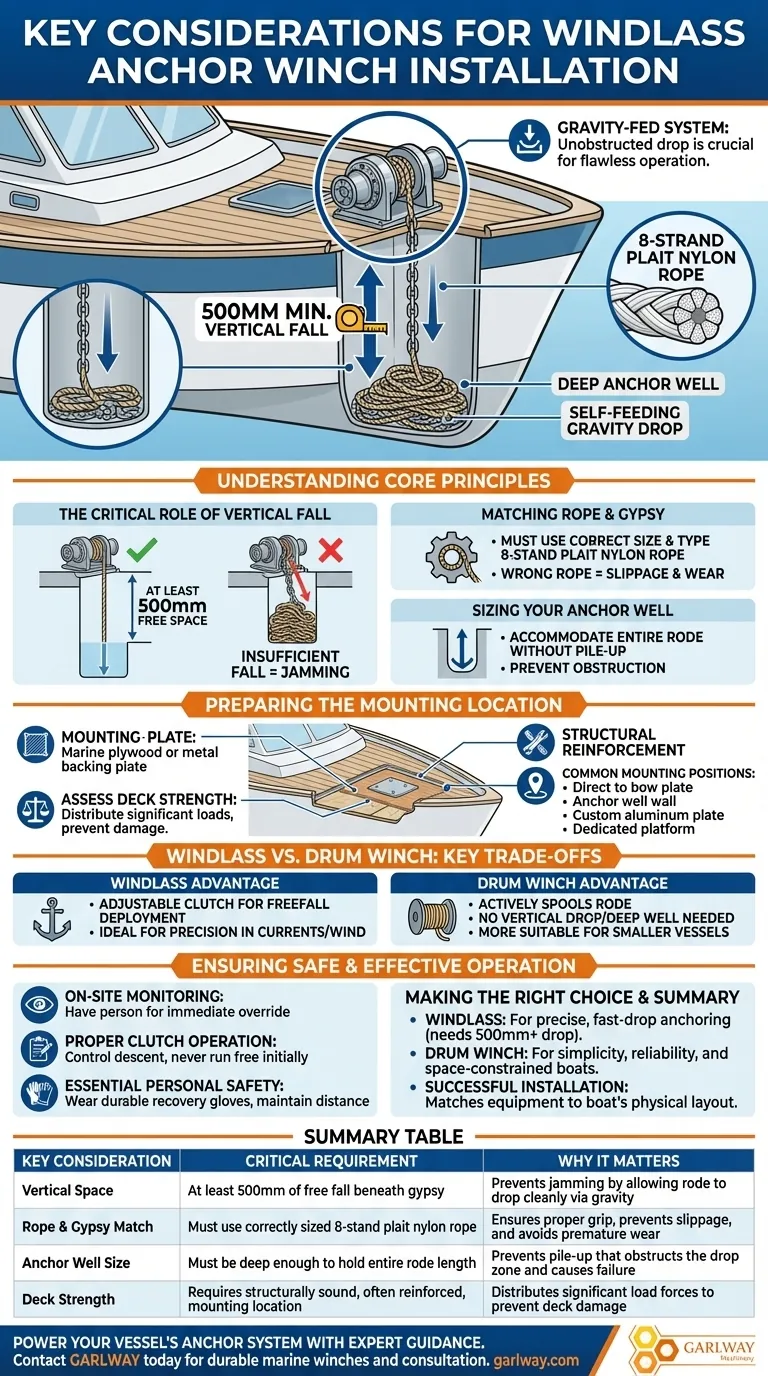
To properly install a windlass type anchor winch, you must ensure three critical conditions are met. You need at least 500mm of free vertical space directly beneath the mounting location, you must use an 8-stand plait nylon rope correctly sized for the gypsy, and your anchor well must be deep enough for the entire length of rope to self-feed via gravity.
The success of a windlass installation hinges less on the winch itself and more on the geometry of your boat. The entire system relies on an unobstructed vertical drop for the anchor rode to feed flawlessly into the anchor well without manual intervention.
Understanding the Core Installation Principles
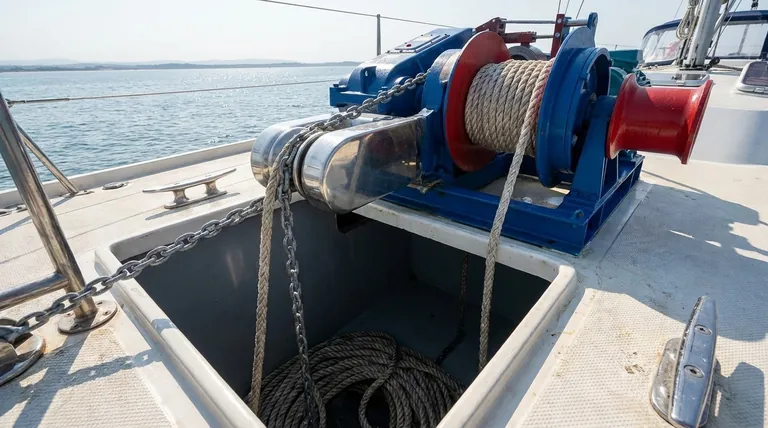
A windlass operates on a simple principle: gravity. Unlike a drum winch that actively spools the line, a windlass simply pulls the rode over a gear (the gypsy) and drops it into the anchor well below. If the path isn't clear and steep, the system will fail.
The Critical Role of Vertical Fall
The requirement for at least 500mm of free vertical space is non-negotiable. This drop allows the rope and chain to fall away from the gypsy under their own weight.
Without sufficient fall, the rode will pile up, creating a "castle" that can jam the mechanism and prevent the anchor from deploying or retrieving smoothly.
Matching the Rope and Gypsy
A windlass is not compatible with all rope types. It is specifically designed for an 8-stand plait nylon rope combined with a chain.
The gypsy has precisely machined teeth that grip the links of the chain and the texture of the rope. Using the wrong size or type of rope will cause slippage, poor performance, and premature wear on both the rope and the winch.
Sizing Your Anchor Well
The anchor well must not only accommodate the vertical drop but also have enough volume to hold the entire length of your anchor rode without it piling up and obstructing the drop zone.
A shallow or poorly designed well is the most common cause of windlass jamming and operational failure.
Preparing the Mounting Location
The forces exerted by an anchor winch are significant, especially in rough conditions. The mounting surface must be strong enough to handle the full load of the vessel at anchor.
Assessing Deck Strength
The chosen mounting location, typically on the bow, must be structurally sound. Many boats require reinforcement under the deck, such as a marine-grade plywood or metal backing plate, to distribute the load and prevent damage to the fiberglass or aluminum.
Common Mounting Positions
Several locations can work, depending on your vessel's layout:
- Directly onto an existing bow plate.
- Vertically on the forward wall of the anchor well.
- On a custom-welded aluminum plate set further back from the bow.
- On a dedicated platform welded directly onto the deck.
Windlass vs. Drum Winch: The Key Trade-offs
While you are focused on a windlass, it's crucial to understand its trade-offs compared to the more common drum winch. This context ensures you are making the right choice.
The Windlass Advantage: Freefall
Windlass winches typically feature an adjustable clutch that allows for freefall deployment. This is a significant advantage for spot anchoring in strong currents or wind, as it lets you drop the anchor precisely where you want it, instantly.
The Drum Winch Advantage: Simplicity
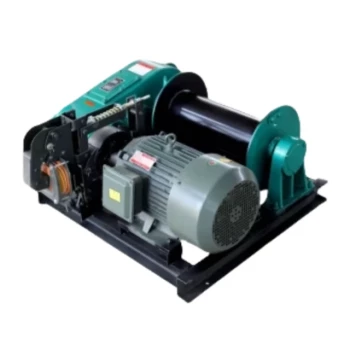
Drum winches are often considered more economical and hassle-free. They actively spool the rode onto a drum, completely eliminating the need for vertical drop and a deep anchor well. This makes them suitable for a wider range of boats, especially smaller vessels with limited space below deck.
Ensuring Safe and Effective Operation
Proper installation is only half the battle. Safe operation is paramount to preventing equipment damage and serious injury.
The Importance of On-Site Monitoring
Even with remote controls, it is highly recommended to have a person stationed beside the winch during operation. This allows for immediate access to override controls if the rode jams or another issue arises.
Proper Clutch Operation
To lower the anchor, ensure the clutch is tight, then pay out a small amount of slack. Gently release the clutch to allow the anchor to descend under control. Never let it run free without initial control.
Essential Personal Safety
Always wear durable recovery gloves to protect your hands from friction burns. Never rush the process, and maintain a safe distance from the line under tension. A rope or chain failure can be catastrophic.
Making the Right Choice for Your Vessel
Selecting and installing the right anchor winch requires a clear understanding of your vessel's design and your operational needs.
- If your primary focus is precise, fast-drop anchoring: A windlass is an excellent choice, provided your boat has the necessary 500mm+ vertical drop for the anchor rode.
- If your primary focus is installation simplicity and reliability: A drum winch is often the better option, as it removes the strict layout constraints imposed by a windlass's gravity-feed system.
- If you are retrofitting a smaller boat with limited space: A drum winch is almost always more space-efficient and easier to install successfully.
Ultimately, a successful installation is one that matches the equipment's operational requirements to the physical layout of your boat.
Summary Table:
| Key Consideration | Critical Requirement | Why It Matters |
|---|---|---|
| Vertical Space | At least 500mm of free fall beneath the gypsy | Prevents jamming by allowing the rode to drop cleanly via gravity |
| Rope & Gypsy Match | Must use correctly sized 8-stand plait nylon rope | Ensures proper grip, prevents slippage, and avoids premature wear |
| Anchor Well Size | Must be deep enough to hold the entire rode length | Prevents pile-up that obstructs the drop zone and causes failure |
| Deck Strength | Requires a structurally sound, often reinforced, mounting location | Distributes the significant load forces to prevent deck damage |
Ready to Power Your Vessel's Anchor System?
Choosing and installing the right anchor winch is critical for safety and performance. GARLWAY specializes in robust marine and construction winches, engineered for reliability in demanding conditions.
We provide:
- Durable winches built for marine applications.
- Expert guidance to match the right equipment to your vessel's specific layout and needs.
Let us help you achieve a seamless, powerful, and safe anchoring solution. Contact GARLWAY today for a consultation and discover the difference professional-grade equipment makes.
Visual Guide
Related Products
- Electric Hoist Winch Boat Anchor Windlass for Marine Applications
- Heavy Duty Electric Boat Winch Windlass Anchor
- 12000 lb Electric Boat Trailer Winch with Windlass Anchor Warn
- Warn Winch Windlass Boat Trailer Winch
- Quick Windlass Portable Winch for Truck and Boat Best Boat Winch
People Also Ask
- How does an electric anchor winch work? Power, Safety, and Reliable Operation Explained
- What are the advantages of installing an electric anchor winch on a boat? Boost Safety & Ease for Boaters
- What are the operational differences between electric hoists and winches? A Guide to Safe Lifting vs. Pulling
- What are the main benefits of a boat anchor winch? Boost Safety & Efficiency for Your Vessel
- How does a boat anchor winch work? A Guide to Reliable Anchor Handling