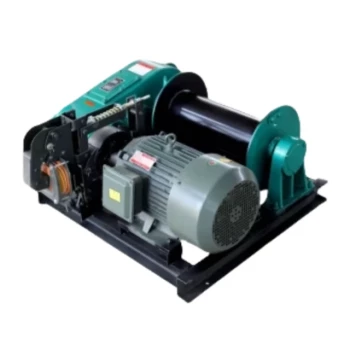
As more cable is wound onto a winch drum, the maximum lifting or pulling force the system can generate decreases. This happens because each new layer of cable increases the drum's effective diameter, which fundamentally alters the leverage the motor can apply.
A winch or hoist is strongest on its first layer of cable and weakest on its last. While the motor's torque remains constant, the growing diameter of the wound cable reduces the available pulling force in exchange for increased line speed.
The Core Principle: Torque vs. Force
To understand this effect, you must distinguish between the motor's output (torque) and the line's resulting pull (force).
Constant Motor Torque
A winch motor is designed to produce a relatively consistent rotational force, which is called torque. Think of this as the raw twisting power the motor provides to the drum.
The Role of Radius
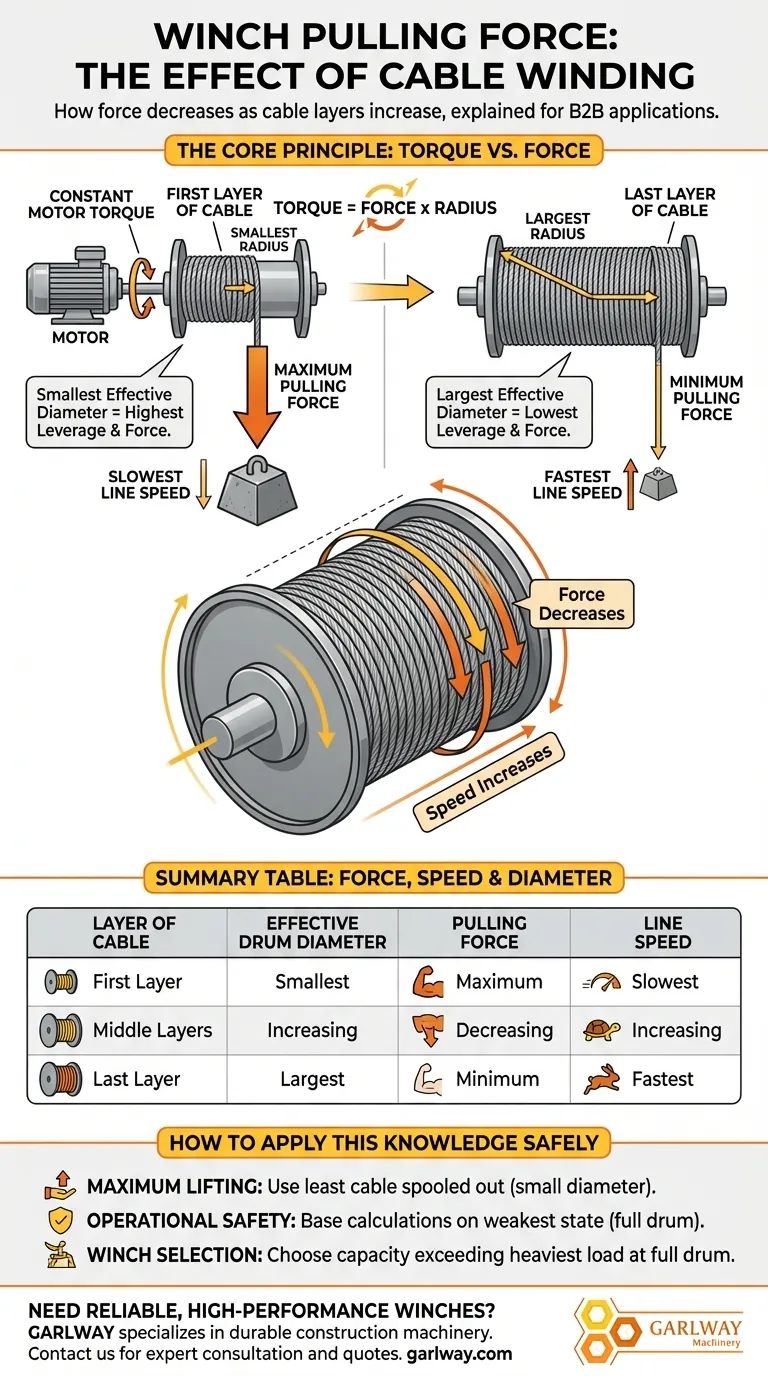
The relationship between this torque and the pulling force is governed by a simple principle: Torque = Force x Radius. The radius, in this case, is the distance from the center of the drum to the outermost layer of the cable.
How Winding Changes the Equation
When the cable is on its first layer, the radius is smallest. For a given amount of torque from the motor, the winch can generate its maximum pulling force.
As more cable winds onto the drum, it forms subsequent layers. Each layer increases the effective radius. Because the motor's torque is constant, an increasing radius must result in a decreasing force to keep the equation balanced.
The Inverse Relationship: Force vs. Speed
This change in diameter creates a direct trade-off between the system's force and its speed.
Why Speed Increases
With each rotation, the drum pulls in a length of cable equal to its circumference. As the effective diameter (and thus the radius) grows, the circumference also gets larger.
This means a single rotation of a full drum reels in significantly more cable than a rotation of an empty one.
The Practical Effect
The result is that a winch pulls slowest on the first layer (when it is strongest) and fastest on the last layer (when it is weakest).
Understanding the Trade-offs
This mechanical principle has critical real-world consequences for safety and performance.
The Loss of Pulling Power
The reduction in force is not trivial. Each additional layer of cable can significantly reduce the winch's rated pulling capacity. The force available on the outermost layer can be substantially less than what is available on the first layer.
The Risk of Overloading
The most common mistake is assuming a winch's maximum rated capacity applies under all conditions. This rating is almost always specified for the first layer of cable only.
A load that is easily handled with only a few wraps on the drum may stall the motor or cause mechanical failure once the drum becomes fuller.
How to Apply This Knowledge Safely
- If your primary focus is maximum lifting power: Operate with the least amount of cable spooled out as necessary for the job. This keeps the effective drum diameter small and maximizes force.
- If your primary focus is operational safety: Always base your load calculations on the winch's weakest state—when the drum is nearly full. Never assume the "first layer" strength applies to every lift.
- If you are selecting a winch or hoist: Choose a model with a capacity rating that safely exceeds your heaviest expected load, accounting for the force reduction on the upper cable layers.
Understanding this simple mechanical trade-off is the key to operating any winch or hoist system both effectively and safely.
Summary Table:
| Layer of Cable | Effective Drum Diameter | Pulling Force | Line Speed |
|---|---|---|---|
| First Layer | Smallest | Maximum | Slowest |
| Last Layer | Largest | Minimum | Fastest |
Need a reliable winch that delivers consistent power?
GARLWAY specializes in high-performance construction machinery, including durable winches, concrete mixers, and batching plants designed for the demanding needs of construction companies and contractors globally. Our equipment is engineered for safety and efficiency, helping you complete your projects on time and within budget.
Let our experts help you select the right winch for your specific application. Contact GARLWAY today for a consultation and quote!
Visual Guide
Related Products
- Warn Winch Windlass Boat Trailer Winch
- Electric and Hydraulic Winch for Heavy Duty Applications
- Small Electric Winch 120V and 240V for Compact Applications
- 12000 lb Electric Boat Trailer Winch with Windlass Anchor Warn
- Quick Windlass Portable Winch for Truck and Boat Best Boat Winch
People Also Ask
- What are the main components of a boat trailer winch? A Guide to Safe & Efficient Boat Loading
- What factors should be considered when choosing a boat trailer winch? Ensure Safe and Effortless Boat Loading
- What is the purpose of boat trailer winches? Safely and Efficiently Load Your Boat
- What are the two main types of boat trailer winches? Manual vs. Electric Explained
- How often should a boat trailer winch be replaced? Your Guide to Safety and Longevity