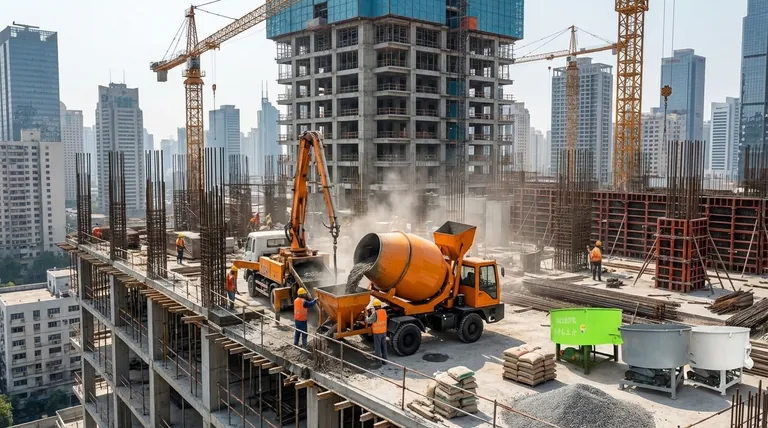
In high-density construction, a self-loading concrete mixer serves as a decentralized, on-demand production plant. It directly counteracts the logistical bottlenecks of delivering concrete to high floors in congested urban environments, reducing dependency on external suppliers and the unpredictability of city traffic. This ensures a consistent, timely supply of concrete precisely where and when it's needed on a vertical job site.
The core value of a self-loading mixer in skyscraper construction is not merely mixing concrete; it's about reclaiming logistical control. By moving production on-site, it transforms concrete supply from a major external dependency into a predictable internal process.
Overcoming Vertical Construction Hurdles
In tall building projects, getting the right materials to the right place at the right time is the primary challenge. Traditional concrete delivery methods often struggle to keep pace with the demands of vertical construction.
Ensuring Consistent Supply to Higher Floors
As a building grows taller, the logistical chain for delivering ready-mix concrete becomes longer and more prone to delays. A crane or pump can only move as fast as the trucks arriving below.
Self-loading mixers provide a continuous, on-site source of fresh concrete, decoupling the upper-floor workflow from ground-level delivery schedules. This consistency is critical for maintaining project momentum.
Navigating Constrained Urban Sites
Skyscraper construction sites are notoriously tight on space. The compact design and mobility of self-loading mixers are significant assets in these environments.
Features like four-wheel drive and excellent off-road performance allow them to operate efficiently in narrow or difficult-to-access areas where larger trucks cannot.
Mitigating External Dependencies
Relying on an external ready-mix plant introduces variables beyond your control, such as plant scheduling, traffic delays, and transport time, which can affect concrete quality.
By producing concrete on-site, project managers mitigate these risks, ensuring a steady workflow and a fresh mix that hasn't been compromised by long transit.
Driving On-Site Efficiency and Quality
Beyond logistics, these machines introduce a level of automation and precision that directly impacts project speed, quality, and cost.
Automating Production for Speed
By combining loading, mixing, and transport into a single automated operation, these mixers drastically reduce the time spent on material handling.
This streamlined process eliminates multiple stages of transport and manual labor, contributing directly to faster project completion times.
Guaranteeing Mix Consistency
For a skyscraper's structural integrity, the quality of the concrete must be unwavering. Self-loading mixers are programmed to produce concrete according to precise formulas.
This automation ensures that every batch meets exact specifications, reducing the risk of human error and guaranteeing the required structural stability.
Lowering Operational Costs
The efficiency of a self-loading mixer translates directly to cost savings. It reduces the need for a large labor force dedicated to concrete transport and mixing.
Furthermore, their efficient operation leads to lower fuel consumption compared to coordinating multiple large vehicles, contributing to a leaner project budget.
Understanding the Trade-offs
While highly effective, self-loading mixers are a specific tool for a specific job. They are not a universal replacement for all concrete solutions.
Volume and Scale Limitations
For massive initial pours, such as the foundation slab of a skyscraper, the sheer volume and speed of a dedicated ready-mix plant and a fleet of trucks may be superior.
Self-loading mixers excel at providing a continuous, but lower-volume, supply suitable for floor-by-floor construction, not necessarily for record-breaking single-day pours.
Raw Material Logistics
While the mixer solves the problem of concrete delivery, it creates a new need for raw material delivery. You must have a well-organized plan for staging sand, aggregate, cement, and water on a constrained site.
Integration with Pumping Systems
The mixer produces the concrete at ground level or on a staging floor. You still need a robust system, such as a high-pressure concrete pump or a crane and bucket, to transport the finished concrete to the final pour location on the upper floors. The mixer complements these systems rather than replacing them.
Making the Right Choice for Your Project
Choosing your concrete strategy depends entirely on the logistical realities of your specific construction site and project goals.
- If your primary focus is a high-rise project in a dense urban core: A self-loading mixer provides essential on-site production control, ensuring a steady supply to upper floors without relying on unpredictable city deliveries.
- If your primary focus is a remote site with limited access to suppliers: The mixer acts as a self-sufficient solution, guaranteeing a continuous source of fresh concrete where ready-mix plants are unreliable or too far away.
- If your primary focus is cost control on small to mid-sized projects: The machine's versatility and efficiency reduce labor needs and eliminate minimum order fees from ready-mix suppliers, offering significant savings.
Ultimately, integrating a self-loading mixer is a strategic decision to gain control over one of your project's most critical resources.
Summary Table:
| Challenge | How a Self-Loading Mixer Helps |
|---|---|
| Vertical Supply Chain | Provides on-site, continuous concrete production, decoupling workflow from ground-level deliveries. |
| Constrained Urban Sites | Compact, mobile design with 4-wheel drive operates efficiently in tight spaces. |
| External Supplier Dependence | Mitigates risks of traffic delays and scheduling issues from ready-mix plants. |
| Quality & Cost Control | Automated mixing ensures precise consistency; reduces labor and fuel costs. |
Ready to take control of your concrete supply and accelerate your high-rise project?
GARLWAY specializes in providing robust construction machinery, including self-loading concrete mixers, for construction companies and contractors tackling complex urban and remote projects. Our solutions are designed to deliver the on-site efficiency and logistical control you need to meet demanding deadlines.
Contact GARLWAY today to discuss how our machinery can be the strategic advantage for your next skyscraper or high-density housing development.
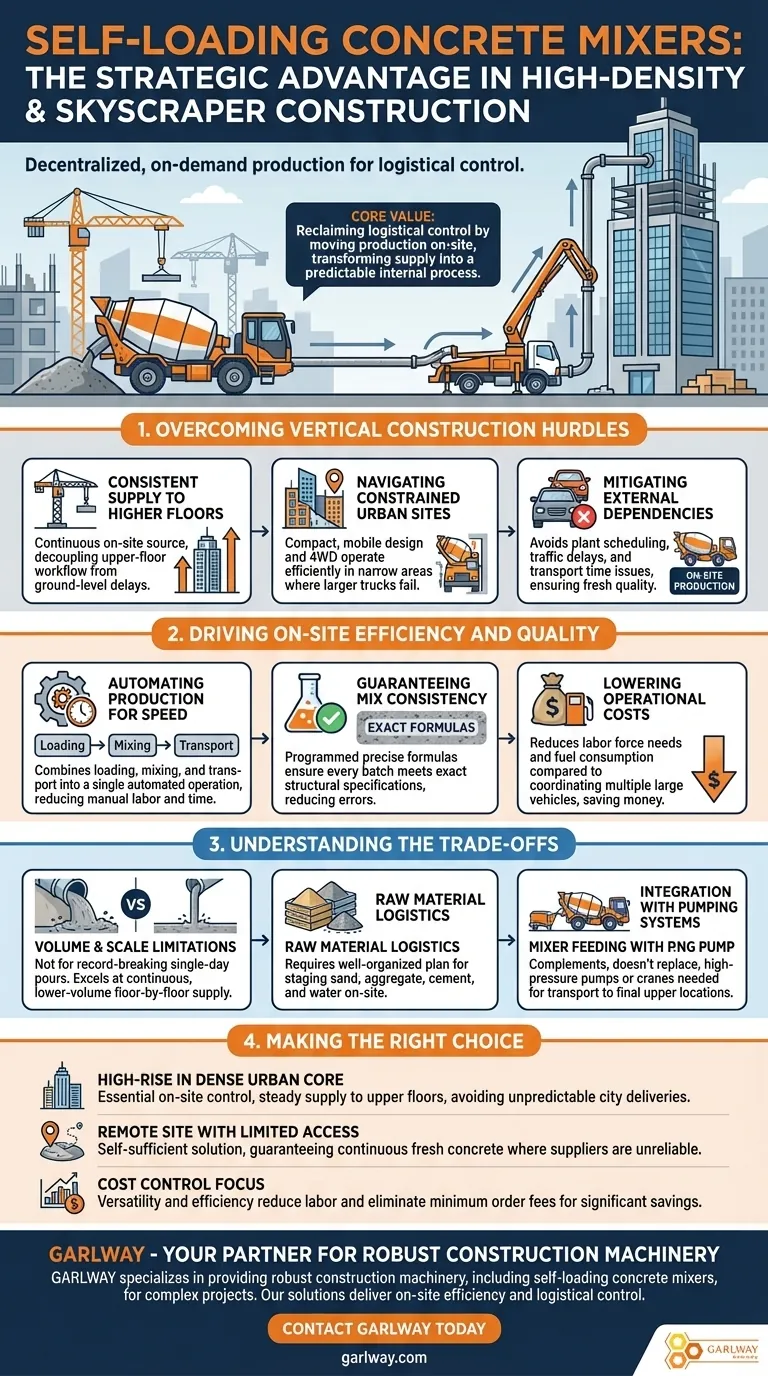
Visual Guide
Related Products
- Skid Steer Self Loading Concrete Mixers for Construction
- Belle Mixer Drum Self Loading Mortar Mixers JS3000
- Portable Cement Mixer with Lift Concrete Machine
- Portable Concrete Mixer Machine Equipment for Mixing Concrete
- Portable Ready Mix Concrete Mixer Equipment
People Also Ask
- How does the control system improve production efficiency in a self loading concrete mixer? Automate Mixing for Speed & Quality
- What is the purpose of keeping the drum rotating during transportation in a self loading concrete mixer? Ensure Quality & Consistency
- How does the weighing process work in a self loading concrete mixer? Achieve Precise, On-Site Concrete Batching
- What components are involved in the loading process of a self loading concrete mixer? A Guide to the Key Systems
- How should materials be loaded into a self-loading concrete mixer? Master the Step-by-Step Process