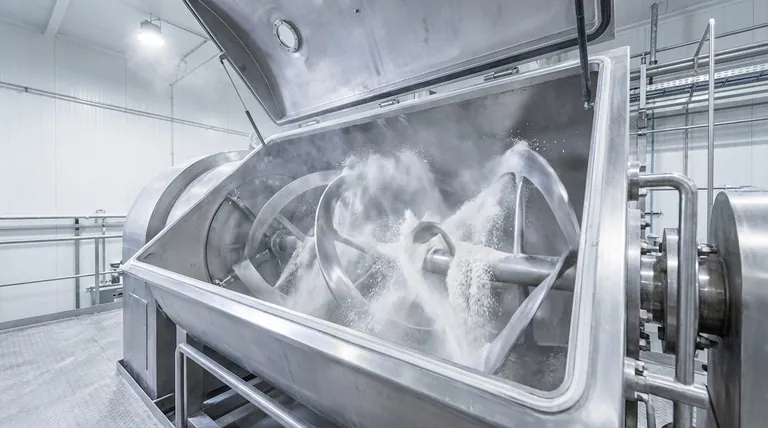
The primary reason ribbon industrial mixers are efficient is their specialized agitator, which creates a unique and powerful "triple-mixing" action. This design uses inner and outer helical ribbons rotating on a central shaft to move materials simultaneously in axial (end-to-end) and radial (up-and-down) directions, ensuring rapid and thorough homogenization of powders and bulk solids.
A ribbon mixer's efficiency is not just about its mixing speed. It is a result of a highly engineered flow pattern combined with a simple, versatile design that performs well across various scales and is straightforward to maintain.
The Core Mechanism: A Triple-Mixing Action
A ribbon mixer’s effectiveness is rooted in the design of its agitator, which operates inside a static, U-shaped trough. This is not a static process; the ribbons are in constant motion.
The Double-Ribbon Agitator
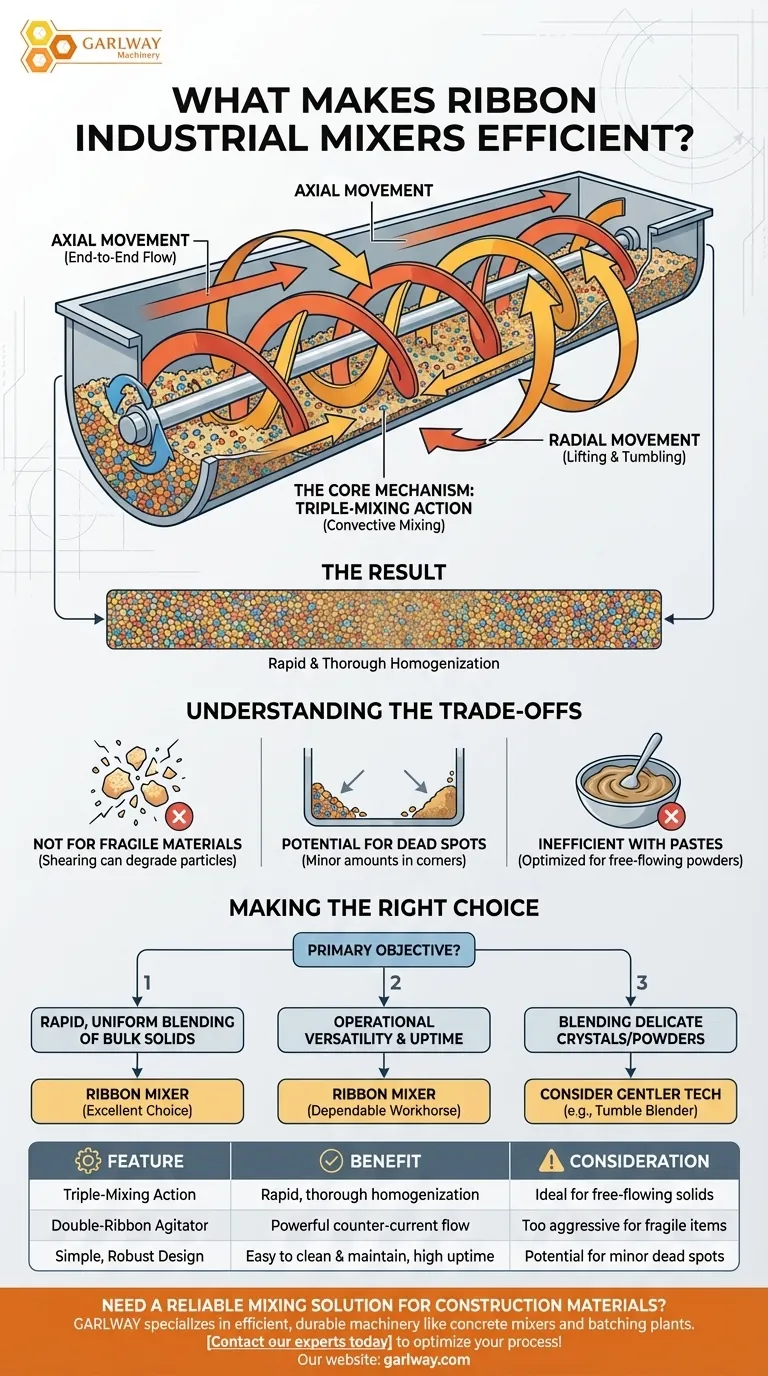
The heart of the mixer is a rotating shaft fitted with two key components: an outer helical ribbon and an inner helical ribbon. These are engineered to work in concert, moving material in opposite directions.
Axial Movement (End-to-End Flow)
The outer ribbon is designed to continuously move material from the ends of the trough towards the center. Simultaneously, the inner ribbon moves material from the center back out towards the ends.
This counter-current action creates a powerful, full-vessel axial flow, ensuring that all particles, regardless of their starting position, are moved throughout the entire length of the mixer.
Radial Movement (Lifting and Tumbling)
As the ribbons rotate, their helical shape also lifts and tumbles the material in a radial direction. This motion prevents powders from settling or packing down, breaking up agglomerates and ensuring vertical integration within the batch.
The Result: Convective Mixing
The combination of powerful axial and radial movements creates a highly efficient mixing pattern known as convective mixing. This fluid, multi-directional flow pattern guarantees that particles are constantly interacting, leading to a homogenous blend in a very short time frame.
Understanding the Trade-offs
While highly efficient for many applications, the ribbon mixer's design has inherent limitations that make it unsuitable for others. Understanding these trade-offs is critical for proper selection.
Not Ideal for Fragile Materials
The shearing action and forceful movement generated by the ribbons can be too aggressive for delicate or friable materials. This can lead to particle degradation, altering the final product's texture or properties.
Potential for Dead Spots
In standard designs, small amounts of material can remain undisturbed in the far corners of the U-shaped trough or near the discharge valve. While often negligible, this can be a concern for applications requiring absolute uniformity.
Limited Effectiveness with Pastes
Ribbon mixers are optimized for free-flowing powders and solids. They are generally inefficient for mixing thick pastes, slurries, or materials with vastly different densities, which can lead to segregation.
Making the Right Choice for Your Goal
To determine if this mixer's efficiency aligns with your needs, consider your primary objective.
- If your primary focus is rapid, uniform blending of bulk solids: The ribbon mixer's triple-mixing action is an industry standard and an excellent choice for achieving homogeneity quickly.
- If your primary focus is operational versatility and uptime: Its simple, robust design makes it easy to clean and maintain, and its ability to handle a wide range of materials makes it a dependable workhorse.
- If your primary focus is blending delicate crystals or shear-sensitive powders: You should evaluate gentler technologies like a tumble blender to avoid damaging your materials.
Ultimately, understanding the specific mechanics behind a ribbon mixer empowers you to select the right tool for your precise processing needs.
Summary Table:
| Feature | Benefit | Consideration |
|---|---|---|
| Triple-Mixing Action | Combines axial and radial movement for rapid, thorough homogenization. | Ideal for free-flowing powders and bulk solids. |
| Double-Ribbon Agitator | Creates a powerful counter-current flow for full-vessel mixing. | Can be too aggressive for fragile or shear-sensitive materials. |
| Simple, Robust Design | Easy to clean and maintain, ensuring high operational uptime. | Potential for minor dead spots in trough corners. |
| Convective Mixing Pattern | Guarantees particles constantly interact for a homogenous blend. | Inefficient for thick pastes, slurries, or materials with vastly different densities. |
Need a reliable mixing solution for your construction materials? GARLWAY specializes in industrial-grade construction machinery. Our expertise in equipment like concrete mixers and batching plants ensures you get efficient, durable solutions tailored for construction companies and contractors. Contact our experts today to discuss how we can optimize your blending process and boost your project's productivity!
Visual Guide
Related Products
- JZC1000 Industrial Concrete Mixer Machine Cement Mixer Price
- Commercial Construction Mixer Machine for Soil Cement Mixing Concrete
- JDY350 Electric Hydraulic Mortar Mud Concrete Mixer
- JDC350 Small Cement Concrete Mortar Mixer
- Construction Products Concrete Plant Machine Mixing Concrete Mixer
People Also Ask
- How are industrial mixers used in the construction industry? The Foundation of Strong, Durable Structures
- What are the three main categories of industrial concrete mixers? Choose the Right Mixer for Your Plant
- What types of materials can be processed in these mixers? Match Your Material to the Perfect Mixer
- Why are industrial mixers important in mining and mineral processing? Maximize Recovery & Ensure Safety
- How are industrial mixers used in the pulp and paper industry? Ensure Consistent, High-Quality Pulp