
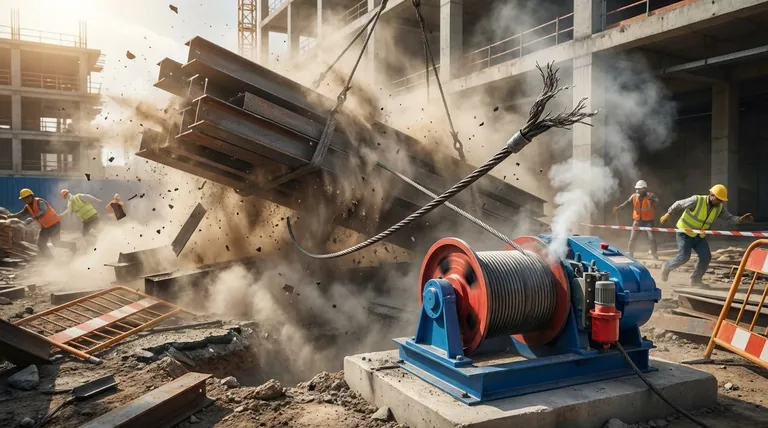
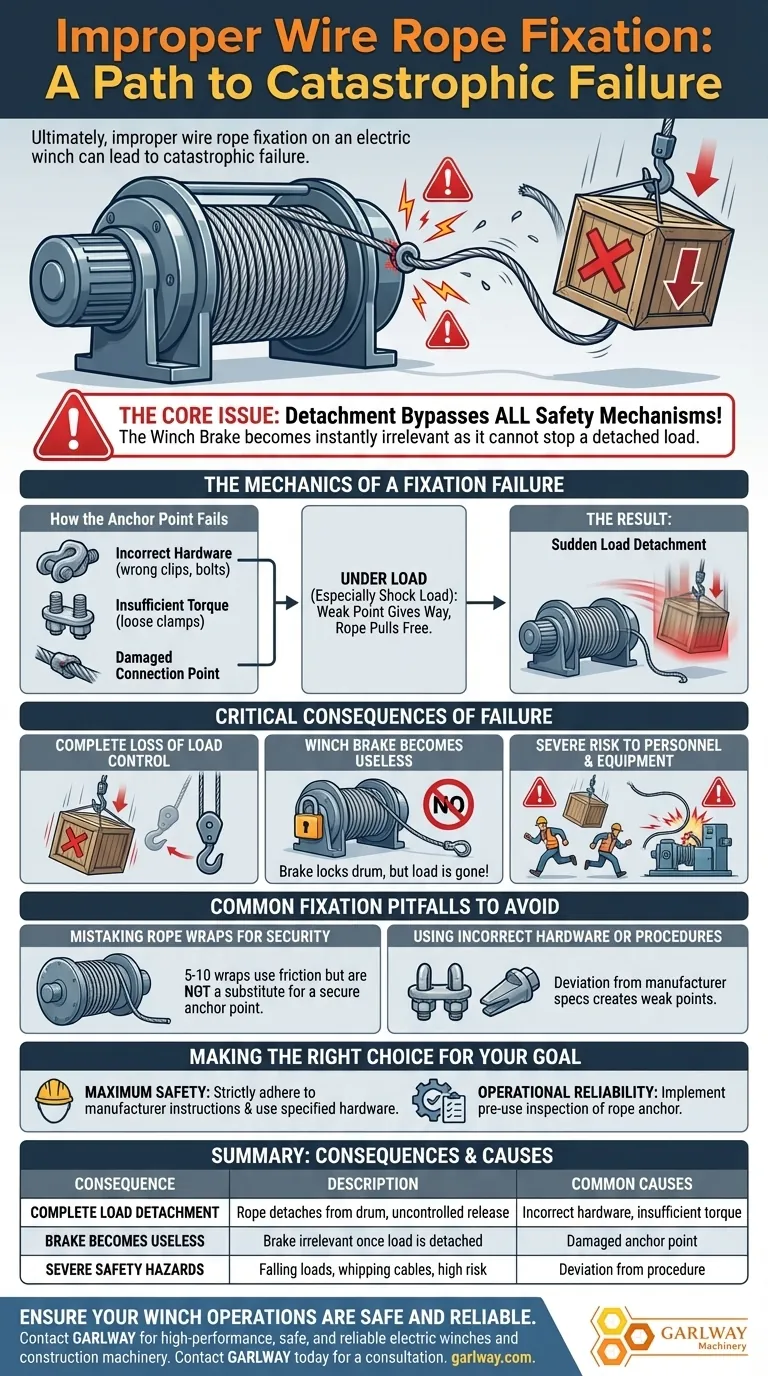
Ultimately, improper wire rope fixation on an electric winch can lead to catastrophic failure. This occurs when the anchor point on the winch drum cannot withstand the operational load, causing the rope to detach completely. The result is a sudden, uncontrolled release of the load, creating one of the most dangerous situations possible during a winching operation.
The core issue is not merely that the rope comes loose; it's that its detachment bypasses every other safety mechanism. The winch's brake becomes instantly irrelevant because it can only stop the drum, not a load that is no longer connected to it.
The Mechanics of a Fixation Failure
The connection point of the wire rope to the winch drum is the system's ultimate anchor. While not intended to bear the full operational load during normal use (that force is handled by the friction of the rope wraps on the drum), its integrity is non-negotiable.
How the Anchor Point Fails
Improper fixation means this anchor point is compromised from the start. This can happen through the use of incorrect hardware, insufficient torque on clamps, or a damaged connection point on the drum itself.
Under load, especially a shock load, this weak point gives way. The rope end pulls free from its anchor, and the entire line rapidly and violently unspools from the drum.
The Result: Sudden Load Detachment
The most immediate consequence is the complete detachment of the wire rope from the winch. The winch is no longer connected to the load it was moving or holding.
This leads to a sudden and total loss of control. A suspended load will fall, and a pulled load will move uncontrollably in response to gravity or other forces.
Critical Consequences of Failure
A fixation failure is not a minor issue; it's a critical event with severe, cascading consequences for both personnel and equipment.
Complete Loss of Load Control
This is the primary and most dangerous outcome. The winch becomes powerless to stop or manage the load's movement, as the physical link between them has been severed.
The Winch Brake Becomes Useless
The reference to "brake failing to position correctly" is more accurately understood as the brake becoming irrelevant. The winch's mechanical brake is designed to lock the drum.
If the rope is no longer attached to the drum, the brake can function perfectly, but it has nothing to hold. The load is already gone.
Severe Risk to Personnel and Equipment
A falling load poses an obvious and extreme danger to anyone in the vicinity. Furthermore, a wire rope detaching under high tension can whip around with immense force, causing severe injury or damage to surrounding equipment.
Common Fixation Pitfalls to Avoid
Understanding why these failures occur is key to preventing them. The root cause is almost always a deviation from established procedure and manufacturer specifications.
Mistaking Rope Wraps for Security
A common rule of thumb is to keep at least 5-10 wraps of rope on the drum at all times. These wraps use friction to distribute the load.
However, these wraps are not a substitute for a secure anchor point. The anchor is the final line of defense if the rope ever pays out to its end.
Using Incorrect Hardware or Procedures
Every winch has a specific, manufacturer-designed method for terminating the rope at the drum. Using the wrong size clips, bolts, or wedge sockets creates a weak point that will fail under stress.
Making the Right Choice for Your Goal
Preventing fixation failure comes down to diligence and adherence to standards. Your operational goal will determine where you focus your efforts.
- If your primary focus is maximum safety: Strictly adhere to the winch manufacturer's instructions for wire rope installation, using only the specified hardware and torque values.
- If your primary focus is operational reliability: Implement a pre-use inspection checklist that explicitly includes checking the security of the rope anchor on the drum.
Ultimately, the integrity of the wire rope's fixation is a non-negotiable foundation of safe winch operation.
Summary Table:
| Consequence | Description |
|---|---|
| Complete Load Detachment | The rope detaches from the drum, leading to uncontrolled load release. |
| Brake Becomes Useless | The winch brake is irrelevant once the load is no longer connected to the drum. |
| Severe Safety Hazards | High risk of falling loads and whipping cables, endangering personnel and equipment. |
| Common Causes | Incorrect hardware, insufficient torque, or damage to the drum's anchor point. |
Ensure Your Winch Operations Are Safe and Reliable
Don't let improper wire rope fixation put your projects and personnel at risk. GARLWAY specializes in high-performance construction machinery, including durable electric winches, concrete mixers, and batching plants designed for safety and reliability.
Our experts can help you select the right equipment and implement best practices to prevent catastrophic failures.
Contact GARLWAY today for a consultation and ensure your winching operations are built on a foundation of safety.
Visual Guide
Related Products
- Electric 120V Boat Winch by Badlands
- Small Electric Winch 120V and 240V for Compact Applications
- 12000 lb Electric Boat Trailer Winch with Windlass Anchor Warn
- Electric Hoist Winch Boat Anchor Windlass for Marine Applications
- Electric and Hydraulic Winch for Heavy Duty Applications
People Also Ask
- How do electric boat winches work? Unlock Effortless Launching & Retrieval
- How much current does an electric boat winch draw? Plan Your Electrical System for Peak Performance
- Can I run a winch straight from a battery? Essential Power Setup for Safe Operation
- What are the types of electric winches available? Choose the Right Winch for Your Job
- What are the uses of electric winches in mining and tunneling? Enhance Safety and Efficiency Underground





