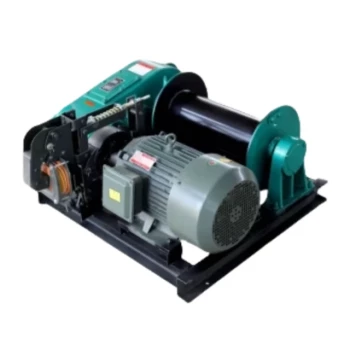
The typical weight capacity of a manual winch ranges from approximately 300 kilograms (around 660 pounds) to 1.2 tons (1,200 kg or about 2,645 pounds). This range covers a wide array of light to medium-duty tasks, positioning the manual winch as a versatile tool for specific applications.
While the numbers define its limits, the true value of a manual winch lies in its mechanical simplicity and reliability. Selecting the right model is less about finding the highest capacity and more about matching its fundamental design to your specific operational needs and environment.

The Principles of Manual Winch Capacity
A manual winch's capacity is not an arbitrary number; it is the direct result of its mechanical design. Understanding these core components helps clarify why a specific winch is rated for a certain load.
The Core Components of Strength
The foundation of a winch's strength comes from its construction. A sturdy steel plate shell and drum provide the structural integrity needed to handle immense tension without deforming.
Internally, the spur gear transmission mechanism is the heart of the machine. This system of gears multiplies the force applied by the operator at the hand crank, allowing a modest human effort to pull or lift a significant load.
Pulling vs. Lifting Capacity
It is critical to distinguish between pulling and lifting. Pulling capacity refers to dragging a load horizontally, where friction is the primary resistance. Lifting capacity (hoisting) refers to raising a load vertically against the full force of gravity.
A winch's lifting capacity is almost always significantly lower than its pulling capacity. Never use a winch for overhead lifting unless it is explicitly rated as a hoist.
Safety and Control Mechanisms
High-quality manual winches incorporate a load brake. This crucial safety feature automatically engages to prevent the drum from slipping backward when you stop cranking, ensuring the load is held securely and can be lowered smoothly and safely.
When is a Manual Winch the Right Tool?
Manual winches thrive in scenarios where their specific advantages in simplicity, cost, and portability outweigh the need for speed or extreme power.
Ideal Use Cases
Their affordability and ease of installation make them perfect for smaller loads. Common applications include loading equipment onto small trailers, tensioning fences, or providing light-duty recovery for smaller off-road vehicles.
The Portability Advantage
Without the need for a battery or power source, manual winches are inherently portable. Their compact design allows them to be easily mounted, moved, and operated in remote locations where electric or hydraulic systems are impractical.
Unmatched Reliability
A manual winch has far fewer points of failure than its powered counterparts. With no motors, wiring, or solenoids to burn out, its operation is simple and dependable, making it a reliable tool in harsh conditions.
Understanding the Trade-offs and Limitations
To use a manual winch effectively, you must be aware of its inherent limitations. These trade-offs are central to deciding if it's the correct tool for your job.
Physical Effort and Speed
The most obvious trade-off is manual operation. Moving a heavy load requires significant physical effort from the operator. The process is also much slower compared to an electric winch, making it unsuitable for tasks requiring rapid or frequent use.
The Firm Capacity Ceiling
While 1.2 tons is a respectable capacity, it falls short of the heavy-duty power offered by many electric and hydraulic winches, which can handle loads many times greater. A manual winch is purpose-built for the lighter end of the workload spectrum.
Environmental Constraints
Most manual winches are designed to operate within a specific temperature range, typically between -10°C and +50°C. While robust, their steel components and cables require proper maintenance, as exposure to moisture can lead to corrosion if the protective paint is compromised.
Making the Right Choice for Your Task
Selecting the appropriate winch comes down to a clear assessment of your primary goal.
- If your primary focus is portability and cost-effectiveness: A manual winch is an excellent choice for loads under 1.2 tons, especially in situations where a power source is unavailable or unreliable.
- If your primary focus is speed, frequent use, or heavier loads: The physical demands and capacity limits of a manual winch make an electric or hydraulic model a more practical and efficient investment.
- If your primary focus is safety for vertical lifting: You must select a device specifically rated as a "hoist" that includes a reliable load-holding brake, not a standard pulling winch.
Understanding these core principles ensures you select a tool that is not only capable but perfectly suited to your specific operational needs.
Summary Table:
| Feature | Specification |
|---|---|
| Typical Capacity Range | 300 kg (660 lbs) to 1,200 kg (1.2 tons / 2,645 lbs) |
| Primary Operation | Manual Crank |
| Ideal For | Light to medium-duty pulling, loading, tensioning |
| Key Advantage | Portability, reliability, no power source needed |
| Key Limitation | Requires physical effort; slower than powered winches |
Need a reliable and cost-effective solution for your light to medium-duty lifting and pulling tasks?
At GARLWAY, we specialize in durable construction machinery, including a range of manual winches perfectly suited for construction companies and contractors. Our winches are engineered for mechanical simplicity and reliability in demanding environments.
Contact our experts today to discuss your specific needs and find the right manual winch to enhance safety and efficiency on your job site.
Visual Guide

Related Products
- Portable Small Trailer Winch
- Quick Windlass Portable Winch for Truck and Boat Best Boat Winch
- Electric and Hydraulic Winch for Heavy Duty Applications
- Small Electric Winch 120V and 240V for Compact Applications
- Hydraulic Winding Engine Harbor Freight Winch
People Also Ask
- What features were incorporated into the upgraded portable winch system? Boost Your Recovery Power & Safety
- What are some uses mentioned for portable winches beyond vehicle recovery? Essential Versatility for Property & Work
- How could the twisting issue with a portable winch be mitigated? Achieve Safe, Centered Pulls with Proper Rigging
- What is the significance of trailer winches in the boating industry? Ensure Safe and Efficient Boat Recovery
- What should be considered when mounting a winch on a trailer? Ensure a Safe, Aligned Installation