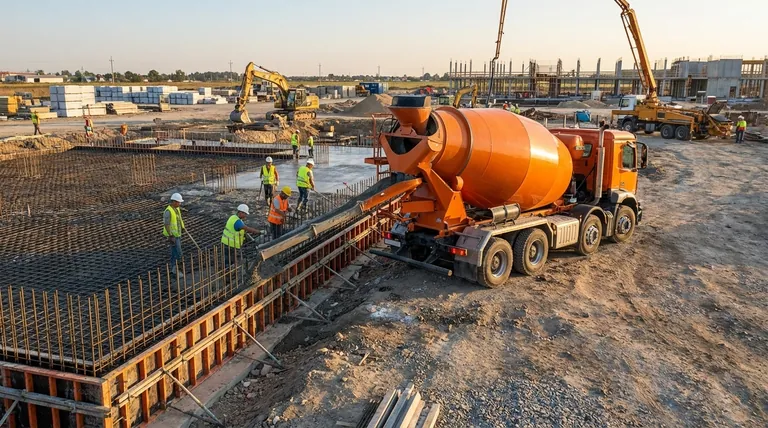
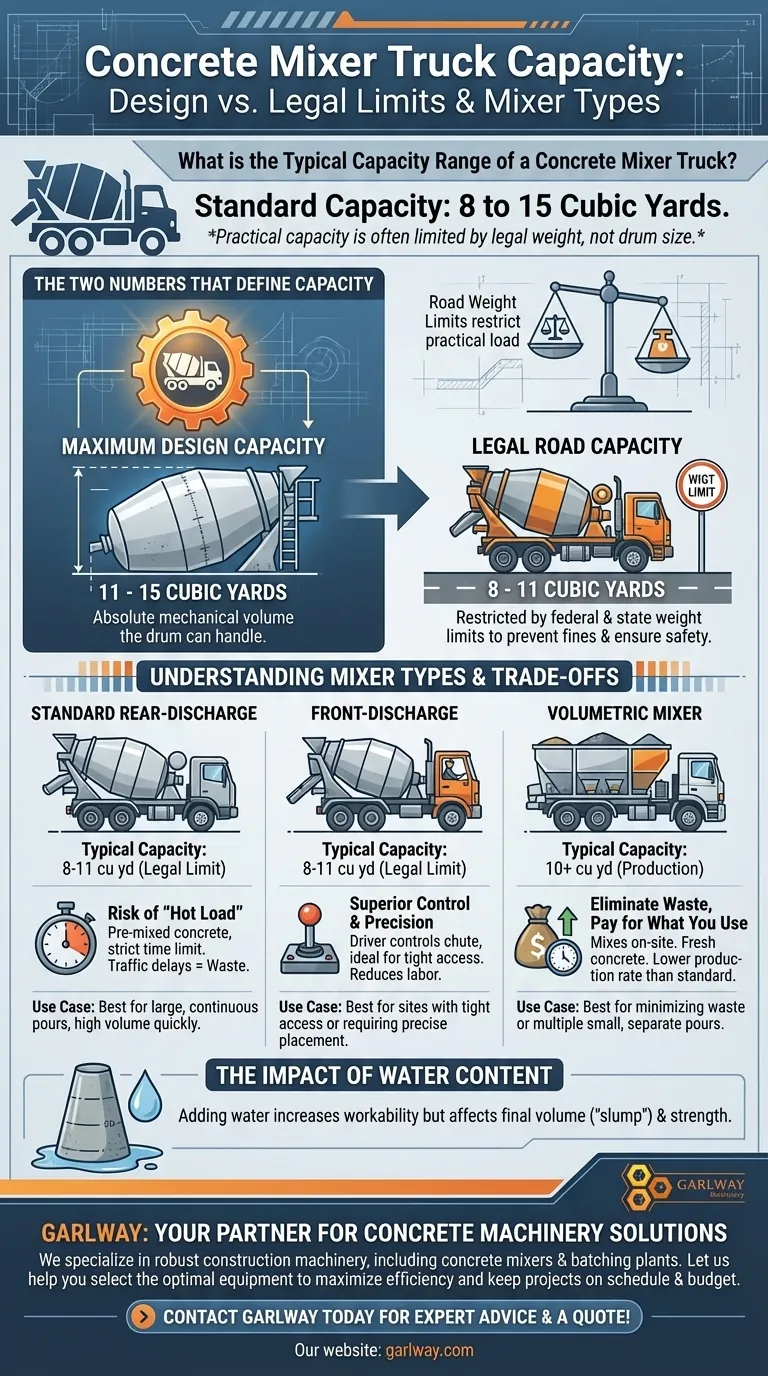
A standard concrete mixer truck's capacity typically falls within a range of 8 to 15 cubic yards. The specific amount a truck can legally carry is most often dictated by local and state road weight restrictions, not the physical size of its mixing drum. This means the practical, delivered capacity is frequently less than the truck's maximum design capacity.
The key to understanding concrete truck capacity isn't just the size of the drum, but the interplay between the truck's design and strict regional weight regulations. The right choice often depends on the type of mixer, as some mix concrete on-site, changing the entire capacity equation.
The Two Numbers That Define Capacity
For any given concrete mixer, there are two different capacity figures to consider: the maximum volume the drum can hold and the maximum volume it can legally transport on public roads.
Maximum Design Capacity
A typical mixing drum is designed to hold and mix between 11 and 15 cubic yards of concrete. This represents the absolute maximum volume the equipment can handle from a purely mechanical standpoint.
Legal Road Capacity
The more important number for logistics and planning is the legal capacity. Due to federal and state gross vehicle weight limits, most trucks are restricted to carrying 8 to 11 cubic yards. Loading a truck to its full design capacity would make it too heavy for most public roads, resulting in fines and safety risks.
Beyond the Standard Drum: Understanding Mixer Types
The term "concrete mixer truck" can refer to several distinct types of vehicles, each with operational differences that affect how you should think about their capacity.
The Standard Rear-Discharge Mixer
This is the most common type of mixer truck. It is loaded with pre-mixed concrete at a batch plant and must deliver it to the site before it begins to set. Its capacity is defined by the legal weight limits mentioned above.
The Front-Discharge Mixer
This model operates similarly to a rear-discharge mixer but allows the driver to control the chute from inside the cab. This provides greater precision and control, making it ideal for job sites with tight access. Its capacity is also governed by road weight limits, falling in the same 8 to 11 cubic yard range.
The Volumetric Mixer
A volumetric mixer functions as a mobile batch plant. It carries sand, stone, cement, and water in separate compartments. The materials are mixed on-site to produce the exact amount of fresh concrete needed. Its "capacity" is the total volume it can produce—often over 10 cubic yards—not the amount of wet concrete it transports.
Understanding the Trade-offs
Choosing the right truck is about more than just volume; it involves balancing efficiency, waste, and concrete quality.
Standard Mixers: The Risk of a "Hot Load"
Because standard transit mixers carry pre-mixed concrete, they are on a strict time limit. Any traffic delays or on-site issues can cause the concrete to harden in the drum (a "hot load"), leading to the waste of the entire batch.
Volumetric Mixers: Precision vs. Production Rate
The primary benefit of a volumetric mixer is eliminating waste—you only pay for what you make. The concrete is always fresh. However, for massive, continuous pours like a large building foundation, a fleet of standard trucks can often deliver a higher volume of concrete per hour.
The Impact of Water Content
Remember that the final yielded volume of concrete can be affected by its "slump," or consistency. Adding more water on-site to increase workability takes up volume and can impact the concrete's final strength if not done according to the mix design.
Making the Right Choice for Your Project
Selecting the appropriate truck and understanding its effective capacity are critical for keeping a project on schedule and on budget.
- If your primary focus is a large, straightforward pour: A fleet of standard rear-discharge trucks, each loaded to its legal capacity, is the most efficient way to deliver high volume quickly.
- If your primary focus is tight access or requires precise placement: A front-discharge mixer offers superior control and reduces the need for extra labor to move concrete on-site.
- If your primary focus is minimizing waste or you have multiple small, separate pours: A volumetric mixer is the ideal choice, as it produces exactly what you need, when you need it.
Ultimately, matching the truck's capabilities to your project's specific demands ensures you get the right amount of quality concrete exactly where you need it.
Summary Table:
| Mixer Type | Typical Capacity (Cubic Yards) | Key Consideration |
|---|---|---|
| Standard Rear-Discharge | 8 - 11 (Legal Road Limit) | Delivers pre-mixed concrete; efficient for large pours. |
| Front-Discharge | 8 - 11 (Legal Road Limit) | Offers superior control for sites with tight access. |
| Volumetric Mixer | 10+ (Production Capacity) | Mixes on-site to eliminate waste; ideal for multiple small pours. |
Need the Right Concrete Mixer for Your Project's Demands?
Understanding capacity is just the first step. GARLWAY specializes in providing robust construction machinery—including concrete mixers and batching plants—tailored for construction companies and contractors worldwide.
We help you:
- Select the optimal equipment for your project's scale, access, and concrete requirements.
- Maximize efficiency and minimize waste with reliable machinery built for performance.
- Ensure your project stays on schedule and budget with equipment designed for durability and ease of use.
Let's discuss your specific needs. Contact GARLWAY today for expert advice and a quote!
Visual Guide
Related Products
- Ready Mixer Machine for Construction Ready Mix Machinery
- JW1000 Mobile Cement Mixer Concrete Mixer Truck and Batching Plant
- Mini Cement Mortar Mixer Truck for Construction
- Harbor Freight JS1500 On Site Concrete Mixing Volumetric Cement Mixer
- HZS90 Large Multiquip Concrete Mixers for Construction
People Also Ask
- What are the purposes of low-speed agitation in truck mixers? Preserve Concrete Quality During Transit
- How is ready-mixed concrete transported from a commercial concrete batching plant? Ensuring Quality & Timely Delivery
- What are the main ingredients mixed in a concrete mixer truck? Master the Formula for Strong Concrete
- In what ways does a mobile concrete mixer improve quality control and consistency? Achieve Superior On-Site Concrete Quality
- What types of construction projects typically use concrete mixer trucks? From Highways to Home Foundations