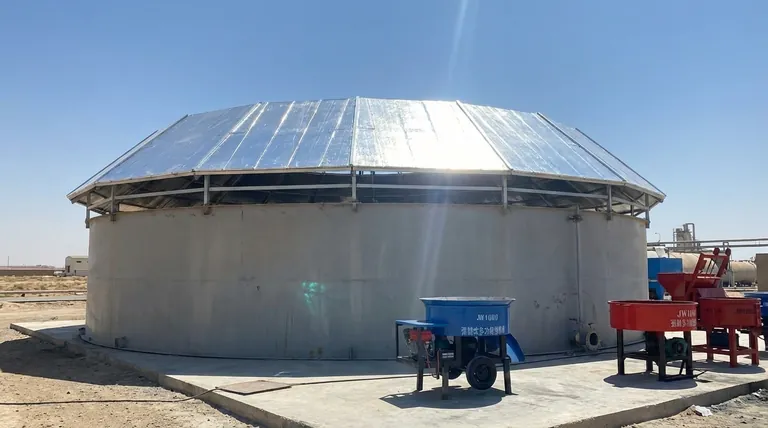
The fundamental purpose of installing reflective insulation panels on cement tanks is to act as a radiant barrier, significantly reducing the amount of solar heat the tank absorbs. By reflecting the sun's energy away, these panels protect the tank's contents from overheating, which mitigates a range of potential hazards and operational problems.
This solution is not about traditional insulation, which slows the transfer of heat. Instead, it is an engineering control designed to block solar radiation at the source, preventing the tank from ever absorbing the majority of the sun's energy in the first place.
The Core Problem: Uncontrolled Solar Heat Gain
When a large cement tank is exposed to direct sunlight, it absorbs a tremendous amount of radiant energy. This process, known as solar heat gain, can have serious negative consequences for the tank and its contents.
Consequence 1: Hazardous Pressure Buildup
For tanks storing volatile liquids or chemicals, rising internal temperatures cause the liquid to vaporize more rapidly. This increases the internal pressure, which can exceed the tank's design limits and create a significant safety hazard.
Consequence 2: Product Degradation and Loss
Many stored materials, from chemicals to agricultural products, are sensitive to temperature. Excessive heat can cause spoilage, trigger unwanted chemical reactions, or reduce product efficacy. For water tanks, heat gain accelerates evaporation, leading to direct material loss.
Consequence 3: Thermal Stress on the Tank
The constant cycle of heating during the day and cooling at night creates thermal stress on the cement structure itself. Over long periods, this can contribute to material fatigue and shorten the operational lifespan of the tank.
How Reflective Panels Counteract Heat Gain
Reflective insulation panels work on a simple but highly effective principle. They are a purpose-built shield designed to manage thermal radiation.
The Principle of a Radiant Barrier
Unlike foam or fiberglass insulation that slows heat conduction, a radiant barrier uses a highly reflective surface to bounce thermal radiation away. The panels effectively form a shield that reflects the sun's rays before they can strike the tank's surface and be absorbed as heat.
The Critical Importance of the Air Gap
The references note that panels are installed at a certain height above the tank's roof. This air gap is not an incidental detail; it is critical to the system's function.
The gap allows air to circulate freely via convection. Any heat that is absorbed by the panel itself, or that radiates into the space between the panel and the tank, is carried away by this natural airflow, preventing it from becoming trapped and heating the tank below.
Understanding the Key Trade-offs
While effective, this solution is specific to a particular problem and is not a universal fix for all thermal management issues.
Effective Against Radiation, Not Conduction
These panels are exclusively designed to combat radiant heat from the sun. They offer minimal protection against high ambient air temperatures (convective heat) or heat transferring from the ground (conductive heat).
Structural and Maintenance Considerations
Adding panels creates a structure that must be engineered to withstand wind and weather. The reflective surfaces must also be kept relatively clean to maintain their effectiveness, which may add a minor maintenance requirement.
Cost vs. Benefit Analysis
The initial investment for a paneling system must be weighed against the value of the product being stored and the potential cost of a safety incident. For low-value, non-hazardous materials, the expense may not be justified.
Making the Right Choice for Your Application
To determine if this solution is right for your needs, consider the primary risk you are trying to mitigate.
- If your primary focus is safety with volatile materials: A radiant barrier is a critical engineering control to prevent dangerous over-pressurization.
- If your primary focus is preserving product quality: This system provides the temperature stability needed to protect heat-sensitive chemicals, additives, or food products.
- If your primary focus is preventing water loss: Reflective panels directly reduce evaporation by keeping the bulk water temperature lower, conserving a valuable resource.
Ultimately, reflective insulation is a targeted solution engineered to solve the specific and powerful problem of solar radiation on storage tanks.
Summary Table:
| Purpose | Key Benefit | Ideal For |
|---|---|---|
| Radiant Barrier | Reflects solar energy away from the tank | Preventing hazardous pressure buildup |
| Temperature Control | Reduces internal heat gain | Protecting heat-sensitive products |
| Evaporation Reduction | Lowers water temperature to minimize loss | Conserving water in storage tanks |
| Structural Protection | Mitigates thermal stress on cement | Extending the tank's operational lifespan |
Protect Your Assets with GARLWAY's Engineered Solutions
Is your cement tank at risk from solar heat gain? GARLWAY specializes in construction machinery and storage solutions, offering durable components and expert advice for construction companies and contractors globally. We can help you select the right protective measures to ensure operational safety and product integrity.
Contact our experts today for a customized solution to prevent overheating, product degradation, and hazardous pressure buildup in your storage tanks.
Visual Guide

Related Products
- Auto Concrete Cement Mixer Machine New
- Construction Products Concrete Plant Machine Mixing Concrete Mixer
- Commercial Electric Concrete Mixer Machine HZS 50 Small Batch Plant for Sale
- HZS35 Small Cement Concrete Mixing Batch Plant
- HZS180 Ready Mix Concrete Plant for Foundations with Sand and Cement
People Also Ask
- What are the four factors to consider when selecting a concrete mixer? Optimize Your Construction Project
- What are the two main types of concrete mixers and their uses? Choose the Right Mixer for Your Project
- What is a concrete mixer and what does it do? Achieve Consistent, High-Strength Concrete
- What are the benefits of using a concrete mixer on construction sites? Boost Efficiency and Quality
- How should water be added when mixing concrete? A Guide to Achieving Perfect Strength & Workability