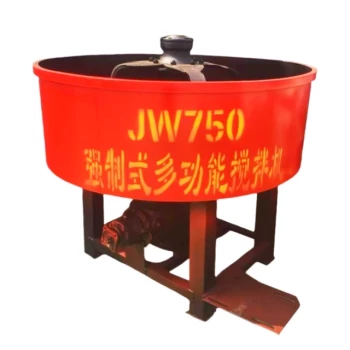
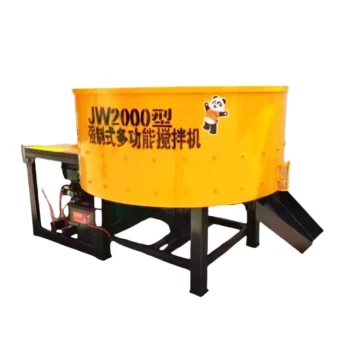
At its core, the general process flow of a concrete batching plant is a highly controlled, sequential operation designed for precision. It begins with feeding raw materials like aggregates, sand, cement, and water into the system, followed by their exact weighing or "batching" according to a specific recipe. These batched materials are then combined in a central mixer until homogeneous, and finally, the finished concrete is discharged for transport.
A concrete batching plant functions as a sophisticated factory for one product: concrete. Its entire process is automated to ensure that every single batch has the precise ingredient proportions and consistency required for modern construction, minimizing waste and guaranteeing quality.
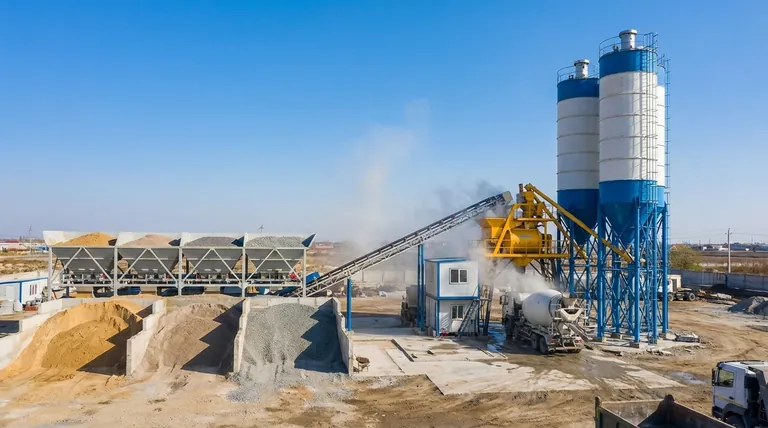
The Anatomy of the Process: A Step-by-Step Breakdown
To truly understand the plant's function, it's best to view it as a linear assembly line. Each stage is distinct and serves a critical purpose in converting raw components into a finished structural material.
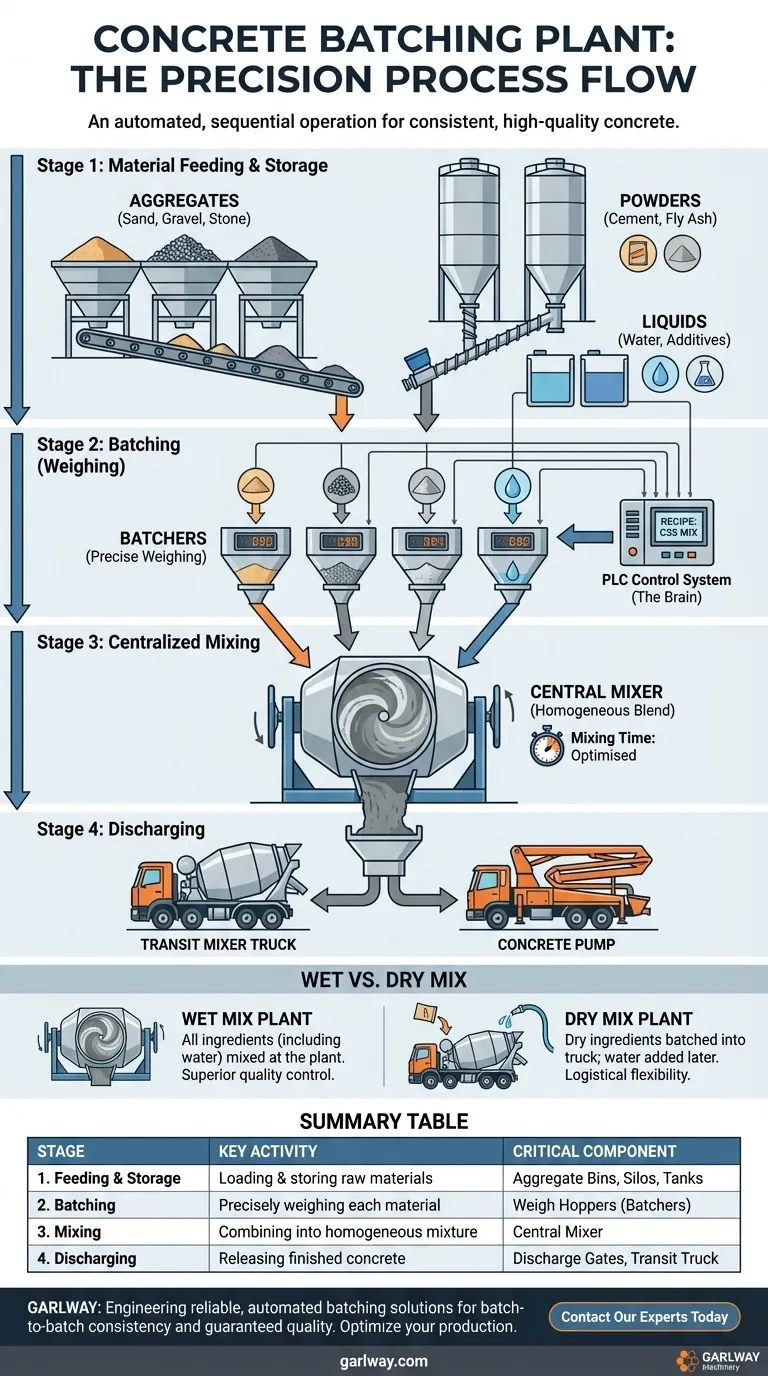
Step 1: Material Feeding and Storage
The process begins with loading and storing the raw ingredients.
Aggregates, such as sand, gravel, and crushed stone, are loaded into separate aggregate bins. Keeping them separate is crucial to allow for precise mixing based on the recipe.
Powders like cement and supplementary materials like fly ash are stored in large, upright silos to protect them from moisture and the elements.
Water and chemical additives are held in their own dedicated tanks, ready to be dosed into the mix.
Step 2: Batching (The Weighing Stage)
This is the most critical stage for ensuring the quality and strength of the final concrete.
Using a system of belt conveyors and screw conveyors, the aggregates and powders are moved from their storage bins and silos to weighing hoppers, often called batchers.
Each material—aggregates, cement, water, and additives—is weighed individually with extreme accuracy according to the pre-programmed mix design. This precision is the defining feature of a modern batching plant.
Step 3: Centralized Mixing
Once precisely weighed, all ingredients are discharged into the plant's core component: the central mixer.
The mixer, often a rotating drum or pan-style unit, blends all the materials for a specific, pre-set duration.
This mechanical action ensures every particle of sand and aggregate is evenly coated with cement paste (the mixture of cement and water), creating a completely homogeneous and durable concrete mix.
Step 4: Discharging the Final Product
After the mixing cycle is complete, the plant's discharge gates open.
The fresh, ready-to-use concrete is then released directly into a transit mixer truck or a concrete pump, which will transport it to the construction site for pouring.
The Brains of the Operation: The Control System
The entire sequence is not managed manually but by a sophisticated, centralized control system that acts as the plant's brain.
The Role of the PLC
Modern plants are governed by a Programmable Logic Controller (PLC). This computer system automates every step, from opening the gates on the aggregate bins to controlling the mixing time down to the second.
Ensuring Accuracy and Consistency
The control panel allows an operator to select a specific mix recipe from a saved list. The PLC then executes that recipe perfectly every time, eliminating the human error that would be inevitable in manual measurement. This guarantees batch-to-batch consistency.
Data and Reporting
A key function of the control system is its ability to save and print batch reports. This data is vital for quality control, providing a record that proves each batch of concrete was produced exactly to specification.
Understanding the Trade-offs: Wet vs. Dry Mix
While the process described is the most common, it's important to recognize a key variation that impacts where the final mixing occurs.
Wet Mix Plants
The process detailed above describes a wet mix plant. All ingredients, including water, are mixed together at the plant to produce concrete that is ready to be poured upon arrival at the site. This offers superior quality control and consistency.
Dry Mix Plants (Transit Mix)
In a dry mix operation, the plant weighs and batches all the dry ingredients (aggregates and cement) into the transit mixer truck. Water is then added to the truck's drum either during transit or upon arrival at the job site. This offers more flexibility for travel time but places more responsibility for final mix quality on the truck operator.
Making the Right Choice for Your Goal
The specific plant configuration directly impacts the final product and project logistics.
- If your primary focus is consistent, high-quality structural concrete: A wet mix plant with a fully automated PLC control system is essential for its precision batching and thorough, centralized mixing.
- If your primary focus is logistical flexibility for distant job sites: A dry mix (transit mix) operation may be more suitable, as it allows for managing the concrete's workability time by adding water just before the pour.
- If your primary focus is operational efficiency and quality assurance: Leveraging a plant's PLC system to manage recipes, automate the process, and generate batch reports is the best way to minimize waste and ensure compliance.
Ultimately, the concrete batching process is a meticulously controlled sequence designed to transform raw materials into the predictable, high-performance foundation of modern construction.
Summary Table:
| Stage | Key Activity | Critical Component |
|---|---|---|
| 1. Feeding & Storage | Loading and storing raw materials (aggregates, cement, water) | Aggregate Bins, Silos, Tanks |
| 2. Batching | Precisely weighing each material according to a mix recipe | Weigh Hoppers (Batchers) |
| 3. Mixing | Combining all ingredients into a homogeneous mixture | Central Mixer |
| 4. Discharging | Releasing the finished concrete for transport | Discharge Gates, Transit Mixer Truck |
Ready to Achieve Precise, High-Quality Concrete for Your Construction Projects?
GARLWAY specializes in engineering reliable and efficient construction machinery, including advanced concrete batching plants, winches, and concrete mixers. Our automated solutions, governed by sophisticated PLC control systems, are designed for construction companies and contractors who demand batch-to-batch consistency, minimized waste, and guaranteed quality.
Let us help you optimize your concrete production. Contact our experts today to discuss your project requirements and discover the right batching plant solution for your needs.
Visual Guide
Related Products
- HZS35 Small Cement Concrete Mixing Batch Plant
- HZS120 Ready Mix Concrete Batching Plant Commercial Mud Cement Mixer
- HZS75 Concrete Batching Plant Cement Mixer Price Concrete Mixer Bunnings Mixing Plant
- HZS180 Ready Mix Concrete Plant for Foundations with Sand and Cement
- Commercial Electric Concrete Mixer Machine HZS 50 Small Batch Plant for Sale
People Also Ask
- Why buy concrete batch plant parts only from the manufacturer? Protect Your Investment and Maximize Uptime
- Why is proper maintenance important for a concrete batch mix plant? Maximize Uptime & Profitability
- What is the advantage of a mobile concrete batching plant? Achieve On-Site Production & Total Control
- What are the advantages and disadvantages of concrete batching plants? Maximize Quality & Efficiency
- What are the two methods of material charging in a concrete mixing station? Single vs. Multiple Charging Explained