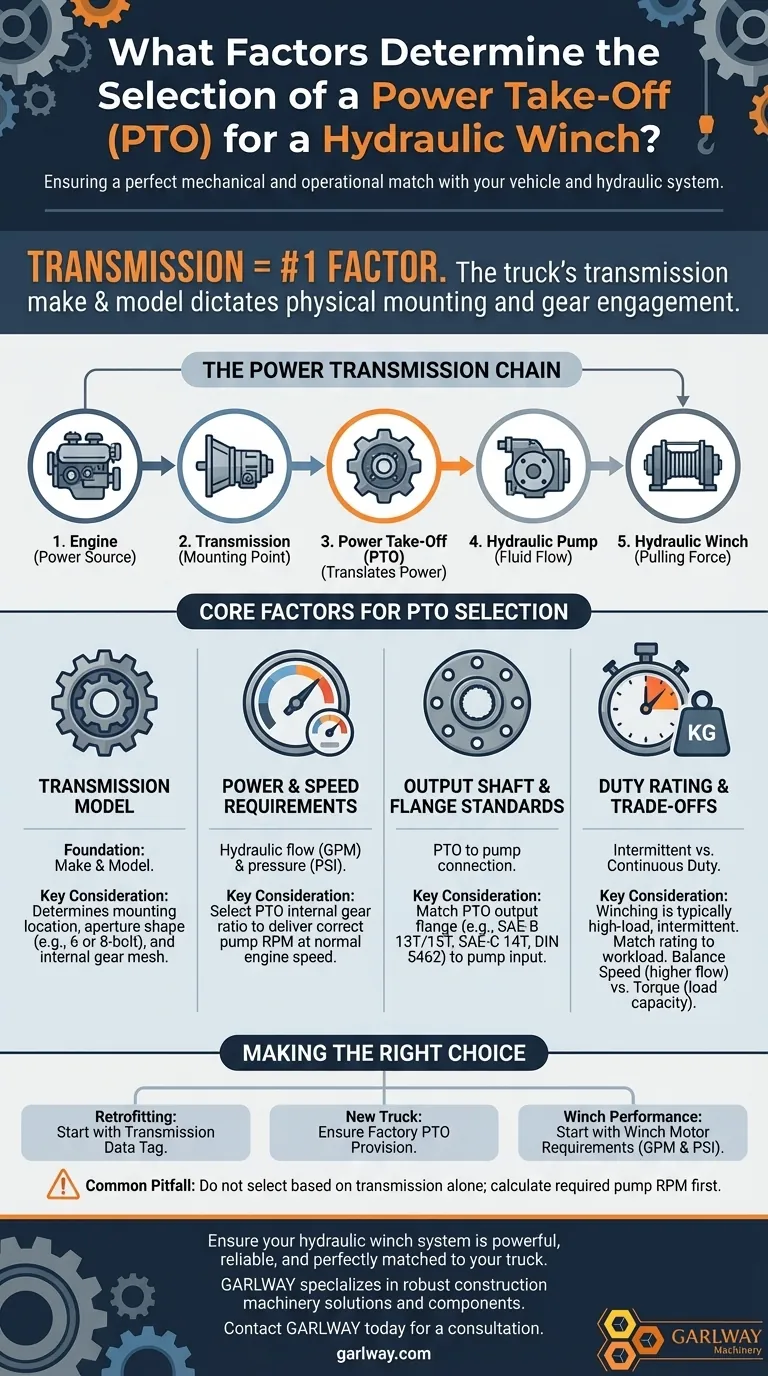
The single most important factor in selecting a Power Take-Off (PTO) for a hydraulic winch is the truck's transmission. The specific make and model of the transmission dictates the physical mounting compatibility and the type of gear the PTO must engage with, making it the non-negotiable starting point for your entire selection process.
A Power Take-Off is the critical bridge translating your truck's engine power into usable hydraulic force for the winch. Selecting the right one is less about the winch itself and more about ensuring a perfect mechanical and operational match with your vehicle's transmission and the hydraulic pump.
The Role of the PTO in Your Hydraulic System
A PTO is essential for powering heavy-duty hydraulic equipment that demands more flow and pressure than a standard vehicle system, like the power steering pump, can provide.
From Engine Power to Hydraulic Force
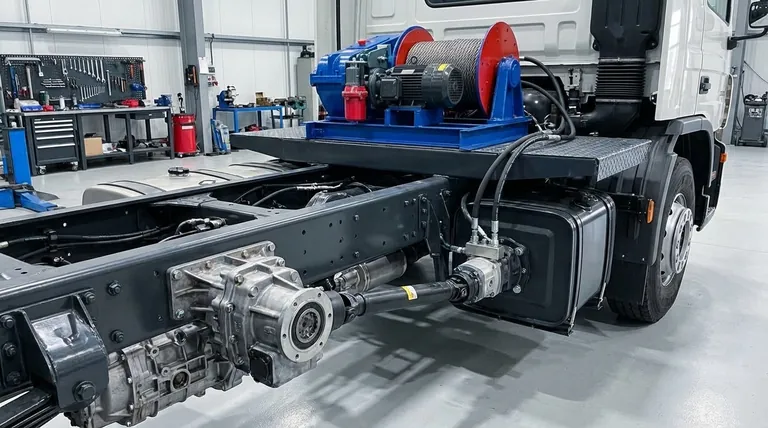
The PTO bolts directly to a specific aperture on the vehicle's transmission. When engaged, it uses the transmission's gearing to spin a shaft. This rotating shaft, in turn, drives a hydraulic pump, which creates the fluid pressure and flow needed to operate the winch's hydraulic motor.
The Power Transmission Chain
The flow of power is linear and sequential:
- Engine: Creates the initial rotational power.
- Transmission: Manages engine power and provides the mounting point for the PTO.
- Power Take-Off (PTO): Taps into the transmission's gearing to create a separate, controllable power output.
- Hydraulic Pump: Connects to the PTO and converts its rotational energy into hydraulic fluid flow.
- Hydraulic Winch: Uses the pressurized fluid from the pump to generate immense pulling force.
Core Factors for PTO Selection
While the transmission is the starting point, several interconnected factors determine the final choice. You must consider the entire system from the gear in the transmission to the hydraulic needs of the winch.
The Transmission: Your Primary Constraint
Your truck's transmission is the foundation. You must identify its exact make and model. This information determines the PTO mounting location (left side, right side, bottom), the shape of the mounting aperture (e.g., 6-bolt, 8-bolt), and the type of gear inside the transmission that the PTO must mesh with.
Power and Speed Requirements
The hydraulic winch and pump have specific requirements for flow (gallons per minute) and pressure (PSI). To meet these, the hydraulic pump must be spun at an optimal RPM. The PTO's internal gear ratio, combined with the engine's speed, determines this output speed. You must select a PTO ratio that delivers the correct RPM to the pump at a normal working engine speed.
Output Shaft and Flange Standards
The PTO's output shaft is what connects directly to the hydraulic pump. This connection is standardized to ensure compatibility. You must match the PTO's output flange to the pump's input.
Common standards include:
- SAE-B (2-bolt or 4-bolt): Often with a 13-tooth (13T) or 15-tooth (15T) spline.
- SAE-C (4-bolt): Typically with a 14-tooth (14T) spline for higher torque applications.
- DIN 5462: A European standard common on transmissions like ZF.
Understanding the Trade-offs
Choosing a PTO involves balancing performance, cost, and complexity. An incorrect choice can lead to poor winch performance or even damage to the transmission.
Speed vs. Torque
A PTO with a higher speed ratio will spin the pump faster at a given engine RPM, generating more hydraulic flow (faster winch speed). However, this comes at the cost of torque. You must select a ratio that provides enough speed for the pump without exceeding the PTO's torque rating for the load the winch will handle.
Intermittent vs. Continuous Duty
PTOs are rated for either intermittent or continuous duty. Winching is typically an intermittent, high-load task. Using a PTO rated only for light, continuous duty could lead to overheating and premature failure in a heavy winching scenario. Always match the PTO's duty rating to your expected workload.
Common Pitfalls to Avoid
A frequent mistake is selecting a PTO based only on the transmission model without considering the pump's requirements. This can result in a winch that is dangerously fast and weak, or frustratingly slow and prone to stalling. Always calculate the required pump RPM first, then select the PTO gear ratio that achieves it.
Making the Right Choice for Your Application
Your goal is to create a seamless and efficient power transfer from the engine to the winch. Your starting point depends on whether you are retrofitting an existing vehicle or specifying a new one.
- If your primary focus is retrofitting an existing truck: Begin by identifying the transmission data tag to get the exact make and model, then find the PTO application catalog for that transmission.
- If your primary focus is specifying a new truck: Ensure the transmission you order is available with a factory-installed PTO provision compatible with your intended hydraulic system.
- If your primary focus is winch performance: Start with the winch's hydraulic motor requirements (flow and pressure), select a pump that can meet them, and then choose a PTO that can drive that pump at its optimal speed.
Ultimately, selecting the correct PTO ensures your hydraulic winch has the power and reliability to perform its job safely and effectively.
Summary Table:
| Factor | Description | Key Consideration |
|---|---|---|
| Transmission Model | The make and model of your truck's transmission. | Determines physical mounting and gear engagement. |
| Power & Speed | The required hydraulic flow (GPM) and pressure (PSI). | PTO ratio must deliver correct pump RPM. |
| Output Shaft Standard | The connection standard between the PTO and pump (e.g., SAE-B, SAE-C). | Ensures mechanical compatibility. |
| Duty Rating | The operational rating (intermittent or continuous). | Must match the expected winching workload. |
Ensure your hydraulic winch system is powerful, reliable, and perfectly matched to your truck.
GARLWAY specializes in providing robust construction machinery solutions, including hydraulic winches and the compatible components needed for seamless integration. Our experts can help you navigate PTO selection based on your specific transmission and performance requirements, ensuring optimal performance for construction companies and contractors globally.
Contact GARLWAY today for a consultation and let us power your projects with confidence.
Visual Guide
Related Products
- Electric and Hydraulic Winch for Heavy Duty Applications
- Hydraulic Winding Engine Harbor Freight Winch
- Small Electric Winch 120V and 240V for Compact Applications
- Electric 120V Boat Winch by Badlands
People Also Ask
- What are the differences between electric and hydraulic winches? Choose the Right Winch for Your Job
- What are some common uses for a heavy-duty winch? Power Your Construction & Industrial Projects
- What are electro-hydraulic winches and their applications? The Integrated Power Solution for Heavy-Duty Operations
- How do winches assist in bridge launching? Accelerate Bridge Placement with Controlled Pulling Power
- What are the benefits of using heavy-duty winches for large projects? Boost Efficiency & Safety