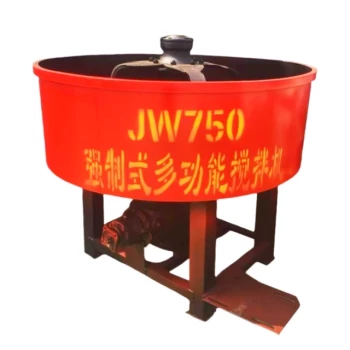
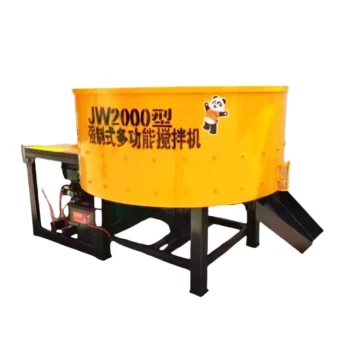
The primary advantage of a continuous mixer is its ability to produce a constant, uninterrupted flow of concrete. Unlike batch mixers that stop and start, a continuous mixer loads materials, mixes them, and discharges the final product all at the same time, dramatically increasing production efficiency for high-volume jobs.
The core value of a continuous mixer isn't just making concrete—it's transforming concrete production into a seamless, on-demand industrial process directly at the job site. This shift from discrete batches to a steady stream is what makes large-scale construction feasible and efficient.
How Continuous Mixing Redefines On-Site Production
To understand the advantage, it's essential to see how these machines differ fundamentally from their batch-based counterparts. The entire design is engineered for relentless output.
The Core Mechanism: A Non-Stop Assembly Line
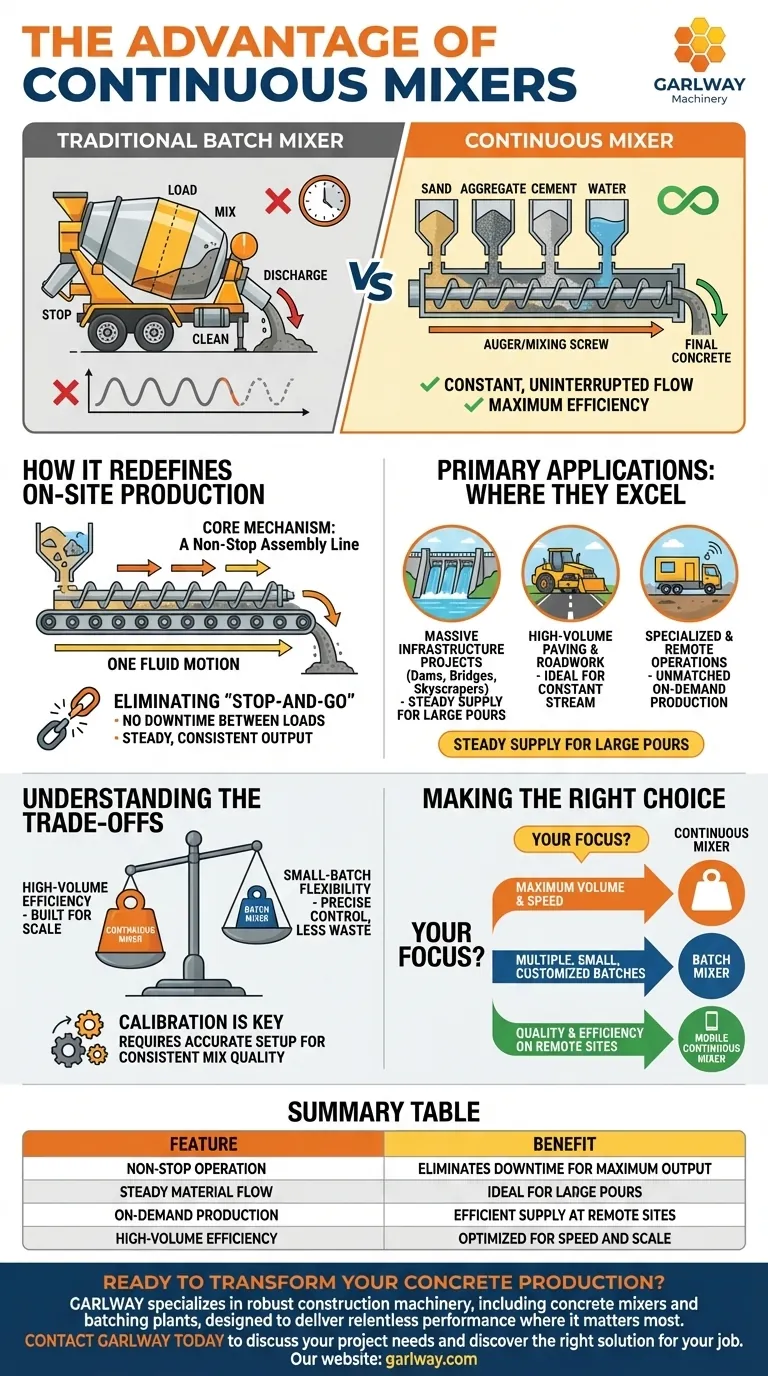
A continuous mixer operates like an assembly line. Raw materials like sand, aggregate, cement, and water are fed from hoppers into the machine.
Inside, a long auger or mixing screw simultaneously transports and blends the ingredients as they travel toward the discharge chute. This process happens in one fluid motion.
Eliminating the "Stop-and-Go" of Batching
Traditional batch mixers must be loaded, run for a specific mix time, completely discharged, and then cleaned before the next cycle can begin. This creates unavoidable downtime between loads.
Continuous mixers eliminate this entire cycle. As long as raw materials are supplied, the machine produces a steady, consistent output, allowing work to proceed without interruption.
The Primary Applications: Where Continuous Mixers Excel
The relentless output of a continuous mixer makes it the ideal choice for specific, demanding project types where volume and speed are critical success factors.
Massive Infrastructure Projects
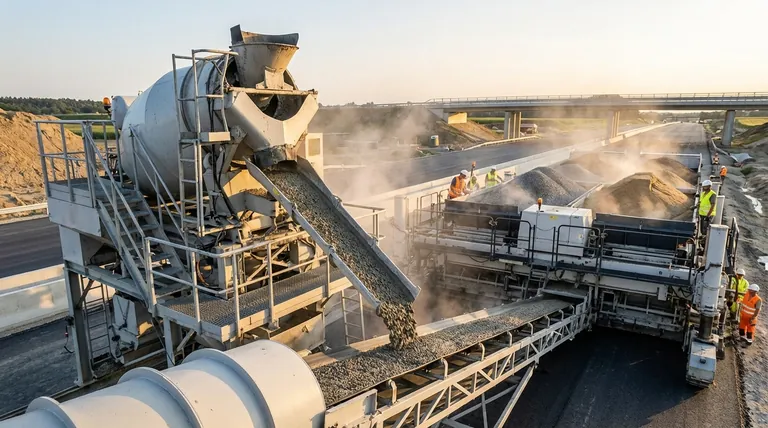
For projects like dams, bridges, and skyscrapers, the demand for concrete can be enormous and prolonged. A continuous mixer provides the steady supply needed to execute large, monolithic pours without cold joints.
High-Volume Paving and Roadwork
Road construction requires laying down vast amounts of concrete or specialized materials like roller-compacted concrete. The ability of a continuous mixer to move and produce a constant stream is perfectly suited for paving operations.
Specialized and Remote Operations
Mobile continuous mixers offer exceptional control and efficiency for remote construction sites where access to a batch plant is impractical. They are also highly effective for producing low-slump concretes used in specialized applications like pavements and linings.
Understanding the Trade-offs
While powerful, the continuous mixing method is not universally superior. The primary trade-off is between high-volume efficiency and small-batch flexibility.
Volume vs. Versatility
Continuous mixers are built for scale. They are less efficient for projects requiring many small, distinct batches with frequently changing mix designs. Batch mixers offer more precise control over individual, smaller loads.
Calibration and Consistency
Achieving a perfectly consistent mix requires the continuous feeder systems to be accurately calibrated. While modern systems are highly reliable, they depend on this initial setup to maintain quality over a long production run.
Making the Right Choice for Your Project
Selecting the right equipment depends entirely on the scale, location, and specific requirements of your job.
- If your primary focus is maximum volume and speed for a large project: The efficiency and uninterrupted flow of a continuous mixer is the definitive advantage.
- If your primary focus is producing multiple, small, and highly customized concrete batches: A traditional batch mixer will likely offer better control and less waste.
- If your primary focus is quality and efficiency on a remote or logistically challenging site: A mobile continuous mixer provides an unmatched on-demand production capability.
Ultimately, choosing a continuous mixer is a strategic decision to prioritize speed and volume for the most demanding construction scenarios.
Summary Table:
| Feature | Benefit |
|---|---|
| Non-Stop Operation | Eliminates downtime between batches for maximum output. |
| Steady Material Flow | Ideal for large pours in dams, bridges, and roadwork. |
| On-Demand Production | Enables efficient concrete supply at remote job sites. |
| High-Volume Efficiency | Optimized for speed and scale in demanding projects. |
Ready to Transform Your Concrete Production?
For construction companies and contractors tackling large-scale infrastructure, paving, or remote projects, a continuous mixer from GARLWAY is the key to unmatched efficiency. We specialize in robust construction machinery, including concrete mixers and batching plants, designed to deliver relentless performance where it matters most.
Let us help you achieve seamless, high-volume output. Contact GARLWAY today to discuss your project needs and discover the right solution for your job.
Visual Guide
Related Products
- JS1000 Volumetric Concrete Mortar Mixer for Sale Skid Steer Cement Mixer
- Portable Concrete Mixer Machine Equipment for Mixing Concrete
- Hydraulic Concrete Mixer Machine Cement Mixing Equipment for Mixture Concrete
- JDY350 Electric Hydraulic Mortar Mud Concrete Mixer
- Portable Cement Mixer with Lift Concrete Machine
People Also Ask
- What is the basic working principle of volumetric concrete mixers? On-Demand Mixing for Zero Waste
- What are the advantages of using volumetric mixers for small concrete jobs? Save Costs and Gain On-Site Control
- What are the advantages of volumetric concrete mixers compared to drum mixers? Achieve On-Demand Mixing & Zero Waste
- What are some innovations in volumetric concrete mixers? Boost Efficiency with On-Demand Production
- Why do volumetric mixers provide better ROI? Maximize Profit with On-Demand Concrete Production