
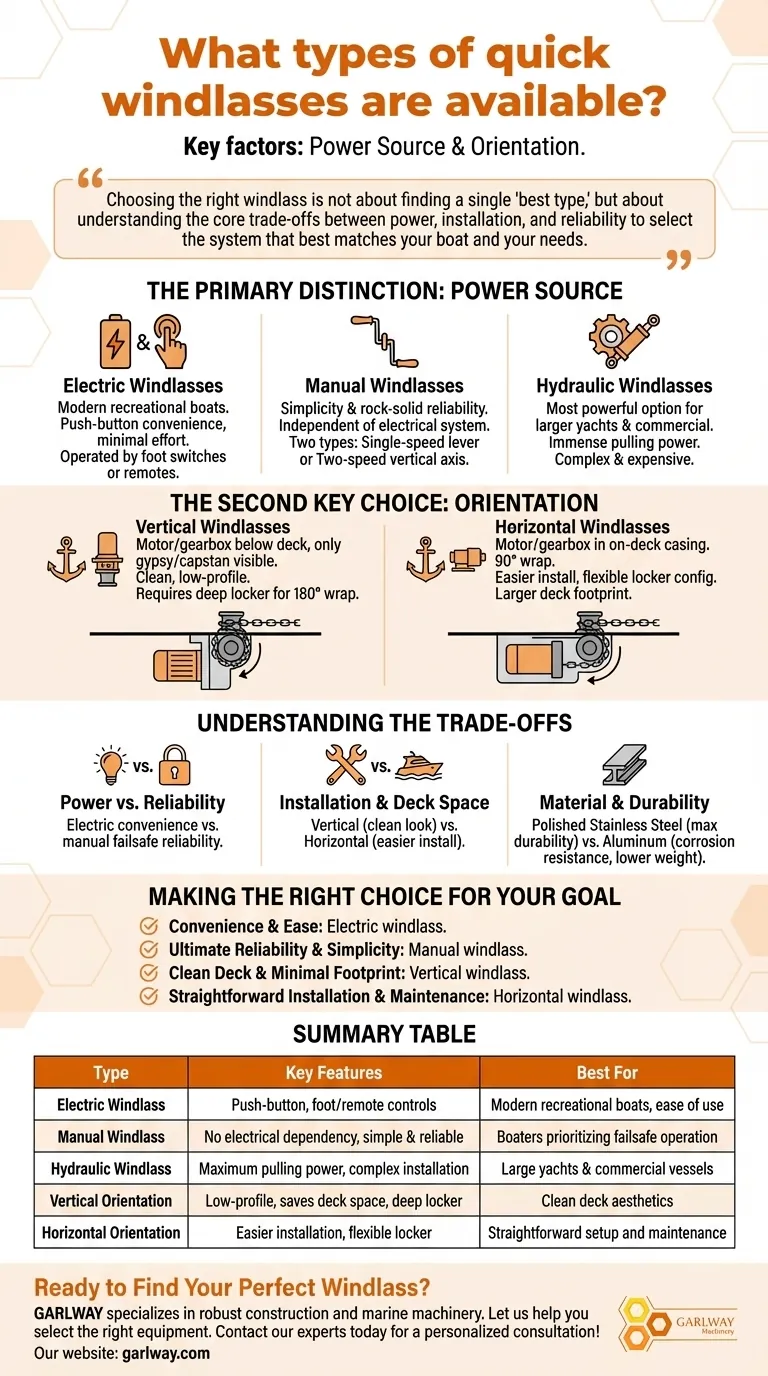
The primary types of windlasses, including those offered by brands like Quick, are defined by their power source and their orientation on the deck. The main power options are electric and manual, while the orientation is either vertical or horizontal, with each combination serving a different set of needs for the vessel and its operator.
Choosing the right windlass is not about finding a single "best type," but about understanding the core trade-offs between power, installation, and reliability to select the system that best matches your boat and your needs.

The Primary Distinction: Power Source
The most fundamental choice you will make is how the windlass is powered. This decision impacts convenience, reliability, and installation complexity.
Electric Windlasses
Electric models are the most common choice for modern recreational boats. They offer push-button convenience, allowing you to raise a heavy anchor and rode with minimal physical effort.
These systems are typically operated by foot switches on the deck or remote controls at the helm, providing excellent operational flexibility.
Manual Windlasses
Manual windlasses are valued for their simplicity and rock-solid reliability. Because they don't depend on your boat's electrical system, they will function in any situation.
They generally come in two designs: a single-speed lever type, which uses a back-and-forth motion, and a two-speed vertical axis type, which operates like a winch and offers a high-speed gear for light loads and a low-speed, high-power gear for breaking out the anchor.
Hydraulic Windlasses
Hydraulic windlasses represent the most powerful option, typically reserved for larger yachts and commercial vessels that already have an onboard hydraulic system. They offer immense pulling power but are the most complex and expensive to install and maintain.
The Second Key Choice: Orientation
After deciding on a power source, you must choose how the unit will be mounted on your deck. This affects both aesthetics and the installation process.
Vertical Windlasses
A vertical windlass has its motor and gearbox located below the deck, with only the gypsy (the wheel for the chain) and capstan visible above. This provides a clean, low-profile look and saves valuable deck space.
The anchor rode makes a 180-degree wrap around the gypsy before feeding down into the anchor locker, which requires a deep and properly aligned locker for the rode to self-stow correctly.
Horizontal Windlasses
With a horizontal windlass, the motor and gearbox are housed in a casing on the deck. The anchor rode only makes a 90-degree wrap around the gypsy before entering the anchor locker.
This design is often easier to install and allows for more flexible anchor locker configurations, but the unit itself has a larger footprint on the deck.
Understanding the Trade-offs
Every windlass type involves a set of compromises. Being aware of them is critical for making an informed decision.
Power vs. Reliability
The core trade-off is between the convenience of an electric system and the failsafe reliability of a manual one. An electrical system failure can leave an electric windlass inoperable, a problem manual windlasses do not have.
Installation and Deck Space
Vertical models offer a cleaner look but require significant space and proper alignment below deck. Horizontal models are bulkier on deck but are generally simpler to install and can be a better solution for boats with shallow or unusually shaped anchor lockers.
Material and Durability
Windlass housings are typically made from highly polished stainless steel or durable aluminum. Stainless steel offers maximum durability and a classic look, while aluminum provides excellent corrosion resistance at a lower weight.
Making the Right Choice for Your Goal
Select your windlass type based on your highest priority.
- If your primary focus is convenience and ease of use: An electric windlass with remote or footswitch controls is the clear choice.
- If your primary focus is ultimate reliability and simplicity: A manual windlass provides dependable operation independent of your boat's power system.
- If your primary focus is a clean deck and a minimal footprint: A vertical windlass is the ideal orientation to keep your foredeck uncluttered.
- If your primary focus is straightforward installation and maintenance: A horizontal windlass is typically easier to mount and service.
Ultimately, the best windlass is the one that integrates seamlessly with your vessel and your style of boating.
Summary Table:
| Type | Key Features | Best For |
|---|---|---|
| Electric Windlass | Push-button convenience, foot/remote controls | Modern recreational boats, ease of use |
| Manual Windlass | No electrical dependency, simple & reliable | Boaters prioritizing failsafe operation |
| Hydraulic Windlass | Maximum pulling power, complex installation | Large yachts & commercial vessels |
| Vertical Orientation | Low-profile, saves deck space, requires deep locker | Clean deck aesthetics |
| Horizontal Orientation | Easier installation, flexible locker requirements | Straightforward setup and maintenance |
Ready to Find Your Perfect Windlass?
GARLWAY specializes in robust construction and marine machinery. While we are experts in winches, concrete mixers, and batching plants for the construction industry, our engineering principles of durability and reliability apply across all mechanical systems.
Let us help you select the right equipment for your project's needs. Whether you're a contractor or a global construction company, we provide durable solutions built to last.
Contact our experts today for a personalized consultation!
Visual Guide
Related Products
- Quick Windlass Portable Winch for Truck and Boat Best Boat Winch
- Electric Hoist Winch Boat Anchor Windlass for Marine Applications
- Warn Winch Windlass Boat Trailer Winch
- Heavy Duty Electric Boat Winch Windlass Anchor
- 12000 lb Electric Boat Trailer Winch with Windlass Anchor Warn
People Also Ask
- What features were incorporated into the upgraded portable winch system? Boost Your Recovery Power & Safety
- What are some uses mentioned for portable winches beyond vehicle recovery? Essential Versatility for Property & Work
- How could the twisting issue with a portable winch be mitigated? Achieve Safe, Centered Pulls with Proper Rigging
- What are the primary uses of a portable winch for a truck? Boost Your Truck's Capability and Self-Reliance
- What is the single rope traction force of the quick winch without a pulley block? 0.5 to 40 Tons Explained


