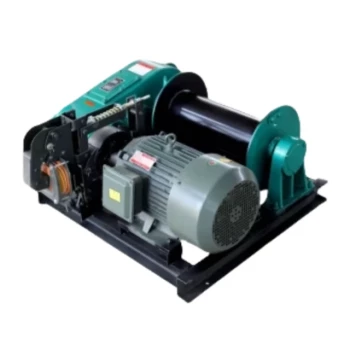
At its core, a winding system is a mechanical assembly designed to raise and lower a load, known as a conveyance, using a rope wound onto a rotating drum. This fundamental hoisting mechanism is the backbone of operations in fields like mining and large-scale material handling, where immense weights must be moved vertically with precision and control. A common configuration is the drum winding system, where one or more ropes are attached directly to the conveyance and spooled onto a large drum.
The central purpose of a winding system is not merely to lift a load, but to precisely manage the immense torque and energy required to do so. The physical shape of the winding drum is a critical engineering choice that directly impacts the system's efficiency and power requirements.
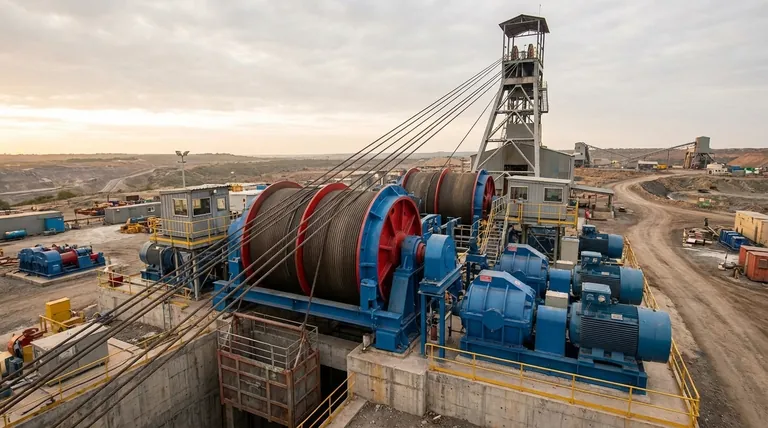
The Core Components and Their Roles
A drum winding system, despite its potentially massive scale, operates on a few key principles and is built from a handful of critical components. Understanding each part's function is essential to grasping the system as a whole.
The Winding Drum
The winding drum is the heart of the system. It is a large cylinder that rotates to either pay out rope (lowering the load) or wind it in (hoisting the load). Its design is paramount to the system's performance.
The Hoisting Rope
This is the connection between the motive force and the load. The rope is spooled onto the drum and must be strong enough to support the conveyance, its contents, and its own significant weight, especially in deep-shaft applications.
The Conveyance
The conveyance is the industry term for the object being moved. This could be a mine cage for transporting workers, a skip for hauling ore, or the car of an elevator.
Why Drum Shape is a Critical Design Choice
The geometry of the winding drum is not arbitrary; it is a direct solution to the physical challenge of managing torque. The shape is chosen to optimize the performance of the drive motor.
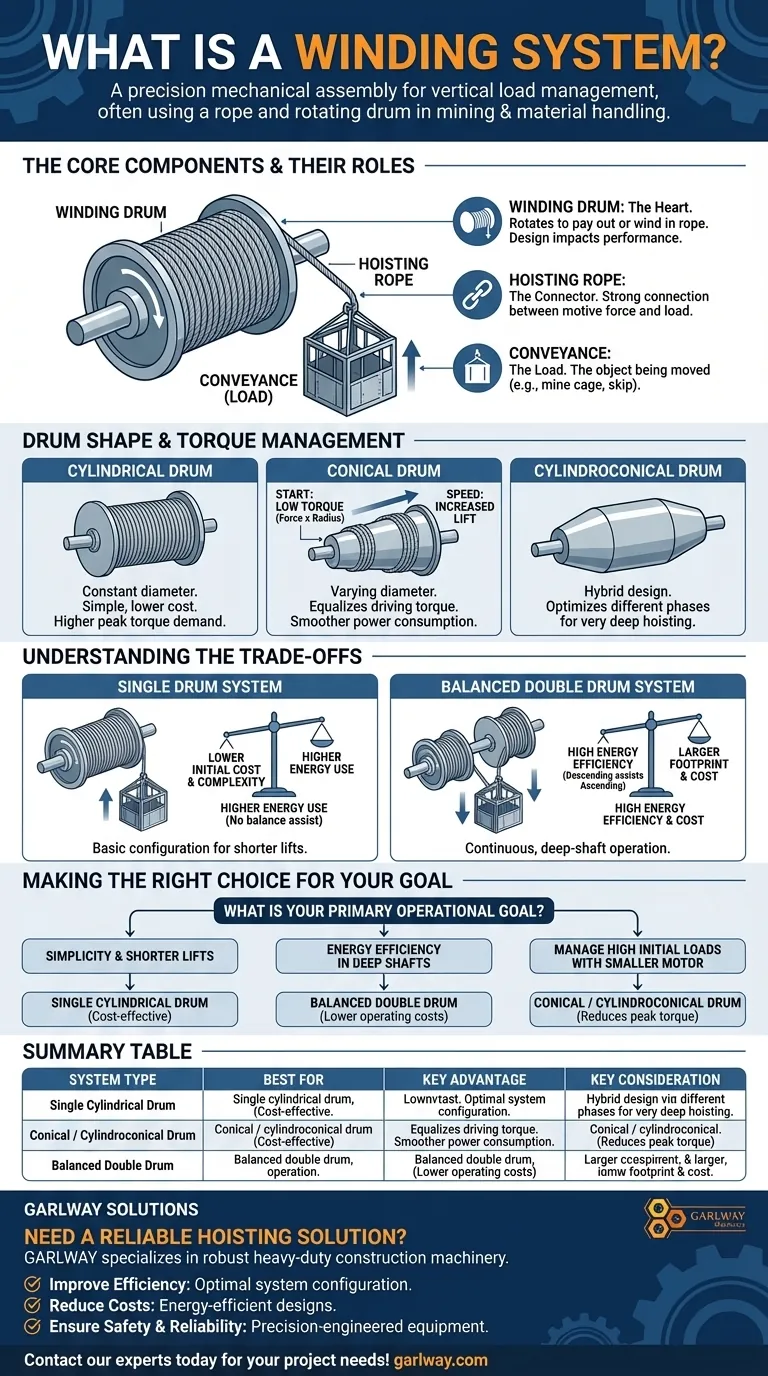
The Cylindrical Drum
This is the simplest design, featuring a constant diameter across its length. It is straightforward to manufacture and maintain. For each rotation of the drum, the same length of rope is wound or unwound.
The Conical Drum
A conical drum has a varying diameter, tapering from small to large. This clever design helps to equalize the driving torque required from the motor throughout a hoist.
When the conveyance is at its lowest point, the rope is at its maximum length and the load on the motor is highest. The rope begins winding on the smaller diameter of the cone, which requires less torque to initiate the lift (Torque = Force x Radius). As the conveyance rises and the suspended rope's weight decreases, the rope winds onto the progressively larger diameter, increasing the lifting speed.
The Cylindroconical Drum
This is a hybrid design, featuring a cylindrical section in the middle with a conical section at each end. It combines the benefits of both shapes and is often used in very deep hoisting applications to optimize different phases of the lift.
Understanding the Trade-offs
Choosing a winding system involves balancing efficiency, complexity, and cost. Each design configuration presents a different set of advantages and disadvantages that must be weighed against the specific operational requirements.
Single vs. Double Drum Systems
A single drum system is the most basic configuration. In contrast, a double drum system uses two drums, often on a common shaft. This allows for two conveyances to operate in balance—as one is hoisted, the other is lowered. The weight of the descending conveyance assists in lifting the ascending one, significantly reducing the net energy required.
Torque Management vs. Mechanical Complexity
The primary reason for using a conical drum is to reduce the peak torque demand on the drive motor, which can lower initial motor costs and smooth out power consumption. However, this benefit comes at the cost of a more complex and expensive drum to manufacture compared to a simple cylindrical one.
The Cost of Efficiency
While a balanced double drum system is far more energy-efficient for continuous operation, it is also more mechanically complex, requires a larger physical footprint, and has a higher initial capital cost than a simple single drum winder.
Making the Right Choice for Your Goal
The optimal winding system is entirely dependent on the specific application. Your primary operational goal will dictate the best configuration.
- If your primary focus is simplicity and shorter lifts: A single, cylindrical drum winder offers the most direct and cost-effective solution.
- If your primary focus is energy efficiency in deep shafts: A balanced double drum system is essential for managing operational costs by using the descending load to assist the ascending one.
- If your primary focus is managing high initial loads with a smaller motor: A conical or cylindroconical drum is specifically engineered to reduce the peak torque demand during acceleration from a standstill.
Ultimately, understanding the interplay between drum shape, system configuration, and torque is key to engineering a safe and efficient hoisting solution.
Summary Table:
| System Type | Best For | Key Advantage | Key Consideration |
|---|---|---|---|
| Single Cylindrical Drum | Shorter lifts, simplicity | Lower initial cost, easier maintenance | Higher peak torque demand |
| Conical / Cylindroconical Drum | Deep shafts, high initial loads | Reduces peak motor torque, smoother operation | Higher manufacturing complexity and cost |
| Balanced Double Drum | Continuous, deep-shaft operation | High energy efficiency, lower operating costs | Larger footprint, higher initial capital cost |
Need a reliable hoisting solution for your project?
At GARLWAY, we specialize in heavy-duty construction machinery. Our expertise in designing and supplying robust equipment like winches and hoists can help you:
- Improve Efficiency: Select the optimal winding system configuration for your specific site conditions and load requirements.
- Reduce Costs: Benefit from energy-efficient designs that lower long-term operational expenses.
- Ensure Safety & Reliability: Get durable, precision-engineered equipment built for demanding construction and mining environments.
Whether you're a construction company or a contractor managing large-scale material handling, GARLWAY has the solution. Contact our experts today to discuss your project needs!
Visual Guide
Related Products
- Hydraulic Winding Engine Harbor Freight Winch
- Electric Hoist Winch Boat Anchor Windlass for Marine Applications
- Quick Windlass Portable Winch for Truck and Boat Best Boat Winch
- Heavy Duty Electric Boat Winch Windlass Anchor
- Small Electric Winch 120V and 240V for Compact Applications
People Also Ask
- What role does hydraulic fluid play in hydraulic winches? It's the Lifeblood of Your Heavy-Duty Pulling Power
- What vehicles commonly use hydraulic winches? For Industrial Trucks Needing Unmatched Power
- What are the features of hydraulic winches? Unmatched Power and Continuous Duty for Heavy Loads
- What preventive measures can be taken to avoid oil leakage in hydraulic winches? Ensure Long-Term Reliability
- What does 'power out' mean in a hydraulic winch? Achieve Absolute Control When Lowering Heavy Loads