
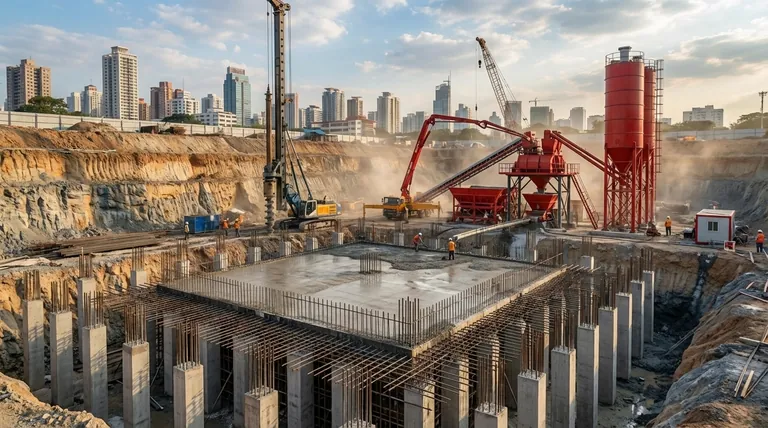
At its core, a pile foundation is a deep foundation system designed to transfer a structure's load through weak or unsuitable surface soil to a stronger, more stable layer of soil or rock below. It consists of long, slender columns called piles, which are driven or drilled into the ground, and a pile cap, which is a concrete block that connects the tops of the piles to distribute the load from the building above. Its primary advantages are high load-bearing capacity, minimal settlement, and robust resistance to horizontal and uplift forces.
The fundamental purpose of a pile foundation is not to support a structure on the ground, but to anchor it to a competent geological layer deep beneath the surface, bypassing unstable soil entirely.
The Fundamental Problem: When is a Pile Foundation Necessary?
Pile foundations are an engineered solution for specific and challenging ground conditions. They are chosen when a simpler, shallow foundation cannot safely support the proposed structure.
Dealing with Weak Upper Soil Layers
The most common reason for using a pile foundation is the presence of weak, compressible, or unstable soil layers near the surface. These soils lack the required bearing capacity to support the structure's weight without excessive or uneven settlement.
Transferring the Structural Load
Piles act like stilts for a building. They bypass these weak upper layers, transferring the building's load vertically down to a stratum of strong soil or rock that can provide adequate support.
The Role of Piles and Pile Caps
The system works in two parts. The piles are the individual columns that perform the deep load transfer. The pile cap is a thick concrete slab that rests on top of a group of piles, uniting them into a single functional unit and creating a stable base for the structure's columns or walls.
Key Advantages in Practice
The design of a pile foundation provides several critical engineering benefits that are unattainable with shallow foundations in poor soil conditions.
High Bearing Capacity
Because piles are anchored in dense soil or solid rock, they can support immense loads. This makes them essential for heavy structures like high-rise buildings, large industrial facilities, and bridges.
Minimal Settlement
By founding the structure on a deep, non-compressible layer, pile foundations prevent the significant and often uneven settlement that would occur on weak surface soils. This ensures long-term structural integrity and stability.
Resistance to Uplift and Lateral Forces
Piles provide excellent anchoring against forces that try to pull the foundation upward (uplift) or push it sideways (lateral loads). This is critical for tall structures subject to wind, structures in floodplains, or retaining walls.
Countering Seismic Liquefaction
In an earthquake, saturated sandy soils can lose their strength and behave like a liquid—a phenomenon called liquefaction. Piles extending through this liquefiable layer to a solid stratum below can prevent a structure from tilting or collapsing.
Understanding the Trade-offs
While powerful, pile foundations are not a universal solution. Their selection involves clear trade-offs that must be carefully considered.
Cost and Complexity
Pile foundations are significantly more expensive and complex to design and install than shallow foundations. The need for specialized equipment and skilled labor contributes to the higher cost.
Extensive Site Investigation is Non-Negotiable
You cannot guess about subsurface conditions. A thorough geotechnical investigation, including soil borings and analysis, is absolutely essential to determine the depth and capacity of the bearing layer and to design the piles correctly.
Construction Impact
The installation process, especially with driven piles, can generate significant noise and ground vibrations. This can be a major concern in dense urban areas or near sensitive existing structures.
Making the Right Choice for Your Project
Selecting a pile foundation is a decision driven by the specific demands of the structure and the realities of the ground beneath it.
- If your primary focus is supporting a heavy structure on poor soil: A pile foundation is the standard engineering solution to bypass weak layers and ensure long-term stability.
- If your project faces significant uplift or lateral forces: The anchoring capability of piles provides essential resistance against wind, water, or seismic loads that a shallow foundation cannot.
- If you are building in a seismically active zone with liquefiable soil: Piles that reach a stable, non-liquefiable layer are a critical safety measure to protect the structure's integrity.
Ultimately, a pile foundation is an engineered solution for achieving stability by connecting your structure to the strength that lies deep within the ground.
Summary Table:
| Key Advantage | Description |
|---|---|
| High Load-Bearing Capacity | Supports immense loads for heavy structures like skyscrapers and bridges. |
| Minimal Settlement | Prevents uneven sinking by anchoring to non-compressible deep soil or rock. |
| Resistance to Lateral/Uplift Forces | Provides robust anchoring against wind, water, and seismic loads. |
| Solution for Weak Soil | Bypasses unstable surface layers to reach a competent bearing stratum. |
Ready to build on a solid foundation?
For construction companies and contractors tackling projects on challenging ground, the right foundation is everything. GARLWAY specializes in providing robust construction machinery, including concrete batching plants and mixers, essential for executing pile cap and other critical concrete works with precision and efficiency.
Let us help you ensure your project's stability from the ground up. Contact GARLWAY today to discuss your machinery needs and build with confidence.
Visual Guide
