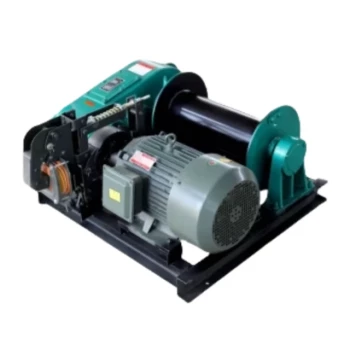
At its core, a capstan winch is a portable pulling device that uses a rotating drum to generate immense pulling force through friction, rather than by storing the rope on a spool. Unlike a traditional winch that is limited by the amount of cable its drum can hold, a capstan winch offers a virtually unlimited pulling distance. It achieves this by having the rope wrap around the drum a few times and then exit, allowing it to pull continuously for the entire length of your rope.
The critical distinction is that a traditional winch combines pulling and storage into one function, limiting its range. A capstan winch separates these functions, using its drum solely for pulling, which unlocks the ability to move heavy loads over any distance.

The Core Principle: Friction Over Spooling
To understand the value of a capstan winch, it’s essential to contrast its mechanics with those of a standard winch.
How a Traditional Winch Works
A conventional winch has a drum that the wire rope or cable winds onto. As the motor turns the drum, it pulls the load closer while simultaneously storing the cable.
This design is simple and effective for many tasks, but it has one fundamental limitation: the pulling distance is capped by the physical size of the drum.
The Capstan Winch Mechanism
A capstan winch discards the idea of storage. Its drum, the capstan, is designed only to create pulling power.
You operate it by wrapping your rope around this rotating drum several times. When the engine or motor runs, the friction between the rope and the spinning drum grabs the rope and pulls it through the system.
The "Unlimited Pull" Advantage
Because the rope is not stored on the winch, you can pull a load for 50 feet, 500 feet, or more. The only constraint is the length of the rope you have on hand.
This makes the capstan winch the superior tool for tasks requiring long-distance pulling, such as retrieving large game from deep in the woods or pulling a cable through a long conduit.
Key Characteristics and Operation
Capstan winches are defined by a few key features that make them ideal for fieldwork.
Portability and Power
Most capstan winches are designed to be lightweight and portable. They are often powered by small gasoline engines, making them self-contained and perfect for use in remote areas where electricity isn't available. Electric models also exist for specific applications.
Simple, Hands-On Operation
Using a capstan winch is a straightforward process:
- Anchor the winch securely to a stable point, like a tree or vehicle.
- Wrap the rope around the capstan drum three or four times.
- Start the engine to get the drum rotating.
- Pull gently on the slack end of the rope. This creates the tension needed for the friction to engage and pull the load.
The operator's pull on the rope's tail end controls the pulling force, making it a very interactive process.
Versatile Applications
The unique combination of power and portability makes capstan winches invaluable for many industries and hobbies, including forestry, hunting, off-road recovery, and construction.
Understanding the Trade-offs
While powerful, the capstan winch's design comes with specific considerations.
Active User Involvement
This is not a "set it and forget it" tool. The operator must actively manage the rope by maintaining tension on the tail end. Releasing that tension immediately stops the pull.
No Rope Storage
The winch pulls the rope through the system, but it doesn't wind it up. The operator is responsible for managing the incoming slack rope to keep it from tangling.
Alignment Can Be Crucial
For optimal performance and to prevent premature rope wear, it's important to ensure the winch is aligned properly with the load you are pulling.
Making the Right Choice for Your Goal
Selecting the correct winch depends entirely on the job you need to accomplish.
- If your primary focus is pulling heavy loads over very long distances: A capstan winch is the ideal tool, as its pull length is not limited by a drum.
- If your primary focus is portability for use in remote locations: The typically lightweight, gas-powered design of a capstan winch makes it superior to heavy, vehicle-mounted electric winches.
- If your primary focus is convenience for short, repetitive pulls: A traditional spooling winch is often simpler, as it automatically manages and stores the rope for you.
Ultimately, choosing the right tool comes from understanding its fundamental principle of operation.
Summary Table:
| Feature | Capstan Winch | Traditional Winch |
|---|---|---|
| Pulling Distance | Virtually unlimited (length of rope) | Limited by drum capacity |
| Portability | High (often lightweight, gas-powered) | Lower (typically vehicle-mounted) |
| Operation | Hands-on, user-controlled tension | Automated spooling |
| Ideal For | Long-distance pulls, remote locations | Short, repetitive pulls, convenience |
Need a powerful, portable winching solution for your construction or contracting project?
GARLWAY specializes in robust construction machinery, including capstan winches designed for the demanding needs of construction companies and contractors globally. Our equipment delivers the reliable, unlimited-pull power you need to get the job done in any location.
Contact GARLWAY today to find the perfect winch for your specific application and boost your on-site efficiency!
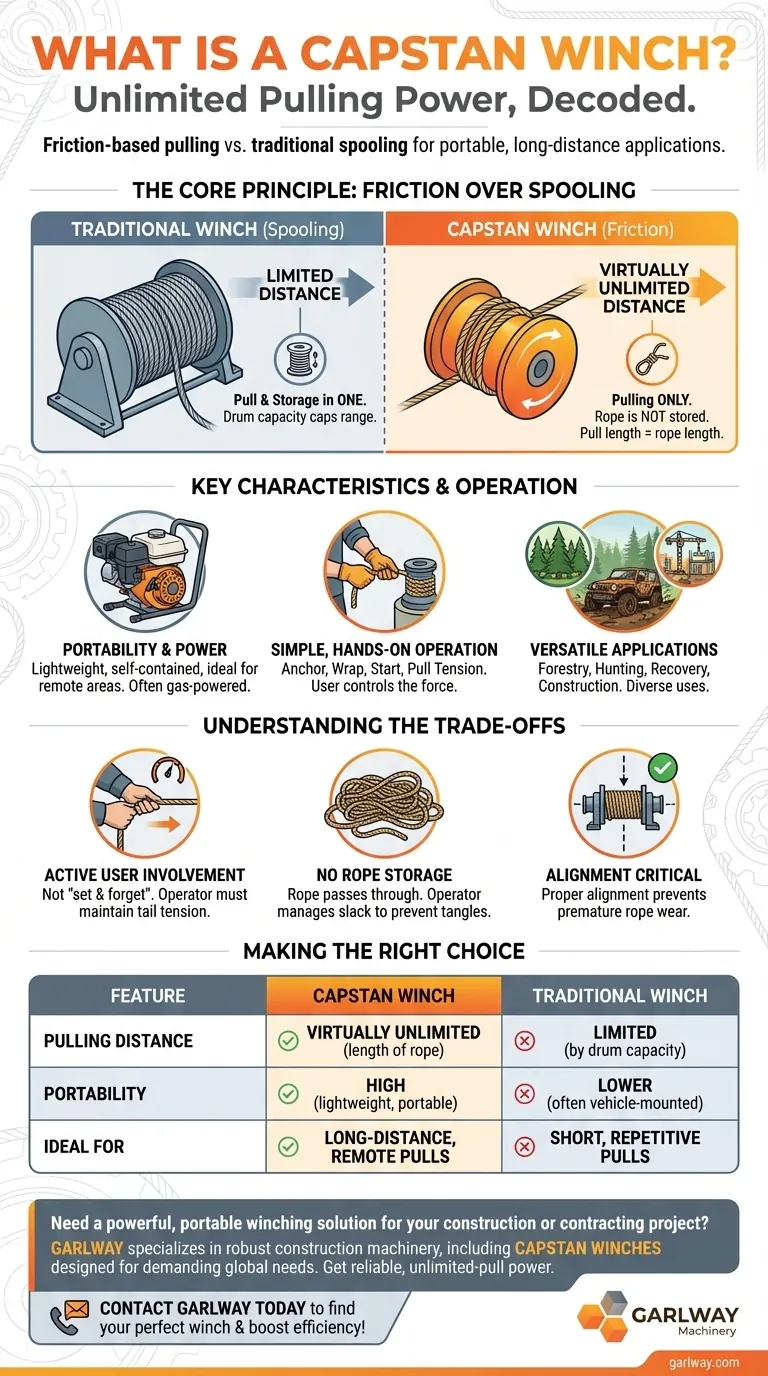
Visual Guide
Related Products
- Portable Small Trailer Winch
- Small Electric Winch 120V and 240V for Compact Applications
- Electric and Hydraulic Winch for Heavy Duty Applications
- 12000 lb Heavy Duty Electric Boat Winch
- Hydraulic Winding Engine Harbor Freight Winch
People Also Ask
- What features were incorporated into the upgraded portable winch system? Boost Your Recovery Power & Safety
- What are some uses mentioned for portable winches beyond vehicle recovery? Essential Versatility for Property & Work
- How could the twisting issue with a portable winch be mitigated? Achieve Safe, Centered Pulls with Proper Rigging
- What is the significance of trailer winches in the boating industry? Ensure Safe and Efficient Boat Recovery
- What should be considered when mounting a winch on a trailer? Ensure a Safe, Aligned Installation