
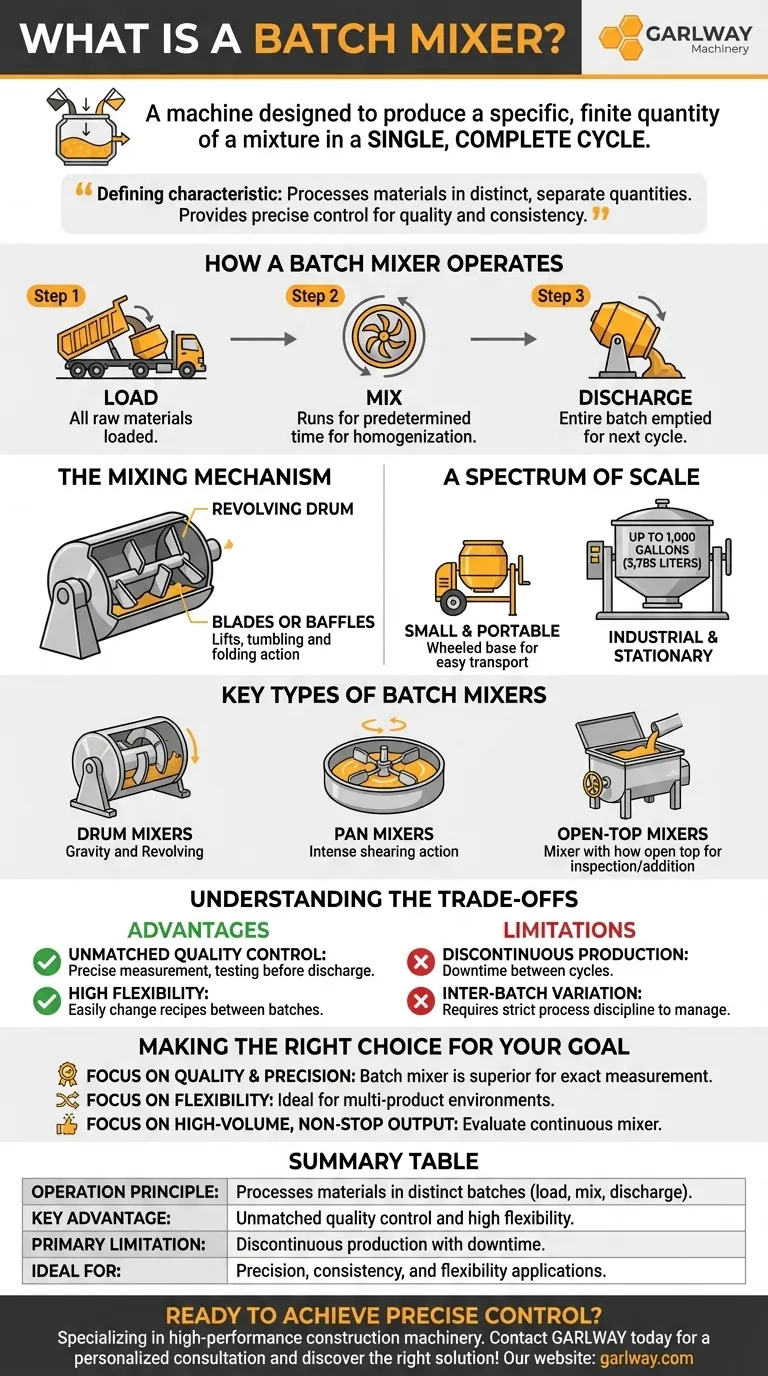
In short, a batch mixer is a machine designed to produce a specific, finite quantity of a mixture in a single, complete cycle. It operates by loading all raw materials, mixing them thoroughly using an internal mechanism, and then discharging the entire completed batch before a new cycle can begin.
The defining characteristic of a batch mixer isn't its size or speed, but its operational principle: it processes materials in distinct, separate quantities. This provides precise control over each batch's composition, making it ideal for applications where quality and consistency are paramount.
How a Batch Mixer Operates
The Core Principle: One Batch at a Time
A batch mixer follows a simple, repeatable sequence: load, mix, discharge. All ingredients for a single batch are added to the machine at the start.
The machine then runs for a predetermined time to ensure complete homogenization. Once mixing is finished, the entire batch is emptied, and the mixer is ready for the next load.
The Mixing Mechanism
Most batch mixers, especially for materials like concrete, utilize a revolving drum.
Inside this drum, a series of blades or baffles are fixed. As the drum rotates, these internal components lift, tumble, and fold the materials, forcing them to combine into a uniform mixture.
A Spectrum of Scale
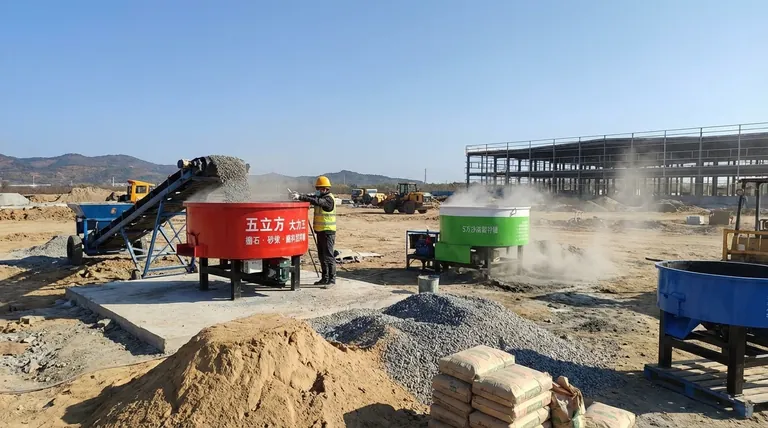
Batch mixers range dramatically in size and mobility. Small, portable units are often powered by electricity and mounted on a wheeled base for easy transport around a construction site.
Conversely, industrial batch mixers can be massive, stationary installations capable of handling batches up to 1,000 gallons (3,785 liters), serving as the heart of a large production facility.
Key Types of Batch Mixers
Drum Mixers
This is the most common type. It includes gravity mixers, where the stationary drum's shape and angle cause the mix, and revolving mixers, where the entire drum turns and internal baffles do the work. They are excellent for coarse aggregates like gravel and sand.
Pan Mixers
Unlike a drum mixer that tumbles material, a pan mixer typically has a stationary pan. A set of rotating paddles or blades moves through the material to create the mixture, often providing a more intense and shearing action suitable for specific formulas.
Open-Top Mixers
As the name implies, these mixers are open at the top, which can be useful for applications where ingredients need to be visually inspected or added incrementally during the mixing cycle.
Understanding the Trade-offs
Advantage: Unmatched Quality Control
The single greatest advantage of batch mixing is control. Each ingredient can be precisely weighed and added, and the final batch can be tested before discharge. This ensures every batch meets exact specifications.
Advantage: High Flexibility
Because each batch is a discrete event, you can easily change the recipe from one batch to the next. This makes batch mixers ideal for operations that produce multiple different products or require frequent formula adjustments.
Limitation: Discontinuous Production
The primary trade-off is efficiency at scale. The need to stop, discharge, and reload between each cycle introduces downtime. This makes batch mixing less suitable for high-volume, uninterrupted production lines where a continuous mixer might be a better fit.
Limitation: Inter-Batch Variation
While each individual batch is highly consistent, slight variations in loading times or operator actions can introduce minor differences between separate batches. This requires strict process discipline to manage.
Making the Right Choice for Your Goal
Choosing a mixer comes down to your operational priorities.
- If your primary focus is quality and precision: A batch mixer is the superior choice, as it allows for exact measurement and verification of every single batch.
- If your primary focus is flexibility: The ability to change formulas between batches makes this mixer ideal for multi-product environments or custom orders.
- If your primary focus is high-volume, non-stop output: You should evaluate if a continuous mixer better suits your needs, as the batch process has inherent downtime between cycles.
Ultimately, selecting a batch mixer is a decision for control and consistency over sheer, uninterrupted throughput.
Summary Table:
| Feature | Description |
|---|---|
| Operation Principle | Processes materials in distinct, separate batches (load, mix, discharge). |
| Key Advantage | Unmatched quality control and high flexibility for recipe changes. |
| Primary Limitation | Discontinuous production with downtime between cycles. |
| Ideal For | Applications where precision, consistency, and flexibility are paramount. |
Ready to achieve precise control over your mixing process?
At GARLWAY, we specialize in high-performance construction machinery, including robust and reliable batch mixers designed for construction companies and contractors who demand consistent, high-quality results.
Let our experts help you select the perfect batch mixer, concrete mixer, or batching plant to enhance your project's efficiency and output quality.
Contact GARLWAY today for a personalized consultation and discover the right solution for your operational goals!
Visual Guide
Related Products
- Commercial Electric Concrete Mixer Machine HZS 50 Small Batch Plant for Sale
- HZS25 Best Cement Mixer for Quick Mix Concrete at Bunnings
- Portable Concrete Mixer Machine Equipment for Mixing Concrete
- HZS120 Ready Mix Concrete Batching Plant Commercial Mud Cement Mixer
- HZS75 Concrete Batching Plant Cement Mixer Price Concrete Mixer Bunnings Mixing Plant
People Also Ask
- What are the types of concrete mixers used in batching plants? Choose the Right Mixer for Your Project
- What is the core component of a concrete batching plant? The Mixer Unit Defines Your Concrete Quality
- Why is proper maintenance important for a concrete batch mix plant? Maximize Uptime & Profitability
- Why buy concrete batch plant parts only from the manufacturer? Protect Your Investment and Maximize Uptime
- What are the two main types of concrete batch mixers? Choose the Right Mixer for Your Project





