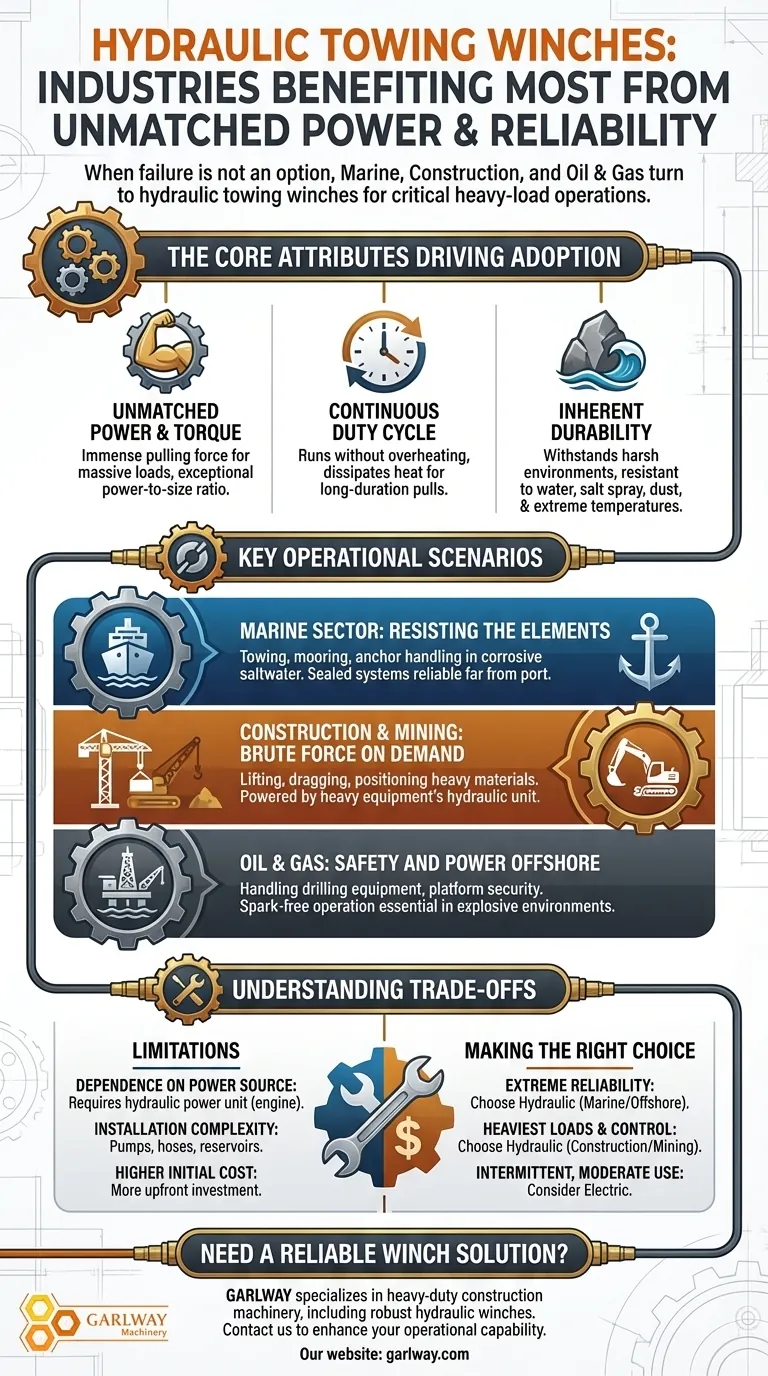
When failure is not an option, specific industries turn to hydraulic towing winches for their most critical operations. The sectors that benefit most are Marine, Construction, and Oil & Gas. These fields depend on the unmatched power, continuous duty cycle, and extreme durability that hydraulic systems provide for their most demanding heavy-load applications.
The choice of a hydraulic winch isn't just about raw power; it's a strategic decision for industries operating in harsh, remote, or hazardous environments where continuous performance and absolute reliability are paramount to safety and operational success.
The Core Attributes Driving Adoption
The preference for hydraulic winches in these demanding industries is not arbitrary. It is a direct result of several key technical advantages that align perfectly with their operational realities.
Unmatched Power and Torque
Hydraulic winches offer an exceptional power-to-size ratio. They can generate immense torque and pull extremely heavy loads that would stall or damage other winch types.
This is essential for moving massive components on a shipyard, positioning heavy materials on a construction site, or managing anchor lines on an offshore rig.
Continuous Duty Cycle
Unlike electric winches that can overheat during prolonged use, hydraulic systems can run continuously without failing. The hydraulic fluid helps dissipate heat, making them ideal for long-duration pulls.
This capability is critical for extended towing operations at sea or complex, hours-long recovery efforts in the field.
Inherent Durability in Harsh Environments
These winches are built to withstand the worst conditions. They operate reliably in a wide temperature range (from -50° to +100° C) and are highly resistant to water, salt spray, dust, and grime.
This ruggedness makes them the default choice for marine vessels, offshore platforms, and exposed construction sites where equipment is constantly battered by the elements.
Key Operational Scenarios
Understanding where these winches are used clarifies why their attributes are so vital. Each industry leverages their strengths to overcome unique challenges.
The Marine Sector: Resisting the Elements
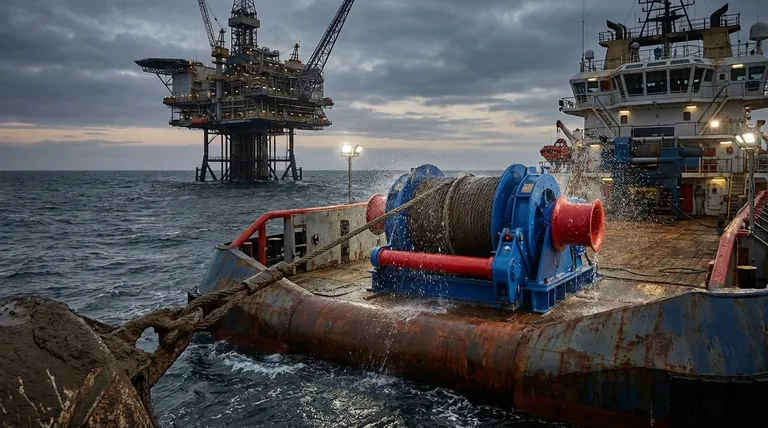
In the marine industry, equipment is constantly exposed to corrosive saltwater. Hydraulic winches are commonly used on ships, docks, and shores for towing, mooring, and anchor handling.
Their sealed systems protect internal components, and their power is independent of a fragile electrical grid, making them reliable far from port.
Construction & Mining: Brute Force on Demand
On construction and mining sites, hydraulic winches are integrated into heavy equipment like cranes, trucks, and dozers. Their primary function is to provide the immense force needed for lifting, dragging, and positioning heavy materials.
The availability of a hydraulic power unit (the vehicle's engine) makes them a natural and powerful extension of the existing machinery.
Oil & Gas: Safety and Power Offshore
For offshore oil and gas platforms, safety is the highest priority. Hydraulic systems are inherently safer in these potentially explosive environments because they do not create sparks like an electric motor might.
Their reliability and power are non-negotiable for handling drilling equipment and securing the platform in volatile sea conditions.
Understanding the Trade-offs
Despite their advantages, hydraulic winches are not the universal solution. Acknowledging their limitations is key to making an informed decision.
Dependence on a Power Source
A hydraulic winch is not self-contained. It requires a hydraulic power unit to function, which is typically the engine of a truck or a separate power pack. Without a running engine, the winch is inoperable.
Installation and Maintenance Complexity
Installing a hydraulic system involves pumps, reservoirs, and high-pressure hoses, which is more complex than wiring an electric winch. These systems also require maintenance, as fluid leaks can be a point of failure.
Higher Initial Cost
The complete hydraulic system—winch, pump, hoses, and fluid reservoir—often represents a higher upfront investment compared to an equivalent electric winch setup.
Making the Right Choice for Your Operation
Your decision should be guided by the primary demands of your application and environment.
- If your primary focus is extreme reliability and continuous use in harsh environments: A hydraulic winch is the superior choice, especially for marine or offshore applications.
- If your primary focus is handling the heaviest possible loads with precise control: The high torque and power of a hydraulic system make it the ideal solution for heavy construction and mining.
- If your primary focus is intermittent use with moderate loads in a standard environment: An electric winch may offer a simpler and more cost-effective solution.
Ultimately, choosing a hydraulic winch is an investment in operational capability for the most challenging tasks on earth.
Summary Table:
| Industry | Key Applications | Primary Winch Benefits |
|---|---|---|
| Marine | Towing, mooring, anchor handling | Corrosion resistance, continuous operation, high torque |
| Construction & Mining | Lifting, dragging, positioning heavy materials | Immense power, integration with heavy equipment |
| Oil & Gas | Handling drilling equipment, platform security | Spark-free safety, extreme reliability in volatile conditions |
Need a reliable winch solution for your most demanding projects?
GARLWAY specializes in heavy-duty construction machinery, offering robust hydraulic winches, concrete mixers, and batching plants designed for the toughest job sites. Our equipment delivers the power and durability that construction companies and contractors worldwide depend on.
Contact GARLWAY today to discuss how our hydraulic winches can enhance your operational capability and safety.
Visual Guide
Related Products
- Electric and Hydraulic Winch for Heavy Duty Applications
- Hydraulic Winding Engine Harbor Freight Winch
- Warn Winch Windlass Boat Trailer Winch
- 12000 lb Electric Boat Trailer Winch with Windlass Anchor Warn
- Portable Small Trailer Winch
People Also Ask
- What are the differences between electric and hydraulic winches? Choose the Right Winch for Your Job
- What are some common uses for a heavy-duty winch? Power Your Construction & Industrial Projects
- What are electro-hydraulic winches and their applications? The Integrated Power Solution for Heavy-Duty Operations
- How do winches assist in bridge launching? Accelerate Bridge Placement with Controlled Pulling Power
- What are the benefits of using heavy-duty winches for large projects? Boost Efficiency & Safety