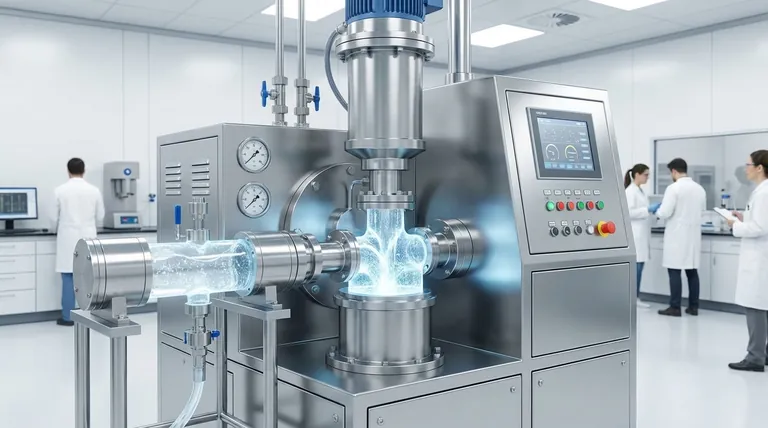
The defining characteristic of a homogenizer mixer is its use of extreme mechanical force, specifically high shear and pressure, to break down and disperse particles within a liquid. Unlike standard mixers that simply blend components, a homogenizer fundamentally alters the mixture's physical structure to create a stable, uniform suspension or emulsion on a microscopic level.
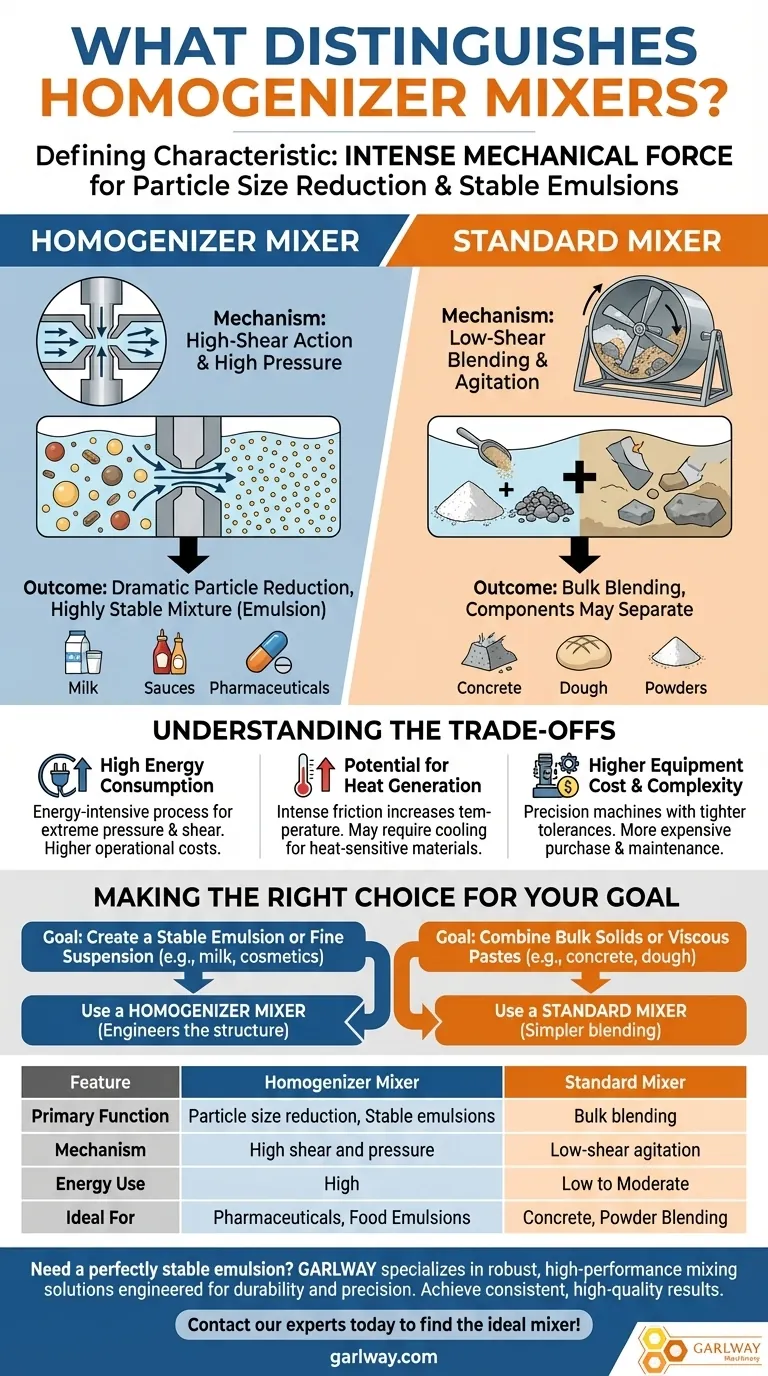
The crucial distinction is that a standard mixer combines ingredients, while a homogenizer mixer refines them. Its primary purpose is not just to mix, but to achieve significant particle size reduction for maximum stability and uniformity.
The Core Principle: Intense Mechanical Force
The unique capability of a homogenizer stems from how it applies energy to the product. It moves beyond simple agitation to a more aggressive and controlled process.
High-Shear Action
A homogenizer imparts intense mechanical shear. This is often achieved by forcing the mixture through a narrow gap at high velocity, creating a force that tears apart droplets and solid particles.
High-Pressure Application
This process relies on high pressure to drive the fluid through the shearing mechanism. The combination of pressure and shear ensures that all components are not just mixed but are thoroughly and evenly integrated.
The True Goal: Particle Reduction
The ultimate outcome of this force is a dramatic reduction in the size of the dispersed particles. This creates a highly stable mixture—like an emulsion—where components will not easily separate over time.
How Homogenizers Differ From Other Mixers
Understanding what a homogenizer is also means understanding what it is not. Its function is highly specialized compared to other common mixing technologies.
Contrast with Low-Shear Blending
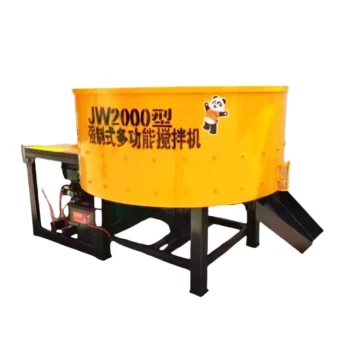
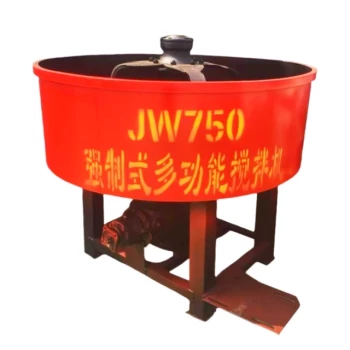
Mixers like drum or mortar mixers are designed for bulk blending. They tumble or stir materials, which is effective for combining components like concrete or powders but does not reduce particle size or create stable liquid emulsions.
Contrast with Flow-Based Mixing
Static mixers, which contain no moving parts, use fixed internal elements to disrupt and redirect fluid flow. They are excellent for blending already miscible fluids within a pipeline but lack the intense mechanical force needed to break down particles in a suspension or create a new emulsion.
Understanding the Trade-offs
The specialized function of a homogenizer comes with specific operational considerations. Choosing one means accepting certain trade-offs compared to simpler mixing methods.
High Energy Consumption
Generating the extreme pressure and shear required for homogenization is an energy-intensive process. This results in higher operational costs compared to low-energy static or drum mixers.
Potential for Heat Generation
The intense friction created during homogenization can significantly increase the product's temperature. For heat-sensitive materials, this may require additional cooling systems, adding complexity to the process.
Higher Equipment Cost and Complexity
Homogenizers are precision machines built to withstand high pressures. They are typically more expensive to purchase and maintain than simpler blending equipment due to their more complex design and tighter tolerances.
Making the Right Choice for Your Goal
The right mixer is the one that achieves your desired end-state most efficiently. The decision hinges entirely on whether particle size reduction is a critical requirement.
- If your primary focus is creating a stable emulsion or a fine suspension (e.g., milk, sauces, pharmaceuticals): A homogenizer is the correct and often necessary tool.
- If your primary focus is combining bulk solids or viscous pastes (e.g., concrete, dough): A simpler, lower-shear technology like a mortar or drum mixer is far more suitable.
- If your primary focus is continuously blending already-miscible fluids in a pipeline: A static mixer offers an effective, low-maintenance, and energy-efficient solution.
Ultimately, selecting the right technology requires clearly defining whether your goal is to simply combine ingredients or to fundamentally engineer the mixture's physical structure.
Summary Table:
| Feature | Homogenizer Mixer | Standard Mixer (e.g., Drum/Mortar) |
|---|---|---|
| Primary Function | Particle size reduction, creating stable emulsions/suspensions | Bulk blending of ingredients |
| Mechanism | High shear and pressure | Low-shear agitation or tumbling |
| Energy Use | High | Low to Moderate |
| Ideal For | Pharmaceuticals, food emulsions, cosmetics | Concrete, dough, powder blending |
Need to create a perfectly stable emulsion or suspension? GARLWAY specializes in robust construction and industrial machinery, including high-performance mixing solutions. Our equipment is engineered for durability and precision, helping construction companies and contractors globally achieve consistent, high-quality results. Contact our experts today to find the ideal mixer for your specific application and enhance your operational efficiency!
Visual Guide
Related Products
- JDC350 Small Cement Concrete Mortar Mixer
- HZS25 Best Cement Mixer for Quick Mix Concrete at Bunnings
- Portable Concrete Mixer Machine Equipment for Mixing Concrete
- Portable Electric Small Cement Mixer Concrete Machine
- Portable Electric Concrete Mixer Machine for Cement Mixing
People Also Ask
- What are the primary uses of a small cement mixer? Boost Efficiency for Small to Medium Construction Jobs
- What are the physical benefits of using a small cement mixer? Reduce Strain and Prevent Injury
- What are the cost benefits of using a small cement mixer? Save on Labor, Materials & Time
- What makes small cement mixers easy and convenient to use? Boost Productivity on Any Job Site
- What factors should be considered before purchasing a small cement mixer? Find the Perfect Match for Your Project