
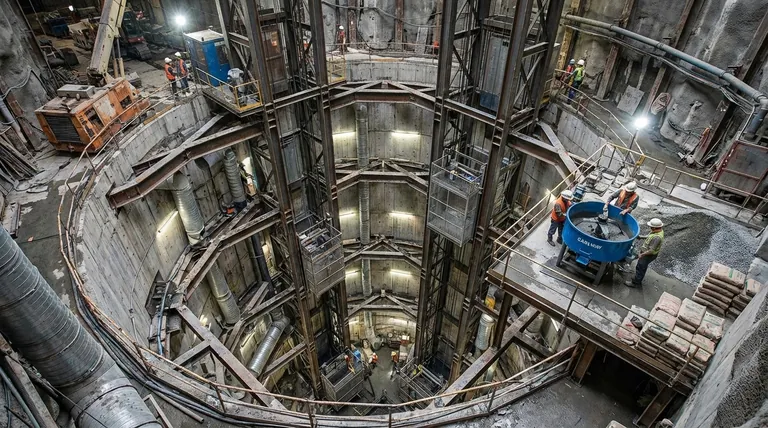
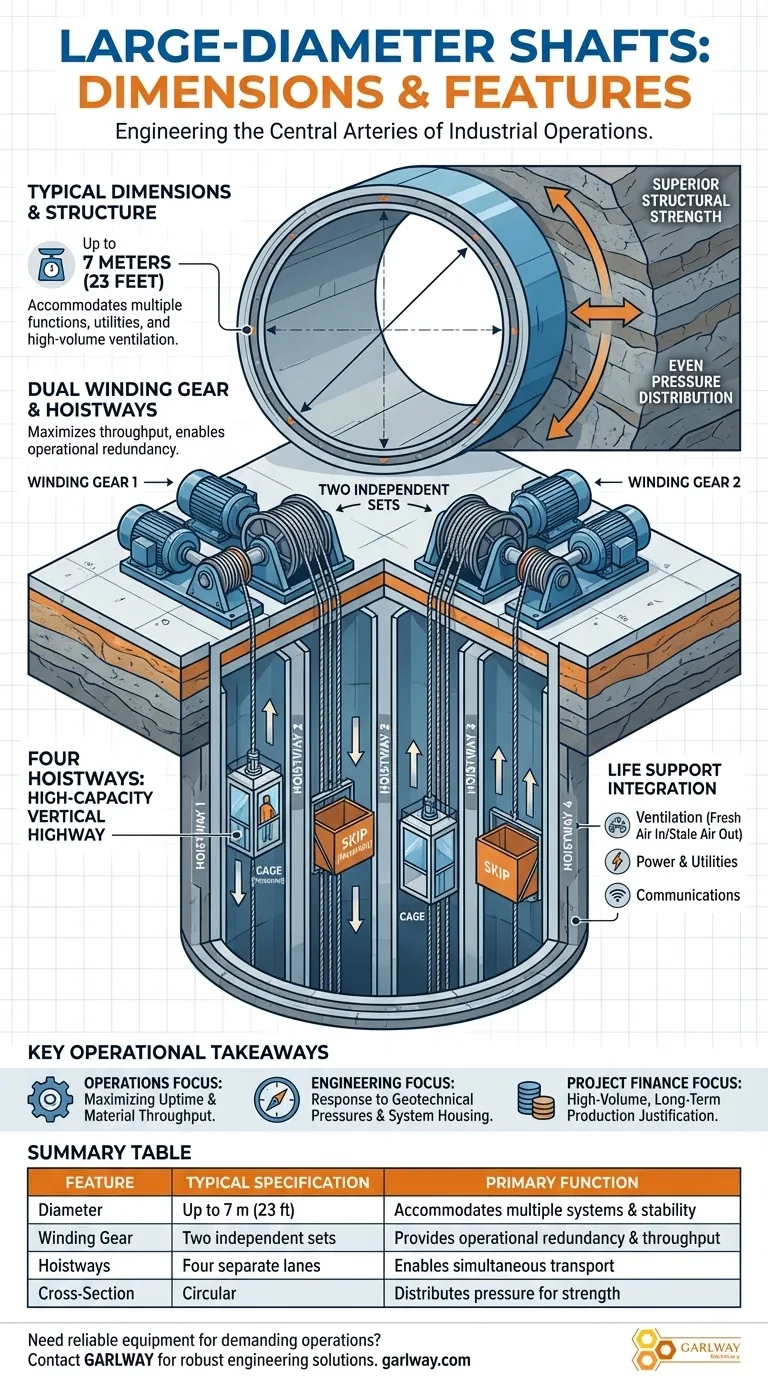
A typical large-diameter shaft is a circular structure that can be up to 7 meters (23 feet) in diameter. Its key features are designed for high-capacity industrial operations, commonly including two complete sets of winding gear that service four separate hoistways, allowing multiple conveyances to move up and down simultaneously.
The core principle behind a large-diameter shaft is not just size, but multi-functionality. These are engineered as the central arteries of a major operation, designed to maximize the transport of personnel and materials while ensuring operational redundancy.
Deconstructing the Shaft's Core Components
A large-diameter shaft is far more than a simple hole; it is a complex system where each component is chosen for a specific engineering or operational purpose.
The Significance of a 7-Meter Diameter
A diameter of this scale is necessary to accommodate multiple functions at once. It provides the required physical space for several hoistways, a large-volume ventilation system, and conduits for essential utilities like power, water, and communications.
The Circular Cross-Section
The circular shape is an intentional engineering choice. It provides superior structural strength, evenly distributing the immense pressure from the surrounding earth and rock. This makes it the most stable and secure geometry for deep vertical excavations.
Dual Winding Gear Systems
The "winding gear" refers to the powerful motor, gearbox, and drum assembly on the surface that winds the steel ropes to lift and lower conveyances. Equipping a shaft with two independent sets is a deliberate strategy for maximizing both throughput and reliability.
Four Hoistways: A Vertical Highway
A hoistway is the vertical path within the shaft that a "cage" (for personnel) or "skip" (for materials) travels along. Having four hoistways creates a high-capacity vertical transport system, much like a four-lane highway.
This configuration allows for simultaneous, independent movement. For example, one hoistway can be bringing ore to the surface while another transports workers underground, dramatically improving operational efficiency.
Understanding the Operational Purpose
The design of a large-diameter shaft directly serves the economic and safety requirements of a large-scale industrial site, such as a major mine.
Maximizing Throughput
The primary goal is to move the maximum amount of material and people in the minimum amount of time. The combination of dual winding systems and four hoistways allows for continuous, high-volume flow, which is critical to the financial viability of the operation.
Ensuring Redundancy and Safety
Operational downtime is extremely costly. With two separate winding gear systems, maintenance can be performed on one while the other remains operational. It also provides a critical layer of redundancy in case of an unexpected mechanical failure.
Integrating Life Support Systems
The vast cross-sectional area is essential for more than just hoisting. It serves as the primary conduit for the mine's ventilation system, pushing fresh air deep underground and exhausting stale air. Without this capacity, operations could not safely take place.
Key Takeaways for Your Role
Understanding these features is crucial for appreciating the shaft's function as the logistical heart of an entire operation.
- If your primary focus is on operations: The design with dual winding gear and four hoistways is fundamentally about maximizing uptime and material throughput.
- If your primary focus is on engineering: The 7-meter circular design is a direct response to immense geotechnical pressures and the need to house multiple critical systems within a single, stable structure.
- If your primary focus is on project finance: This shaft configuration represents a significant capital expenditure that is only justified by the high-volume, long-term production it enables.
Ultimately, these shafts are monumental feats of engineering designed to be robust, efficient, and multi-functional lifelines for deep underground work.
Summary Table:
| Feature | Typical Specification | Primary Function |
|---|---|---|
| Diameter | Up to 7 meters (23 feet) | Accommodates multiple systems & ensures structural stability |
| Winding Gear | Two independent sets | Provides operational redundancy and maximizes throughput |
| Hoistways | Four separate lanes | Enables simultaneous transport of personnel and materials |
| Cross-Section | Circular | Distributes geotechnical pressure evenly for superior strength |
Need a reliable partner for your heavy-duty construction and mining equipment?
At GARLWAY, we specialize in engineering robust machinery for demanding industrial applications. Our expertise in winches, concrete mixers, and batching plants supports the high-capacity, reliable operations that large-diameter shafts require.
Let us help you build the backbone of your project with equipment designed for durability and efficiency.
Contact GARLWAY today to discuss your specific needs and discover the right solutions for your operation.
Visual Guide
Related Products
People Also Ask
- How do cement mixers enhance safety on construction sites? Reduce Strain, Hazards, and Accidents
- What are the key benefits of using a cement mixer on a construction site? Boost Efficiency, Quality & Safety
- What are the efficiency advantages of cement mixers? Boost Project Speed, Quality, and ROI
- How does cleaning a cement mixer after use benefit its performance? Maximize Lifespan and Mix Quality
- Can a cement mixer be used for mixing mortar? Understanding the Risks and Best Practices
