
In short, the primary functions of a dry concrete batching plant are material storage, feeding, precise weighing, and the controlled discharge of all dry ingredients—like sand, aggregates, and cement—into a transit mixer truck. The key distinction is that the plant itself does not mix the components; it only measures and loads them.
A dry batching plant operates as a highly accurate proportioning system rather than a mixing station. Its core purpose is to precisely measure and combine all the solid materials according to a specific recipe, leaving the final step of adding water and mixing the concrete to the transit mixer truck itself, typically while it is en route to the job site.
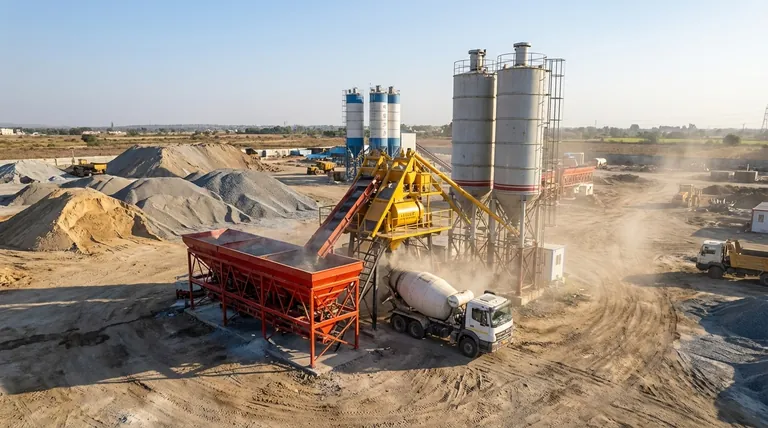
The Core Workflow: From Storage to Discharge
To understand how a dry batch plant achieves its purpose, it's essential to follow the flow of materials from their raw state to their departure from the facility. Each step is governed by a central control system to ensure accuracy.
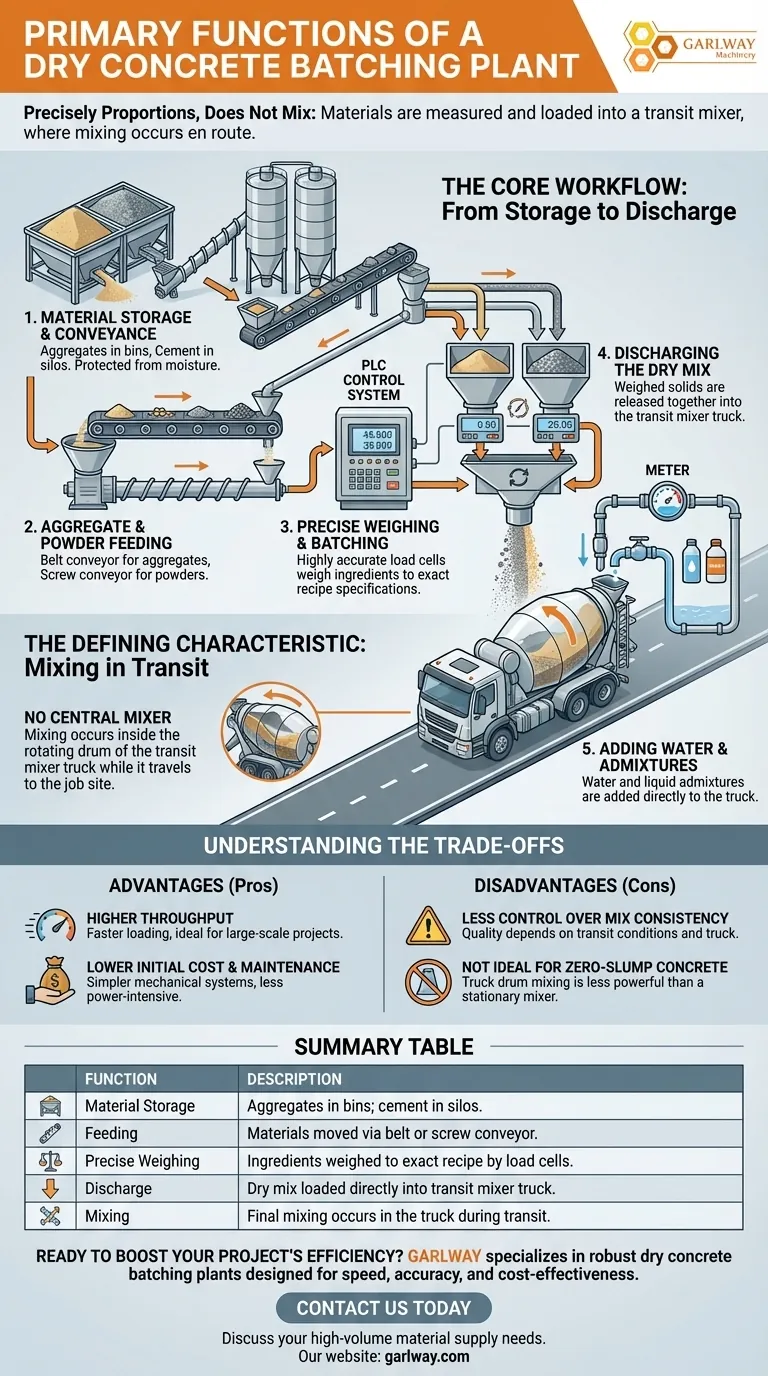
Step 1: Material Storage and Conveyance
Before any batching can occur, all raw materials must be properly stored.
Aggregates like sand and gravel are kept in large storage bins. Powders such as cement and fly ash are stored in vertical silos to protect them from moisture.
Step 2: Aggregate and Powder Feeding
From storage, materials are moved to be weighed. This is the feeding stage.
Aggregates are typically transported via a belt conveyor, while powders are moved from their silos using a screw conveyor. This ensures a controlled and efficient transfer.
Step 3: Precise Weighing and Batching
This is the most critical function of the plant and the source of its value.
Using highly sensitive load cells, separate hoppers weigh the aggregates and powders to the exact specifications of the concrete recipe. The plant's control system (often a PLC) guarantees this measurement is fast and exceptionally accurate.
Step 4: Discharging the Dry Mix
Once the correct proportions of all solid ingredients are weighed, they are discharged together.
The weighed materials are released through a discharge gate directly into the drum of a transit mixer truck waiting below.
Step 5: Adding Water and Admixtures
Uniquely in a dry batch plant, water and any liquid admixtures are added separately.
These liquids are measured and then discharged directly into the same transit mixer truck. The truck's water tank is often used for this purpose.
The Defining Characteristic: Where Mixing Happens
The name "dry batch" directly refers to the state of the materials as they leave the plant. The plant's job ends before the concrete is actually made.
No Central Mixer
Unlike a "wet batch" plant, a dry batch plant does not have a large, stationary central mixer. This simplifies the plant's design, reduces its initial cost, and speeds up the loading process.
Mixing in Transit
The actual blending of cement, aggregates, and water into concrete happens inside the rotating drum of the transit mixer. This mixing occurs as the truck travels from the plant to the construction site, saving valuable time.
Understanding the Trade-offs
Choosing a dry batch plant involves clear advantages and potential downsides that are critical to understand for any project manager.
Advantage: Higher Throughput
Because the plant doesn't spend time on a mixing cycle, it can load trucks much faster. This results in a higher hourly production rate, which is ideal for large-scale projects requiring a continuous supply of concrete.
Advantage: Lower Initial Cost and Maintenance
The absence of a large, power-intensive central mixer makes the plant less expensive to purchase, install, and maintain. The mechanical systems are simpler overall.
Disadvantage: Less Control Over Mix Consistency
The final quality of the concrete is heavily dependent on factors outside the plant's control, such as the transit time to the job site and the condition of the truck's mixing drum and blades. This can lead to variability between batches.
Disadvantage: Not Ideal for Zero-Slump Concrete
Dry batch plants are less effective for producing very stiff, low-slump concrete mixes, as the mixing action of a truck drum is not as powerful as that of a dedicated stationary mixer.
Making the Right Choice for Your Goal
Selecting the right type of batching plant depends entirely on the priorities of your operation.
- If your primary focus is high-volume production for large civil projects: A dry batch plant is the superior choice due to its speed and high throughput.
- If your primary focus is cost-efficiency and rapid deployment: The lower capital investment and simpler design of a dry plant make it highly attractive.
- If your primary focus is absolute mix consistency for specialized or high-specification concrete: A wet batch plant provides greater control over the mixing process and is generally preferred.
Ultimately, a dry batching plant is a powerful tool for efficiency, excelling at rapidly and accurately proportioning the raw materials needed to make concrete.
Summary Table:
| Function | Description |
|---|---|
| Material Storage | Aggregates stored in bins; cement in silos. |
| Feeding | Materials moved via belt or screw conveyor. |
| Precise Weighing | Ingredients weighed to exact recipe by load cells. |
| Discharge | Dry mix loaded directly into transit mixer truck. |
| Mixing | Final mixing occurs in the truck during transit. |
Ready to boost your project's efficiency with a high-throughput concrete solution?
GARLWAY specializes in construction machinery, offering robust and reliable dry concrete batching plants designed for construction companies and contractors who prioritize speed, accuracy, and cost-effectiveness for large-scale projects.
Contact us today to discuss how our batching plants can deliver the precise, high-volume material supply your operations demand.
Visual Guide
Related Products
- HZS35 Small Cement Concrete Mixing Batch Plant
- HZS120 Ready Mix Concrete Batching Plant Commercial Mud Cement Mixer
- HZS75 Concrete Batching Plant Cement Mixer Price Concrete Mixer Bunnings Mixing Plant
- HZS180 Ready Mix Concrete Plant for Foundations with Sand and Cement
- Commercial Electric Concrete Mixer Machine HZS 50 Small Batch Plant for Sale
People Also Ask
- Why buy concrete batch plant parts only from the manufacturer? Protect Your Investment and Maximize Uptime
- Why is proper maintenance important for a concrete batch mix plant? Maximize Uptime & Profitability
- What is the advantage of a mobile concrete batching plant? Achieve On-Site Production & Total Control
- What are the advantages and disadvantages of concrete batching plants? Maximize Quality & Efficiency
- What are the two methods of material charging in a concrete mixing station? Single vs. Multiple Charging Explained





