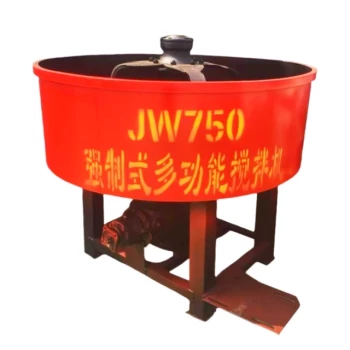
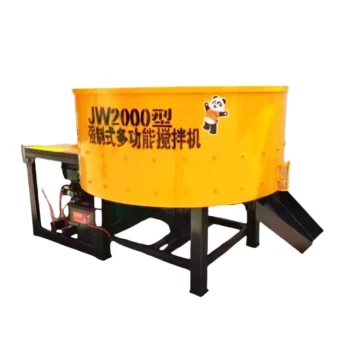
Ultimately, concrete mixers are classified in three distinct ways: by their operating principle (batch vs. continuous), their mobility and scale (stationary vs. portable), and their internal mixing mechanism (drum vs. shaft). Understanding these categories is essential to grasping their specific applications and capabilities.
The most critical insight is that "type of mixer" is not a single label. It's a combination of characteristics. The right choice for a project depends entirely on its scale, the required quality of the concrete, and logistical constraints like location and delivery.
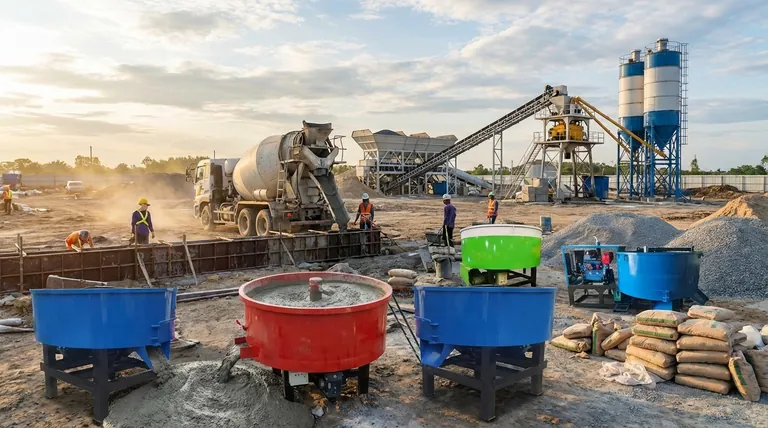
The Two Fundamental Operating Principles
The most basic way to divide concrete mixers is by how they process materials. Every mixer falls into one of these two categories.
Batch Mixers: The Industry Standard
Batch mixers produce concrete one batch at a time. Ingredients are loaded, mixed for a set duration, and then the entire completed batch is discharged.
This method offers precise control over the mix proportions and consistency for each individual load, making it the most common type for almost all construction applications.
Continuous Mixers: For Non-Stop Production
Continuous mixers are fed materials constantly and produce a steady, uninterrupted flow of concrete. They are essentially a concrete factory on a production line.
This type is used for very large-scale projects like dam construction or road paving, where massive, continuous volumes are required without the start-and-stop cycle of batching.
Classification by Mobility and Scale
Beyond their operating principle, mixers are defined by their physical form factor, which dictates their use case from small repairs to massive infrastructure projects.
Stationary Mixers (Batching Plants)
These are large, fixed installations designed for high-volume, consistent production. A batching plant is an entire system built around a powerful stationary mixer.
They are the heart of ready-mix concrete operations and are established on-site for major construction projects that demand a reliable, high-quality concrete supply.
Truck Mixers (Transit Mixers)
Truck mixers are mounted on a chassis and are designed to both transport and mix concrete. The large, rotating drum agitates the materials during transit to prevent segregation.
This is the standard solution for delivering ready-mix concrete from a batching plant to a job site, ensuring it arrives fresh and ready to pour.
Portable Mixers
These are the smaller, often wheeled mixers commonly seen at residential or smaller commercial construction sites.
Their primary advantages are mobility, lower cost, and simplicity, making them ideal for small pours, repairs, or projects where on-site mixing is more practical than delivery.
Self-Loading Mixers
A self-loading mixer is a specialized, all-in-one mobile machine. It can load its own aggregate and cement, measure water, and mix the concrete on-site before placing it.
This makes it exceptionally useful for remote job sites or infrastructure projects where setting up a full batching plant is impractical.
Classification by Mixing Mechanism
The internal design of the mixer has a significant impact on the quality and homogeneity of the final concrete product.
Drum Mixers (Tilting and Reversing)
Drum mixers use a rotating vessel with internal fins or blades that lift and tumble the materials. This is a very common and effective design.
Tilting drum mixers, which are predominant in North America, tilt downwards to discharge the batch quickly. They are known for handling larger batches with larger aggregate sizes.
Shaft Mixers (Twin, Single, and Planetary)
Shaft mixers operate differently: the mixing vessel (a pan) remains stationary while one or more rotating shafts with paddles create a powerful, compulsory mixing action.
Twin-shaft mixers, common in Europe and precast factories, are renowned for producing a very high-quality, homogenous mix in a short amount of time. Pan and planetary mixers are also common choices for precast and high-performance concrete production.
Understanding the Key Trade-offs
Choosing a mixer involves balancing efficiency, quality, and cost. Each type presents a distinct set of compromises.
Quality vs. Volume
A shaft mixer provides a higher-energy, more thorough mixing action, resulting in superior concrete consistency. However, a tilting drum mixer can typically handle a larger volume per batch, prioritizing output.
Flexibility vs. Consistency
Portable and self-loading mixers offer maximum flexibility for varied or remote job sites. In contrast, a stationary batching plant provides unparalleled consistency and quality control at a massive scale, but with zero mobility.
Cost vs. Performance
Simple drum mixers are generally less expensive to purchase and maintain. High-performance twin-shaft mixers carry a higher initial cost but deliver a faster, more homogenous mix, which can be critical for specialized applications.
Making the Right Choice for Your Project
Your project's specific goals will determine the ideal type of concrete mixer.
- If your primary focus is a large-scale construction site: A stationary batching plant with a high-capacity tilt-drum or twin-shaft mixer is the necessary solution.
- If your primary focus is small to medium-sized jobs or repairs: A portable drum mixer provides the perfect balance of cost, mobility, and ease of use.
- If your primary focus is delivering ready-mix concrete over distances: The truck-mounted transit mixer is the industry-standard and most logical choice.
- If your primary focus is high-performance or precast concrete: A stationary pan, planetary, or twin-shaft mixer is required to achieve the necessary consistency and strength.
- If your primary focus is working in remote locations: A self-loading mixer provides an all-in-one solution, eliminating the need for separate batching equipment.
By aligning the mixer's core function with your project's demands, you ensure both efficiency and quality in your work.
Summary Table:
| Classification | Main Types | Key Characteristics |
|---|---|---|
| Operating Principle | Batch Mixers, Continuous Mixers | Control vs. Uninterrupted Flow |
| Mobility & Scale | Stationary, Truck-Mounted, Portable, Self-Loading | Fixed Installation to On-Site Mobility |
| Mixing Mechanism | Drum Mixers (Tilting/Reversing), Shaft Mixers (Twin/Single/Planetary) | Tumbling Action vs. High-Energy Mixing |
Ready to choose the right concrete mixer for your project's efficiency and quality? As GARLWAY, a specialist in construction machinery, we provide a full range of solutions—from durable portable mixers for contractors to high-capacity batching plants for large-scale construction companies. Our expertise ensures you get the perfect equipment to match your scale, budget, and performance requirements. Contact us today for a personalized consultation and let us help you build better.
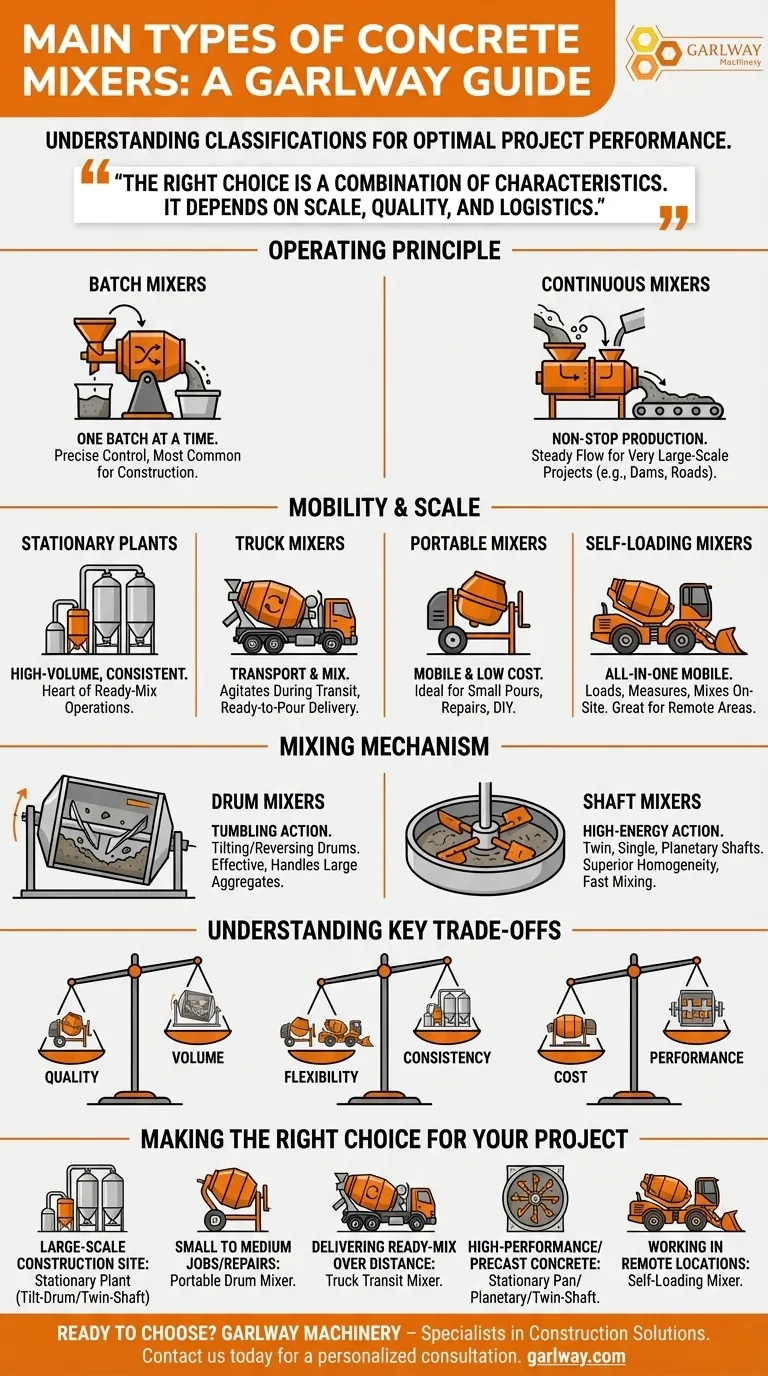
Visual Guide
Related Products
- Portable Concrete Mixer Machine Equipment for Mixing Concrete
- Construction Products Concrete Plant Machine Mixing Concrete Mixer
- Portable Electric Concrete Mixer Machine for Cement Mixing
- Concrete Cement Mixer Machine Drum Mixer for Construction
- HZS90 Large Multiquip Concrete Mixers for Construction
People Also Ask
- Why is it necessary to use a portable concrete mixer? Gain Total Control & Efficiency
- How much concrete can you pour with a portable mixer? Find the Perfect Fit for Your Project
- What types of projects are portable concrete mixers suitable for? Ideal for DIY & Small-Scale Construction
- How much does a portable concrete mixer hold? A Guide to Choosing the Right Capacity
- What types of portable concrete mixers exist? Find the Perfect Mixer for Your Project