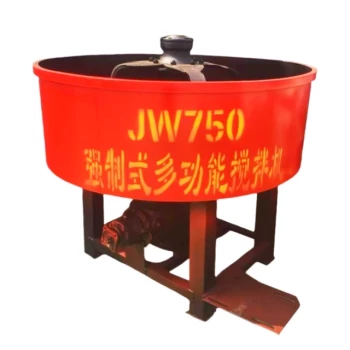
At its core, a Rotary Batch Mixer is defined by a few primary components working in unison. These are the stationary inlet and outlet chutes, a central rotating drum, internal mixing flights, and a discharge valve. Together, these elements create a unique mixing environment designed for precision and gentle handling.
The effectiveness of a Rotary Batch Mixer comes not from its individual parts, but from how they combine to produce a gentle, four-way mixing action. This design is engineered to achieve rapid batch uniformity while protecting the integrity of the materials being mixed.
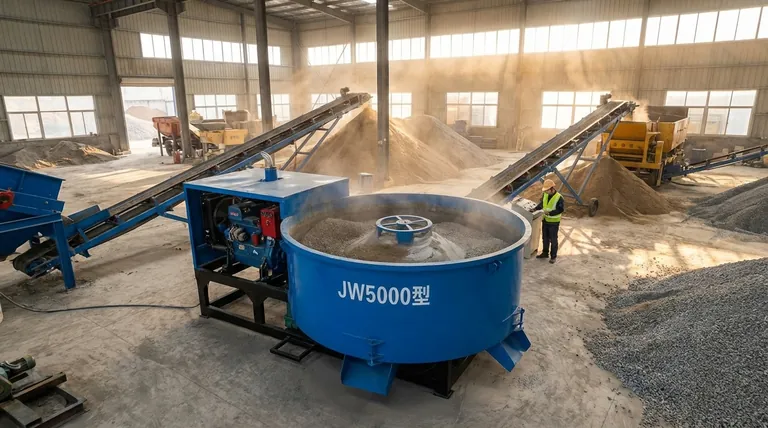
The Anatomy of a Rotary Batch Mixer
Each component serves a distinct and critical function in the overall process. Understanding how they interact reveals why this design is so effective for specific applications.
The Stationary Inlet & Discharge
The mixer features a stationary inlet for loading materials and an opposing stationary discharge for unloading. This stationary design simplifies integration into automated production lines, as the entry and exit points remain fixed while the mixing happens in between.
The Rotating Drum
This is the main body of the mixer and the primary source of movement. The drum rotates around the stationary inlet and discharge points, tumbling the material within. Its rotation is the foundation of the mixing process.
Internal Mixing Flights
Welded to the interior of the drum, these flights are the most critical element for achieving a homogenous mix. They are precisely shaped and angled to lift, cut, and fold the material as the drum turns. This prevents particles from simply sliding along the drum wall.
The Plug Gate Discharge Valve
Located at the discharge end, a plug gate provides a reliable, tight seal during mixing. When the cycle is complete, it opens to allow the thoroughly blended material to exit the mixer quickly and completely.
How These Components Create a Superior Mix
The physical design of the mixer directly translates to its unique and highly efficient mixing capabilities.
The Four-Way Mixing Action
As the drum rotates, the internal flights create a gentle yet thorough four-way mixing action. They tumble, fold, cut, and turn the material, continuously recombining particles an estimated 288 times per minute.
This constant, multi-directional movement ensures that every particle is repositioned relative to others, leading to a homogenous blend in a very short time.
Preventing Material Degradation
Crucially, this mixing action occurs without any free-fall. The material is always supported by the drum or the flights, eliminating the impact and shear forces common in other mixer types. This makes the Rotary Batch Mixer ideal for fragile products that could otherwise be damaged.
Ideal for Liquid Additions
The tumbling motion created by the drum and flights spreads the material out, creating a wide "curtain" of moving particles. This provides a massive surface area, making it perfect for spraying on liquid ingredients like coatings, flavors, or oils. The liquid is distributed evenly and absorbed quickly, preventing clumping.
Practical Design Considerations
Beyond the mix quality, the mechanical design offers significant operational advantages.
Unobstructed Access for Cleaning
The design prioritizes ease of cleaning and inspection. Large access doors provide unobstructed entry to all interior surfaces. This significantly reduces downtime between batches, especially when switching between different products or recipes.
Optional Retractable Chutes
To further enhance cleanability, some models offer a retractable intake chute. This feature allows the chute to be pulled away from the drum, providing even faster and more thorough access for inspection and sanitation.
Making the Right Choice for Your Goal
The components of a Rotary Batch Mixer are engineered to deliver specific outcomes.
- If your primary focus is gentle handling of fragile materials: The flight design and lack of free-fall make this mixer ideal for protecting product integrity.
- If your primary focus is uniform liquid coating: The tumbling, curtaining action ensures even distribution and rapid absorption of liquids.
- If your primary focus is rapid, repeatable batch consistency: The four-way mixing action guarantees a homogenous blend in a short, predictable cycle time.
Ultimately, understanding these components reveals a mixer engineered for precision, protection, and performance.
Summary Table:
| Component | Key Function |
|---|---|
| Rotating Drum | Main body that tumbles materials for mixing. |
| Internal Mixing Flights | Lifts, cuts, and folds material for a homogenous blend. |
| Stationary Inlet/Discharge | Fixed points for easy loading and unloading. |
| Plug Gate Discharge Valve | Provides a tight seal and ensures complete discharge. |
Ready to enhance your mixing process with precision and care?
GARLWAY specializes in robust construction machinery, including industrial mixers designed for durability and performance. Our equipment is ideal for construction companies and contractors who need reliable, efficient blending for materials like concrete, coatings, and more.
Let us help you achieve a superior, homogenous mix while protecting your materials. Contact GARLWAY today to discuss your specific needs and find the perfect mixer solution for your project!
Visual Guide

Related Products
- Portable Concrete Mixer Machine Equipment for Mixing Concrete
- Commercial Electric Concrete Mixer Machine HZS 50 Small Batch Plant for Sale
- HZS25 Best Cement Mixer for Quick Mix Concrete at Bunnings
- HZS120 Ready Mix Concrete Batching Plant Commercial Mud Cement Mixer
- JW1000 Mobile Cement Mixer Concrete Mixer Truck and Batching Plant
People Also Ask
- Why is it necessary to use a portable concrete mixer? Gain Total Control & Efficiency
- How much concrete can you pour with a portable mixer? Find the Perfect Fit for Your Project
- What types of projects are portable concrete mixers suitable for? Ideal for DIY & Small-Scale Construction
- How much does a portable concrete mixer hold? A Guide to Choosing the Right Capacity
- What types of portable concrete mixers exist? Find the Perfect Mixer for Your Project