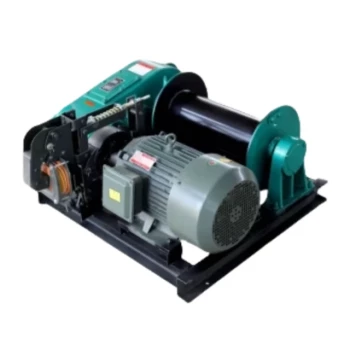
At its core, a manual winch is a simple yet powerful force multiplier. It allows a single person to move immense loads by converting rotational force into a strong, linear pull. The key components that make this possible are a crank handle, an internal gear train, a drum to wind the cable, a ratchet or brake system to hold the load, and a sturdy frame to house it all.
A winch is more than a list of parts; it's a system where each component works in concert. Understanding how the gears create power and how the ratchet ensures safety is the key to using this tool effectively and securely.
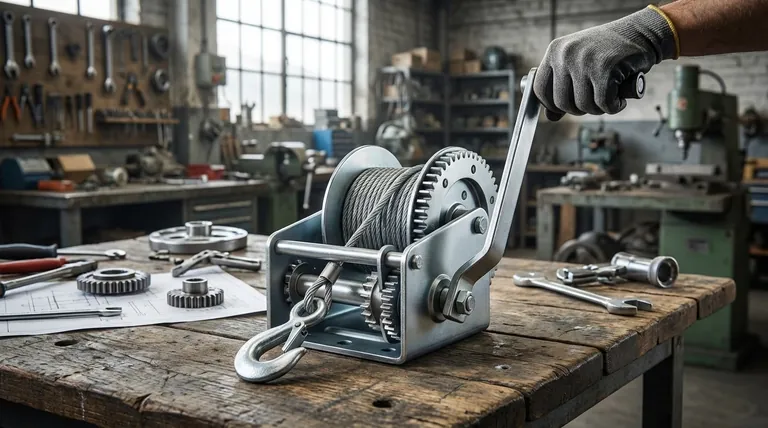
The Anatomy of a Manual Winch: How Each Part Works
A manual winch appears simple, but its effectiveness comes from the precise interaction between its core components. Breaking it down reveals a clear chain of force, from your hand to the final load.
The Input: The Crank Handle
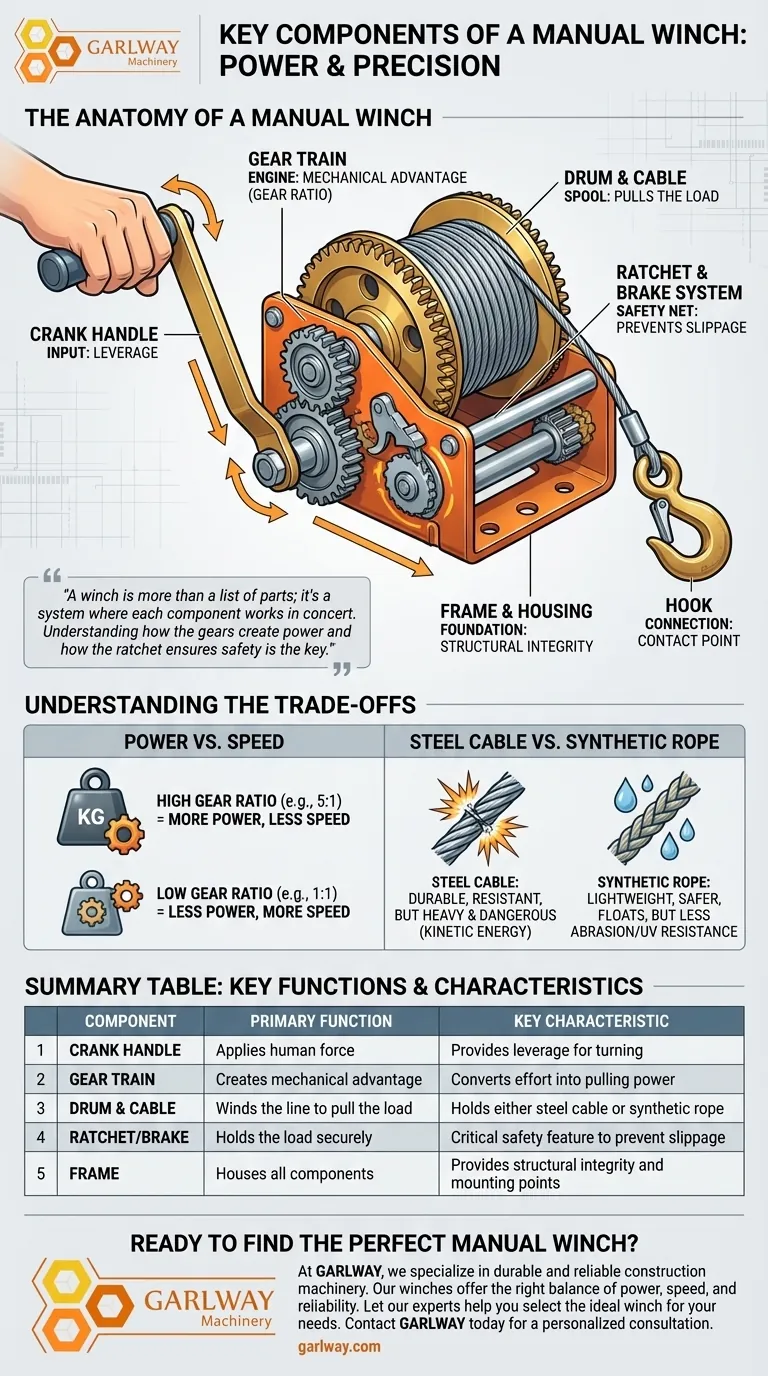
The crank handle is the direct interface for human power. It provides the leverage needed to turn the internal gear system. A longer handle generally allows for easier cranking but requires a larger sweep of motion.
The Engine: The Gear Train
This is the heart of the winch's power. The gear train uses a series of gears to create mechanical advantage. It takes the high-speed, low-force input from the crank and converts it into a low-speed, high-force output at the drum.
Gear ratios, sometimes displayed as 3:1 or 5:1, indicate how many turns of the handle are required for one revolution of the drum. A higher ratio means more pulling power but a slower line speed.
The Spool: The Drum and Cable
The drum is the cylinder that the cable or rope winds onto. Its rotation, driven by the gear train, is what pulls the load.
The line itself is typically either steel cable or synthetic rope. Each has distinct properties that make it suitable for different tasks.
The Safety Net: The Ratchet and Brake System
This is arguably the most critical component for safety. The ratchet is a pawl-and-gear mechanism that allows the drum to turn in only one direction (when pulling).
This prevents the load from slipping backward the moment you release pressure from the handle. It locks the drum in place, securely holding the load until you intentionally disengage it or reverse the winch's direction.
The Foundation: The Frame and Housing
The frame is the rigid structure that holds all the other components together. It provides the mounting points to secure the winch to a solid surface, like a trailer, a boat deck, or a vehicle bumper. A sturdy frame ensures that all pulling forces are transferred effectively.
The Connection: The Hook
The hook is the final point of contact with the object being pulled. It is attached to the end of the cable or rope and must be robust enough to handle the winch's maximum rated load.
Understanding the Trade-offs
Choosing or using a winch requires understanding the inherent compromises in its design. These trade-offs directly impact performance and safety.
Power vs. Speed
The gear ratio dictates the winch's primary characteristic. A winch with a high gear ratio (e.g., 5:1) will be able to pull heavier loads with less effort from you, but it will be very slow. Conversely, a low gear ratio (e.g., 1:1) will pull the line in quickly but will require much more physical effort and can't handle heavy loads.
Steel Cable vs. Synthetic Rope
This is a critical decision. Steel cable is highly durable and resistant to abrasion, making it excellent for rugged environments. However, it is heavy, can develop sharp burrs, and stores immense kinetic energy, which can be extremely dangerous if it snaps.
Synthetic rope is significantly lighter, floats on water, and does not store the same level of kinetic energy, making it much safer if it breaks. Its main drawback is a lower resistance to abrasion and UV degradation over time.
Simplicity vs. Features
Basic manual winches have one speed and a simple ratchet. More advanced models might offer multiple gear settings, providing both a fast speed for light loads and a powerful speed for heavy ones. While more versatile, these systems introduce more complexity and potential points of failure.
Making the Right Choice for Your Goal
By understanding the function of each component, you can select a tool that is perfectly suited to your needs.
- If your primary focus is vehicle recovery or moving very heavy loads: Prioritize a winch with a high gear ratio, a robust steel frame, and a proven, reliable brake system.
- If your primary focus is speed for lighter tasks, like loading a small boat: A winch with a lower gear ratio will get the job done much faster and with less cranking.
- If your primary focus is safety and ease of handling: Consider a winch with synthetic rope to minimize risk, and always inspect the ratchet mechanism before putting it under load.
Knowing how these simple parts create powerful results is the first step to operating a manual winch with both confidence and respect for its capabilities.
Summary Table:
| Component | Primary Function | Key Characteristic |
|---|---|---|
| Crank Handle | Applies human force | Provides leverage for turning |
| Gear Train | Creates mechanical advantage | Converts effort into pulling power |
| Drum & Cable | Winds the line to pull the load | Holds either steel cable or synthetic rope |
| Ratchet/Brake | Holds the load securely | Critical safety feature to prevent slippage |
| Frame | Houses all components | Provides structural integrity and mounting points |
Ready to find the perfect manual winch for your project?
At GARLWAY, we specialize in durable and reliable construction machinery. Our manual winches are engineered for performance and safety, offering the right balance of power, speed, and reliability for construction companies and contractors worldwide.
Let our experts help you select the ideal winch for your specific needs—whether it's for heavy-duty recovery, material handling, or marine applications.
Contact GARLWAY today for a personalized consultation and discover how our winches can enhance your operational efficiency and safety.
Visual Guide
Related Products
- Quick Windlass Portable Winch for Truck and Boat Best Boat Winch
- Portable Small Trailer Winch
- Electric and Hydraulic Winch for Heavy Duty Applications
- Small Electric Winch 120V and 240V for Compact Applications
- Hydraulic Winding Engine Harbor Freight Winch
People Also Ask
- What features were incorporated into the upgraded portable winch system? Boost Your Recovery Power & Safety
- What are some uses mentioned for portable winches beyond vehicle recovery? Essential Versatility for Property & Work
- How could the twisting issue with a portable winch be mitigated? Achieve Safe, Centered Pulls with Proper Rigging
- What are the primary uses of a portable winch for a truck? Boost Your Truck's Capability and Self-Reliance
- What is the single rope traction force of the quick winch without a pulley block? 0.5 to 40 Tons Explained