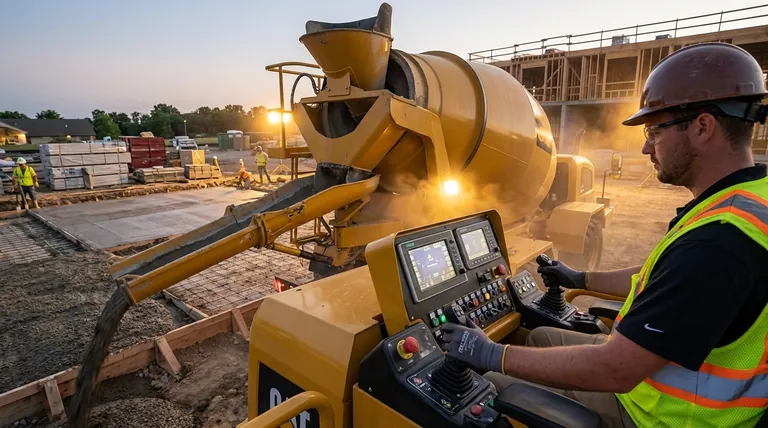
At its core, the control system is the brain of a self-loading concrete mixer. It acts as the central command unit, managing every stage of the concrete production process from loading raw materials to discharging the final, uniform mixture. Its primary role is to ensure precision, consistency, and efficiency.
The true value of the control system lies in its ability to transform the mixer from a simple piece of machinery into a precise, on-site batching plant. It guarantees the quality of the concrete while significantly reducing manual labor and operational time.
The Core Functions: From Loading to Discharge
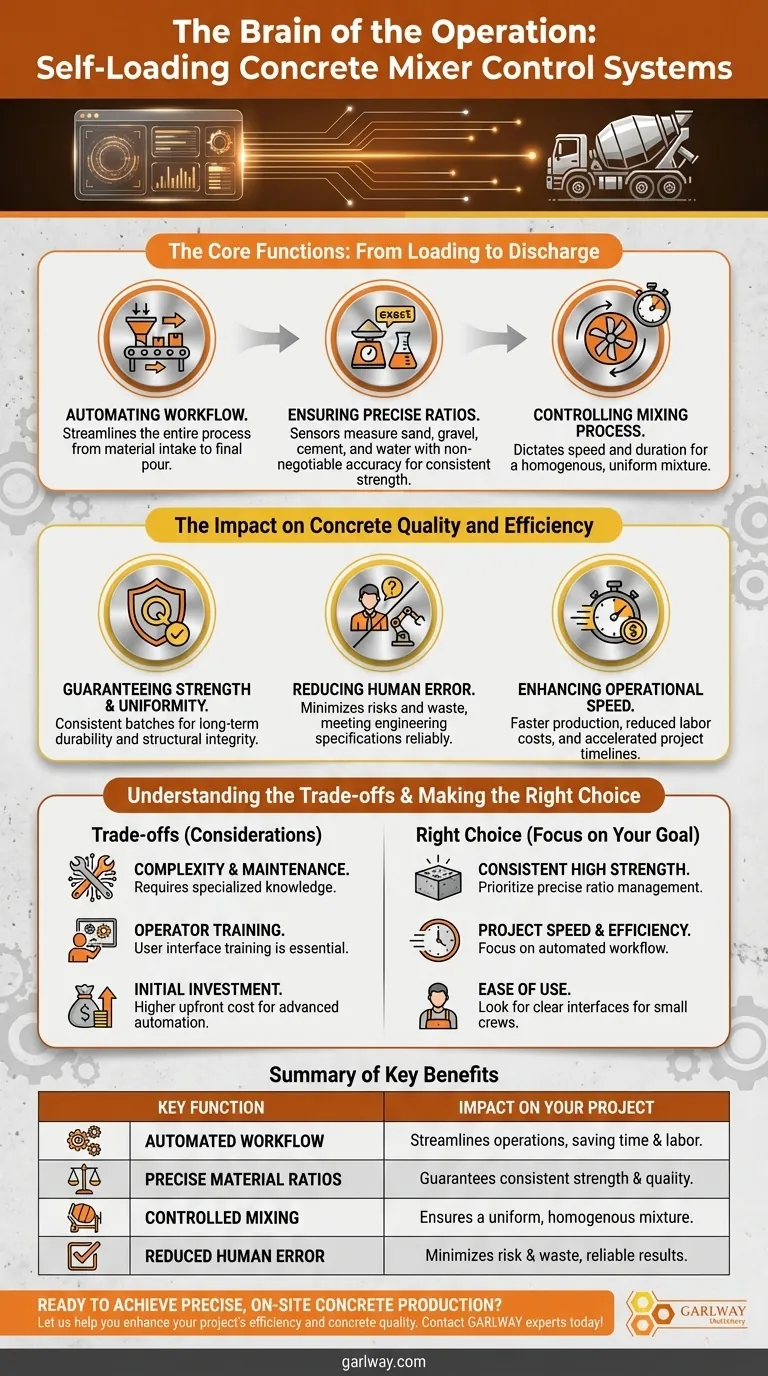
A modern control system is responsible for orchestrating the entire workflow. It integrates various mechanical functions into a single, cohesive process that an operator can easily manage.
Automating the Workflow
The system manages the sequence of operations, telling the machine when to load aggregates, when to add water and cement, how long to mix, and when to discharge. This automation streamlines the entire process.
Ensuring Precise Material Ratios
This is arguably the most critical function. The control system uses sensors and programmed inputs to measure and load the exact required amounts of sand, gravel, cement, and water. This accuracy is non-negotiable for producing concrete that meets specific strength requirements.
Controlling the Mixing Process
Once loaded, the system controls the rotation of the mixing drum. It dictates the speed and duration of the mix, ensuring the internal spiral blades thoroughly blend all ingredients into a homogenous mixture. This controlled agitation is essential for uniform consistency.
The Impact on Concrete Quality and Efficiency
The precision of the control system directly translates into the quality of the end product and the speed of the project. It removes guesswork and introduces reliability.
Guaranteeing Strength and Uniformity
By strictly managing material ratios and mixing time, the control system ensures that every batch of concrete is consistent. This uniformity is vital for the structural integrity and long-term durability of the final construction.
Reducing Human Error
Manual batching is prone to error, leading to inconsistent concrete quality. The automated control system minimizes this risk, producing a reliable product batch after batch, which is crucial for meeting engineering specifications.
Enhancing Operational Speed
Automation dramatically reduces the time spent on manual measurements and operations. This allows a single operator to produce concrete much faster, speeding up the entire construction timeline and reducing labor costs.
Understanding the Trade-offs
While advanced control systems offer significant advantages, it's important to recognize the associated considerations. They introduce a layer of technical complexity to the machine.
System Complexity and Maintenance
A sophisticated electronic control system involves sensors, actuators, and a central processing unit. While reliable, these components can require specialized knowledge for troubleshooting and maintenance compared to simpler, fully mechanical systems.
Operator Training
The system simplifies the physical labor but requires the operator to be trained on the user interface. An operator must understand how to input recipes, monitor the process, and interpret any system alerts or error codes to use the machine effectively.
Initial Investment
Self-loading mixers equipped with advanced, automated control systems typically have a higher upfront cost. This investment is weighed against the long-term gains in efficiency, quality control, and reduced labor expenses.
Making the Right Choice for Your Goal
The control system's capabilities directly determine the performance of the mixer. Understanding your primary goal helps you evaluate the importance of its features.
- If your primary focus is consistent, high-strength concrete: The system's ability to precisely manage and verify material ratios is its most valuable feature.
- If your primary focus is project speed and efficiency: The automation of the entire workflow, from loading to discharging, is what minimizes downtime and on-site labor costs.
- If your primary focus is ease of use for a small crew: A system with a clear interface and real-time monitoring allows a single operator to manage the entire production process smoothly and confidently.
Ultimately, the control system is what elevates a self-loading mixer from a simple machine to a reliable, mobile concrete production plant.
Summary Table:
| Key Function | Impact on Your Project |
|---|---|
| Automated Workflow | Streamlines operations from loading to discharge, saving time and labor. |
| Precise Material Ratios | Guarantees consistent concrete strength and quality, batch after batch. |
| Controlled Mixing Process | Ensures a uniform, homogenous mixture for superior structural integrity. |
| Reduced Human Error | Minimizes risk and waste, ensuring reliable results that meet specifications. |
Ready to achieve precise, on-site concrete production?
At GARLWAY, we specialize in engineering robust construction machinery, including self-loading concrete mixers with advanced control systems. Our equipment is designed to deliver the efficiency, quality control, and reliability that construction companies and contractors need to meet tight deadlines and strict quality standards.
Let us help you enhance your project's efficiency and concrete quality. Contact our experts today to find the perfect solution for your needs!
Visual Guide
Related Products
- Skid Steer Self Loading Concrete Mixers for Construction
- Belle Mixer Drum Self Loading Mortar Mixers JS3000
- JW1000 Mobile Cement Mixer Concrete Mixer Truck and Batching Plant
- Portable Cement Mixer with Lift Concrete Machine
- Portable Concrete Mixer Machine Equipment for Mixing Concrete
People Also Ask
- How does the control system improve production efficiency in a self loading concrete mixer? Automate Mixing for Speed & Quality
- What is the purpose of keeping the drum rotating during transportation in a self loading concrete mixer? Ensure Quality & Consistency
- How does the weighing process work in a self loading concrete mixer? Achieve Precise, On-Site Concrete Batching
- What components are involved in the loading process of a self loading concrete mixer? A Guide to the Key Systems
- How should materials be loaded into a self-loading concrete mixer? Master the Step-by-Step Process