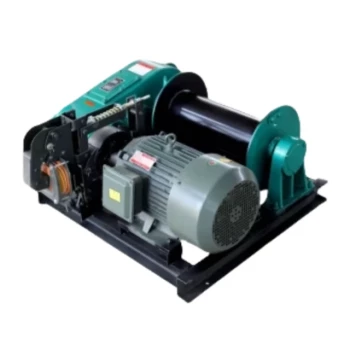
At their core, air winches offer three distinct advantages: immense lifting power, unparalleled safety in hazardous environments, and complete independence from the electrical grid. Their design leverages compressed air to drive a motor, making them uniquely suited for demanding industrial applications where electric models would be impractical or unsafe.
The decision to use an air winch over an electric one is rarely about lifting capacity alone. It is fundamentally a choice driven by the operating environment—prioritizing absolute safety in explosive atmospheres and continuous performance where electricity is unavailable or unreliable.
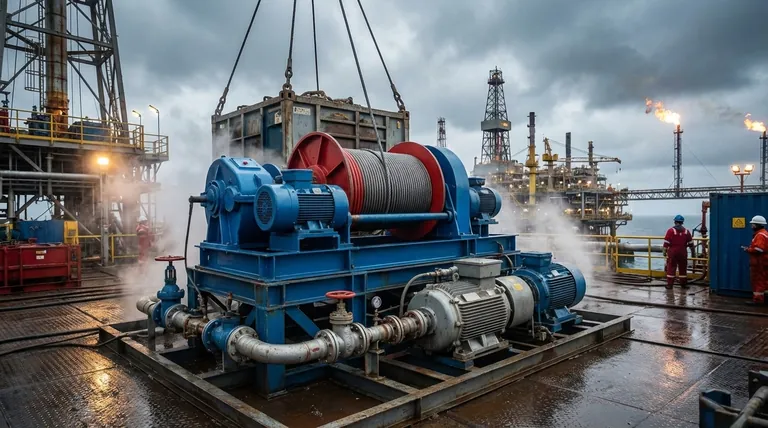
Unmatched Safety in Hazardous Environments
The single most important advantage of an air winch is its inherent safety in locations with flammable gases, vapors, or dust.
The Spark-Resistant Advantage
An air (pneumatic) motor contains no electrical components, wiring, or brushes that could generate a spark during operation. This makes it the default, and often mandated, choice for industries like oil and gas, mining, chemical plants, and marine applications where a single spark could be catastrophic.
Resilience to Harsh Conditions
Because their mechanical systems are fully sealed and powered by air, these winches are highly resistant to dust, dirt, and moisture. They can operate reliably in conditions that would cause an electric motor to short out or fail.
Power and Duty Cycle Superiority
Air winches are built for the most demanding, continuous lifting and pulling tasks.
Continuous, Stall-Proof Operation
Unlike many electric winches that have a limited duty cycle (requiring a cool-down period after a few minutes of work), air winches can run continuously without overheating. Furthermore, they can be stalled under a full load indefinitely without damaging the motor, a critical feature for safely holding suspended loads.
Independent of Electrical Infrastructure
Air winches thrive in remote locations or facilities where high-amperage or three-phase electricity is unavailable. As long as you can power a suitable air compressor, the winch can deliver its full rated power.
Understanding the Trade-offs
Choosing an air winch involves acknowledging its specific operational requirements and limitations.
The Need for an Air Compressor
The most significant consideration is the need for a large, powerful air compressor. This ancillary equipment adds to the overall system's cost, size, weight, and maintenance requirements. You are not just buying a winch; you are investing in a pneumatic system.
Precision and Speed Control
While incredibly powerful, standard air winches often lack the fine-tuned variable speed control found in many advanced electric winches. Electric models can offer more precise, slower speeds for carefully positioning sensitive materials.
Operational Noise
Pneumatic systems are characteristically louder than their electric counterparts. The sound of the compressor and the air motor exhaust are significant factors in an enclosed or noise-sensitive workspace.
Making the Right Choice for Your Application
Your final decision must be aligned with the non-negotiable requirements of your project.
- If your primary focus is safety in an explosive atmosphere: The spark-resistant air winch is the only responsible and often compliant choice.
- If your primary focus is continuous, heavy-duty operation: An air winch's ability to run without overheating and stall without damage makes it superior for high-demand duty cycles.
- If your primary focus is precision, convenience, and lower initial cost: An electric winch is likely the better fit, assuming a safe environment and readily available power.
By understanding that the choice is dictated by the environment, not just the load, you can confidently select the winch that guarantees both performance and safety.
Summary Table:
| Key Advantage | Description | Ideal For |
|---|---|---|
| Intrinsic Safety | No electrical components to create sparks; safe for flammable environments. | Oil & gas, mining, chemical plants, marine. |
| Continuous Duty Cycle | Can run indefinitely without overheating; can be stalled under load without damage. | Heavy, continuous lifting and pulling tasks. |
| Operational Independence | Does not rely on an electrical grid; powered by a standard air compressor. | Remote job sites or facilities with unreliable power. |
Ready to harness the power and safety of an air winch for your project?
GARLWAY specializes in providing robust and reliable construction machinery, including a range of industrial winches designed for demanding environments. Our air winches are engineered for construction companies and contractors who require uncompromising safety in hazardous areas and continuous, heavy-duty performance where electricity is not an option.
Let us help you select the perfect winch to guarantee both performance and worksite safety.
Contact GARLWAY today for a consultation and to discuss your specific lifting needs!
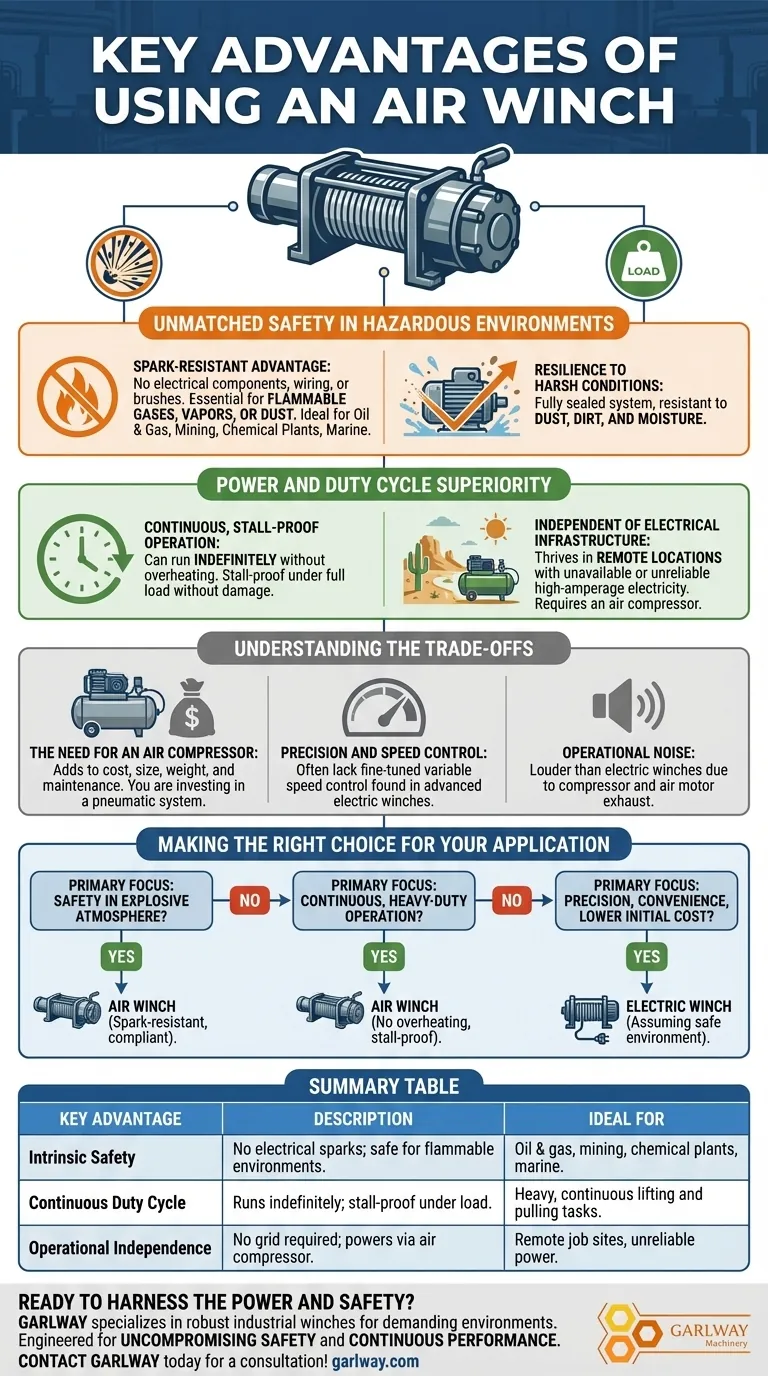
Visual Guide
Related Products
- Small Electric Winch 120V and 240V for Compact Applications
- Portable Small Trailer Winch
- Electric and Hydraulic Winch for Heavy Duty Applications
- Quick Windlass Portable Winch for Truck and Boat Best Boat Winch
- Heavy Duty Electric Boat Winch Windlass Anchor
People Also Ask
- What makes electric winches suitable for off-road use? Key Features for Reliable Vehicle Recovery
- What are the common applications of electric winches? Power Your Lifting & Pulling Tasks
- What are the common uses of an electric winch? A Guide to Safe and Efficient Heavy Lifting
- What are the uses of electric winches in mining and tunneling? Enhance Safety and Efficiency Underground
- How do electric winches contribute to energy savings? Maximize Efficiency and Lower Costs