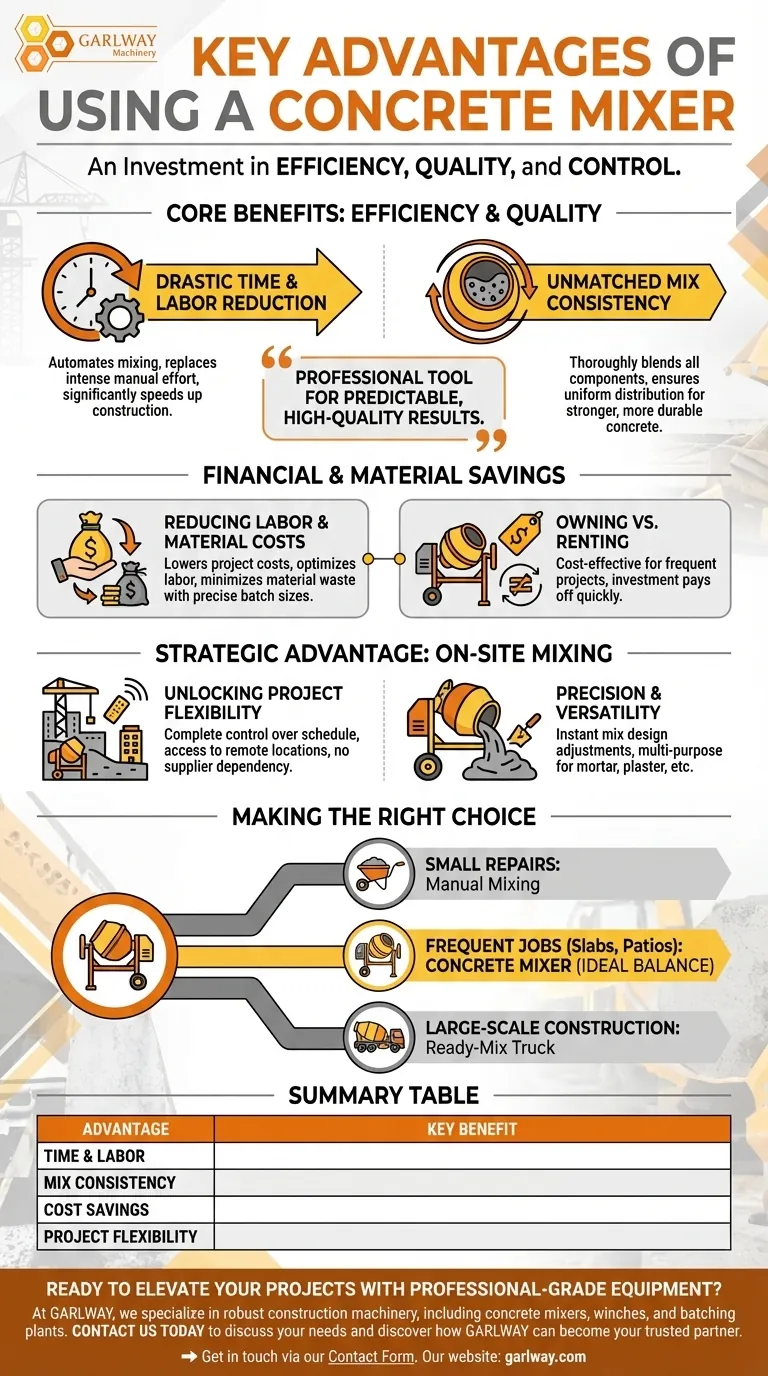
At its core, a concrete mixer is an investment in efficiency, quality, and control. The primary advantages are a dramatic reduction in the time and physical labor required for mixing, the creation of a far more consistent and structurally sound concrete, and significant long-term cost savings through reduced waste and optimized labor.
A concrete mixer moves beyond being a simple convenience; it is a professional tool that ensures a predictable, high-quality result by eliminating the inconsistencies and physical strain inherent in manual mixing.
The Core Benefits: Efficiency and Quality
The most immediate advantages of using a concrete mixer revolve around saving time and improving the final product. These two benefits are directly linked, as better processes naturally lead to better outcomes.
Drastic Time and Labor Reduction
A mixer automates what is arguably the most physically demanding part of working with concrete. It replaces intense manual effort with mechanical power.
This automation significantly speeds up the entire construction process, allowing workers to be more productive and focus on placement and finishing rather than manual mixing.
Unmatched Mix Consistency
Hand-mixing often results in an uneven distribution of water, cement, and aggregates. This can create weak spots and lumps, compromising the integrity of the finished structure.
A concrete mixer's rotating drum ensures all components are thoroughly and uniformly blended. This consistent quality is critical for achieving the concrete's specified strength and durability.
Financial and Material Savings
While there is an upfront cost, a mixer provides clear financial benefits, especially for those who work with concrete regularly. The savings come from optimized use of both labor and materials.
Reducing Labor and Material Costs
By reducing the labor needed for mixing, a mixer directly lowers project costs. A single person can often manage the mixing process, freeing up others for different tasks.
Furthermore, mixers allow you to create specific batch sizes on demand. This precision minimizes the risk of over-ordering pre-mixed concrete and eliminates the material waste common with manual methods.
Owning vs. Renting
For frequent projects, owning a mixer is more cost-effective than repeatedly renting one. With new mixers available in a range from approximately $165 to $640, the investment can pay for itself after just a few medium-sized jobs.
Understanding the Trade-offs
While highly beneficial, a mixer isn't the right tool for every single situation. Understanding its limitations is key to making a sound decision.
The Scope of Your Project
For extremely small repair jobs, like patching a tiny crack, the setup and cleanup time for a mixer may not be justified. In these cases, mixing a small batch by hand in a wheelbarrow can be faster.
Conversely, for massive, continuous pours like a large building foundation, the volume and speed of a ready-mix concrete truck are indispensable and far exceed the capacity of a portable mixer.
Initial Investment and Maintenance
The primary trade-off is the initial purchase price. It's an investment that requires storage space and periodic maintenance to ensure it remains in good working order.
The Strategic Advantage of On-Site Mixing
Portable and mobile mixers offer a level of flexibility that is crucial for many modern construction scenarios.
Unlocking Project Flexibility
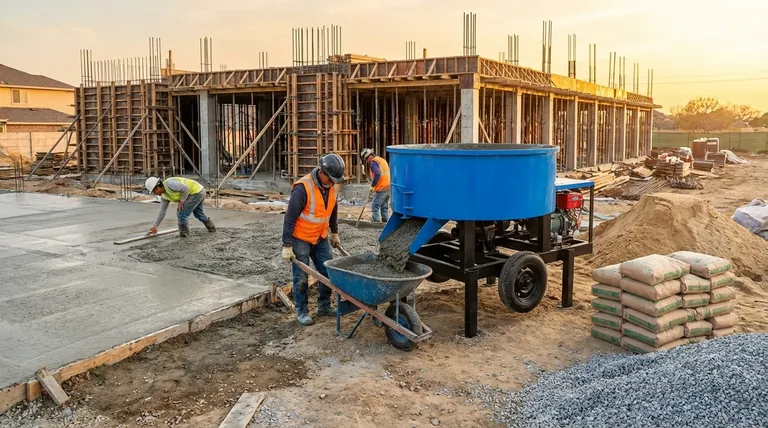
Mobile mixers provide complete control over your project schedule. You are not dependent on a ready-mix supplier's availability or susceptible to traffic delays.
They also enable you to work in remote or hard-to-reach locations where a large concrete truck simply cannot go, opening up new possibilities for projects.
Precision and Versatility
On-site mixing allows for instant adjustments to the mix design as needed. It also gives you the versatility to mix other materials, such as mortar or plaster, making the machine a multi-purpose tool on the job site.
Making the Right Choice for Your Project
Selecting the best mixing method depends entirely on the scale and frequency of your work.
- If your primary focus is small, one-off repairs: Manually mixing in a wheelbarrow is likely the most practical and cost-effective approach.
- If your primary focus is frequent DIY or professional jobs (slabs, patios, footings): Owning a concrete mixer offers the ideal balance of quality, cost-savings, and convenience.
- If your primary focus is very large-scale, high-volume construction: Ordering pre-mixed concrete from a ready-mix truck is the only viable option for efficiency.
Ultimately, integrating a concrete mixer into your workflow is about elevating the quality and professionalism of your work while optimizing your resources.
Summary Table:
| Advantage | Key Benefit |
|---|---|
| Time & Labor | Drastically reduces manual effort and speeds up projects. |
| Mix Consistency | Ensures uniform blending for stronger, more durable concrete. |
| Cost Savings | Lowers labor costs and minimizes material waste. |
| Project Flexibility | Enables on-site mixing in remote or hard-to-reach locations. |
Ready to elevate your construction projects with professional-grade equipment?
At GARLWAY, we specialize in providing robust and reliable construction machinery, including concrete mixers, winches, and batching plants, designed for construction companies and contractors worldwide. Our solutions are engineered to deliver the efficiency, consistency, and cost savings detailed above, ensuring your projects are completed on time and to the highest standards.
Contact us today to discuss your specific needs and discover how GARLWAY can become your trusted partner for powerful, profitable construction. ➡️ Get in touch via our Contact Form
Visual Guide
Related Products
- Portable Concrete Mixer Machine Equipment for Mixing Concrete
- Construction Products Concrete Plant Machine Mixing Concrete Mixer
- Portable Electric Concrete Mixer Machine for Cement Mixing
- JZC400 Mobile Small Concrete Mixer Cement Mixer Machine
- Hydraulic Concrete Mixer Machine Cement Mixing Equipment for Mixture Concrete
People Also Ask
- Why is it necessary to use a portable concrete mixer? Gain Total Control & Efficiency
- How much concrete can you pour with a portable mixer? Find the Perfect Fit for Your Project
- What types of projects are portable concrete mixers suitable for? Ideal for DIY & Small-Scale Construction
- How much does a portable concrete mixer hold? A Guide to Choosing the Right Capacity
- What types of portable concrete mixers exist? Find the Perfect Mixer for Your Project