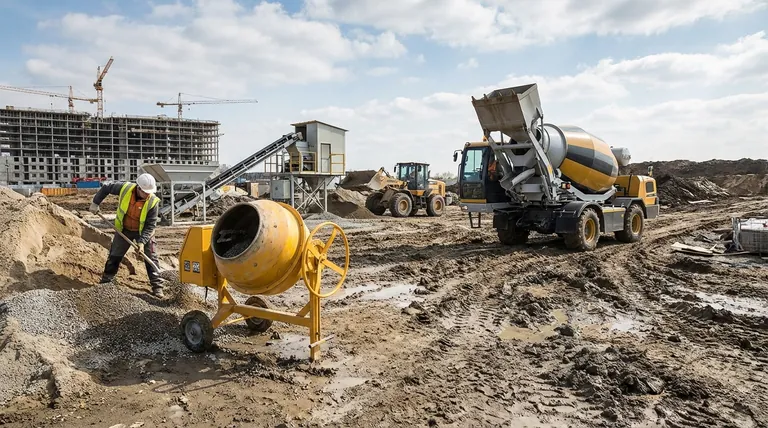
At its core, a self-loading concrete mixer is a mobile batching plant. Unlike traditional systems that separate material loading, mixing, and transportation into different machines and locations, a self-loading mixer integrates all these functions into a single, all-terrain vehicle that can be managed by one operator.
The fundamental advantage of a self-loading mixer is not just convenience; it's a strategic shift from relying on a centralized, fixed batching plant to having decentralized, on-demand concrete production directly at the job site.
The Core Advantage: A Self-Sufficient Batching Plant on Wheels
The most significant distinction of a self-loading mixer is its ability to operate autonomously, independent of a separate batching plant. This changes the entire workflow of concrete production and delivery.
Unifying Loading, Mixing, and Transporting
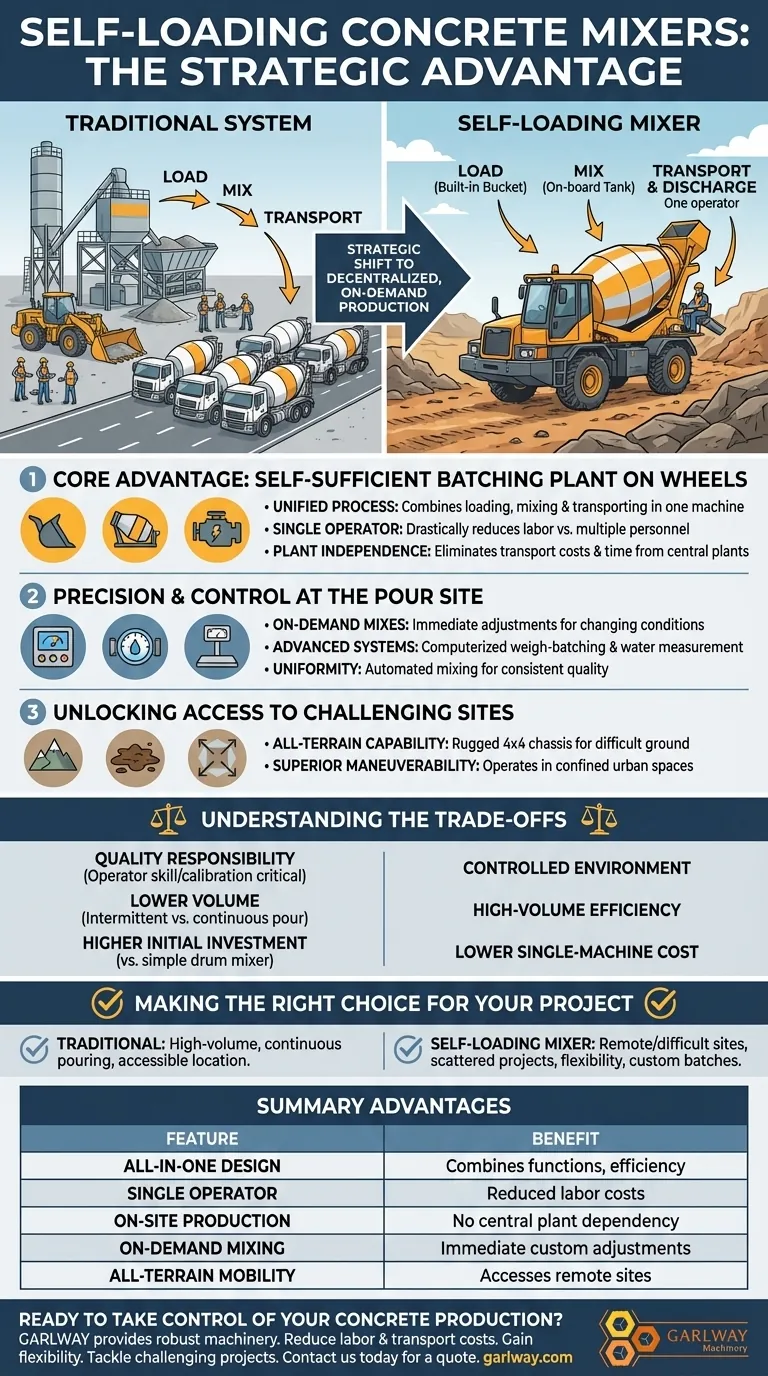
A traditional setup requires a wheel loader to load aggregates into a batching plant, a transit mixer to transport the concrete, and often a separate water source.
The self-loading mixer uses its own built-in loading bucket to scoop aggregates and cement. It then mixes them with water from its own tank, all within the same machine that transports it to the pour site.
From Multiple Workers to a Single Operator
This all-in-one design drastically reduces labor requirements. A single skilled operator can manage the entire process of loading raw materials, mixing the batch, and discharging the concrete.
This contrasts sharply with the multiple personnel needed to run a batching plant, a loader, and a fleet of transit mixers.
Eliminating Dependency on a Central Plant
By producing concrete on-site, you eliminate the time, fuel costs, and logistical challenges of transporting wet concrete from a plant.
This is especially critical for projects with tight schedules or in remote locations where travel time to the nearest plant would be prohibitive.
Precision and Control, Directly at the Pour Site
Bringing the production process to the job site gives you an unprecedented level of control over the final product.
On-Demand, Customized Mixes
Unlike a transit mixer that arrives with a pre-determined mix, a self-loader allows for immediate adjustments to the mix design.
If site conditions change or a specific consistency is required, the operator can alter the ratios of cement, sand, aggregate, and water for each individual batch, ensuring optimal quality.
Advanced Onboard Systems
Modern self-loading mixers are equipped with sophisticated technology to ensure accuracy.
Computerized weigh-batching systems measure materials precisely, and integrated water flow meters manage water content for consistent slump. This ensures every batch meets project specifications.
Enhancing Material Uniformity
The controlled, automated mixing process ensures a thorough and uniform distribution of all materials. This consistency helps prevent the unevenness that can sometimes occur with less controlled traditional methods, improving the structural integrity of the final pour.
Unlocking Access to Challenging Job Sites
One of the most compelling advantages is the machine's mobility and agility, which opens up projects that would be difficult or impossible with traditional equipment.
True All-Terrain Capability
Self-loading mixers are typically built on rugged, 4x4 chassis with hydrostatic transmissions.
They are designed to navigate the complex and undeveloped terrain of a construction site, from muddy ground to steep hills and mountainous areas where a heavy, road-based transit mixer could never go.
Superior Maneuverability
Their compact design allows them to operate effectively in confined spaces common on urban or residential construction sites. This agility reduces the need for additional equipment like concrete pumps.
Understanding the Trade-offs
While powerful, the self-loading mixer is not a universal solution. Its advantages come with specific trade-offs that are critical to understand.
Quality Control Is a Responsibility
While the potential for high-quality, custom mixes is a key advantage, the final quality rests heavily on the skill of the operator and the calibration of the machine.
A centralized batching plant operates in a highly controlled environment, offering a level of quality assurance that is more difficult to replicate in the field with a single machine.
Lower Output Volume vs. Batching Plants
For large-scale projects requiring a continuous, high-volume pour (like a large foundation or highway), a dedicated batching plant is far more efficient.
A self-loading mixer is designed for intermittent or smaller batches. Its "construction efficiency" is lower when measured by sheer cubic meters per hour compared to a full-scale plant.
Higher Initial Investment
Compared to a simple drum mixer, the initial capital outlay for a self-loading mixer is significant. However, this cost must be weighed against the combined expense of a wheel loader, transit mixer, and the operational costs of a traditional multi-machine workflow.
Making the Right Choice for Your Project
Choosing between a self-loading mixer and a traditional setup depends entirely on your project's specific needs for scale, location, and flexibility.
- If your primary focus is high-volume, continuous pouring in an accessible location: A traditional batching plant and transit mixer fleet offers the most efficient solution.
- If your primary focus is work on remote, difficult-to-access, or scattered sites: The self-loading mixer's all-in-one, all-terrain capability is unmatched.
- If your primary focus is project flexibility with frequent, small, or custom batches: The self-loader provides superior on-demand control and eliminates waste from unused pre-mixed concrete.
Ultimately, adopting a self-loading concrete mixer is about choosing the right tool to gain control over your timeline, materials, and job site logistics.
Summary Table:
| Advantage | Key Benefit |
|---|---|
| All-in-One Design | Combines loading, mixing & transport in one machine |
| Single Operator | Reduces labor costs and increases efficiency |
| On-Site Production | Eliminates dependency on central batching plants |
| On-Demand Mixing | Allows for immediate, customized concrete adjustments |
| All-Terrain Mobility | Access remote or difficult-to-reach job sites |
Ready to take control of your concrete production?
GARLWAY specializes in providing robust construction machinery, including self-loading concrete mixers, winches, and concrete batching plants, designed for construction companies and contractors globally. Our self-loading mixers can help you:
- Reduce labor and transport costs by unifying multiple functions into one machine.
- Gain flexibility with on-demand, customized mixes directly at the job site.
- Tackle challenging projects with all-terrain capability and superior maneuverability.
Contact us today to find the perfect solution for your project's unique needs and see how GARLWAY can bring efficiency and control directly to your site.
Get a Quote & Discuss Your Project
Visual Guide
Related Products
- Skid Steer Self Loading Concrete Mixers for Construction
- Belle Mixer Drum Self Loading Mortar Mixers JS3000
- Portable Cement Mixer with Lift Concrete Machine
- Portable Concrete Mixer Machine Equipment for Mixing Concrete
- JW1000 Mobile Cement Mixer Concrete Mixer Truck and Batching Plant
People Also Ask
- How does the control system improve production efficiency in a self loading concrete mixer? Automate Mixing for Speed & Quality
- What is the purpose of keeping the drum rotating during transportation in a self loading concrete mixer? Ensure Quality & Consistency
- How does the weighing process work in a self loading concrete mixer? Achieve Precise, On-Site Concrete Batching
- What components are involved in the loading process of a self loading concrete mixer? A Guide to the Key Systems
- How should materials be loaded into a self-loading concrete mixer? Master the Step-by-Step Process